



Namaste, diaspora family! We are now less than a week away from what might be the most consequential election in Nepal’s recent history. On March 5, nearly 19 million voters will decide between a former rapper, the fresh face of Nepal’s oldest party, and a communist veteran determined to reclaim power. Away from the campaign trail, Nepal’s economy continues its strange paradox of record-breaking remittances alongside sluggish growth — and in one of the week’s most heartwarming stories, Nepal rallied behind its women’s football captain when the system let her down. Let’s get into it.
🌍 Diaspora & Globalisation
NRNA World Conference Locked In for March 14–16 in Kathmandu
Just nine days after the election, thousands of Non-Resident Nepalis will converge on Kathmandu for the 12th NRNA World Conference. A high-level organising committee has been formed under Foreign Minister Balananda Sharma, with the theme “Our Unity, the Foundation for Prosperity.” The three-day programme will tackle the Non-Resident Nepali Act, joint investment opportunities, tourism and health sector collaboration, and — notably — the participation of women, youth, and second-generation NRNs. The government has also proposed conducting NRNA leadership elections via an online system for the first time, a move that could significantly widen participation for diaspora members who can’t travel to Nepal. With a new government likely being formed in the same week, the timing couldn’t be more politically charged — or more important for shaping diaspora policy under whatever administration emerges (OnlineKhabar).
US Immigration Squeeze Tightens: Smuggling Ring, Visa Pause & Document Fraud
It’s been a grim stretch for Nepalis navigating the US immigration system. Two Nepali nationals were charged in a $7 million scheme to smuggle more than 250 migrants into the United States, while separately, seven were arrested for forging educational documents to obtain green cards through the Diversity Visa lottery (NepYork). Meanwhile, the March 2026 US Visa Bulletin confirms Nepal remains among 75 countries facing an ongoing suspension of immigrant visa processing — family-based green cards are stable on paper but effectively inaccessible (NepYork). These cases underscore a painful pattern: as legal pathways narrow, desperation drives people toward increasingly risky alternatives.
In Brief:
Deportation numbers keep climbing — 585 Nepalis have now been deported since Trump’s second term began, with January 2026 recording a record 101 deportees in a single month. Most had entered via the Mexico border after paying smugglers $60,000–$75,000 each (Kathmandu Post).
UK work visas drop 19% — work visas issued to foreign nationals in the UK fell to 168,000 by December 2025 under stricter immigration policies — a trend likely to affect Nepali workers seeking opportunities in Britain (Nepal News).
British Gorkhali Cricket League gets new backing — Bridge International became the main sponsor of the BGCL in the UK, the only 40-over format league for the Nepali diaspora in Britain, now entering its sixth season (Nepal News).
🏛️ Politics & Governance
Six Days to Go: Balen, Thapa & Oli in Nepal’s Most Watched Election
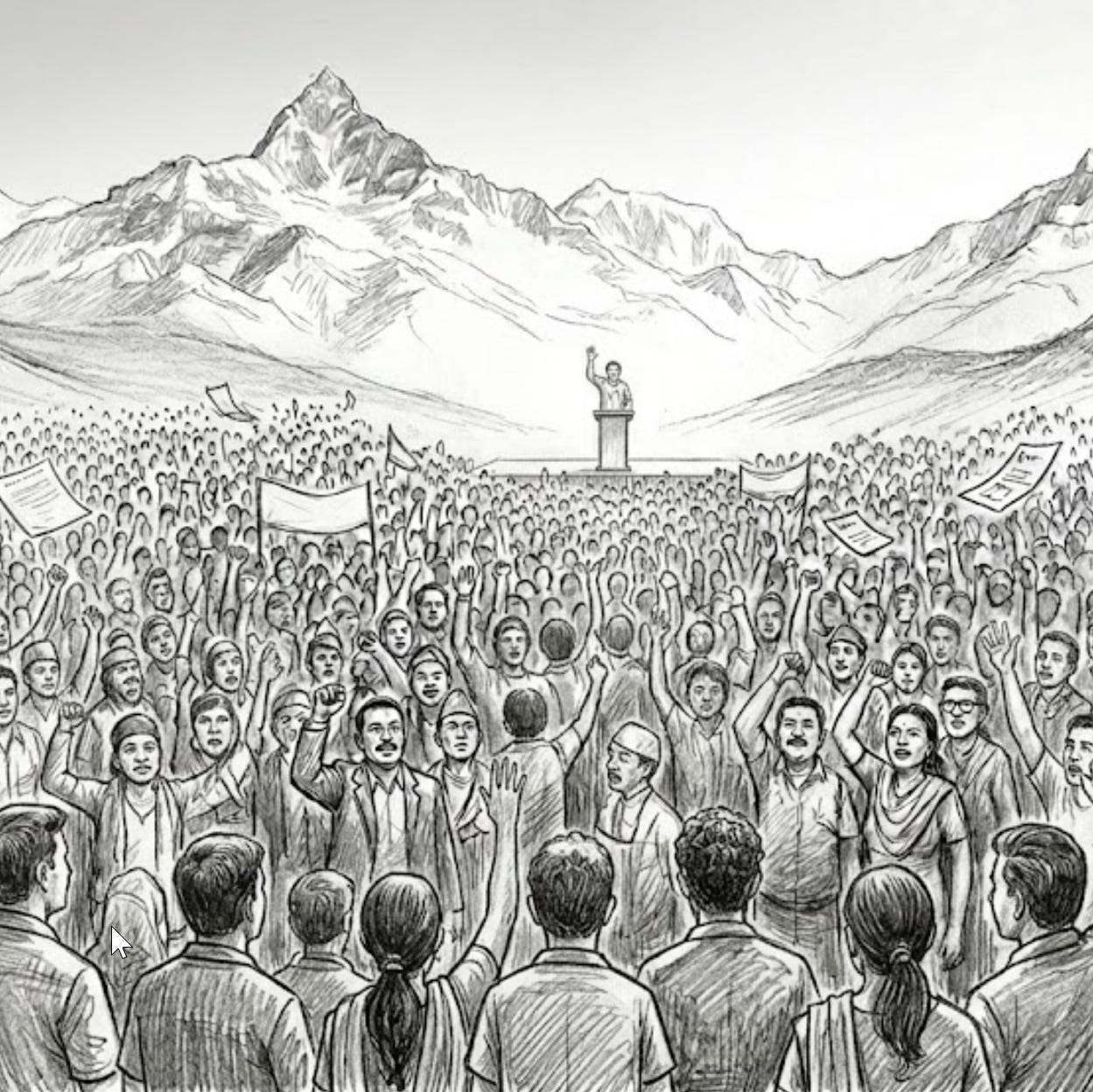
Nepal’s March 5 parliamentary election — the first since the Gen Z protests toppled KP Sharma Oli’s government last September — is shaping up to be a genuine three-way race. Over 3,400 candidates are contesting 275 seats, with more than 1,000 under the age of 40. The marquee showdown is in Jhapa-5, where Balendra “Balen” Shah, 35, the rapper-turned-Kathmandu-mayor who resigned to run for parliament, is challenging Oli directly in the veteran’s traditional stronghold. Balen represents the Rastriya Swatantra Party, which came fourth in 2022 but has since surged in popularity. Meanwhile, Gagan Thapa, 49, mounted a rebellion within the Nepali Congress to secure the party presidency and is now its PM candidate — offering a generational refresh within Nepal’s oldest democratic party. Oli’s CPN-UML is banking on a stability message: steady policies, economic focus, no more chaos. With 18.9 million registered voters and 339,000 security personnel deployed, this is the biggest democratic exercise Nepal has seen in years (Washington Post).
The Machine Behind March 5: Bans, Ballots & All-Female Polling Centres
The sheer logistics of Nepal’s election are staggering — and this week, the machinery went live. Ballot papers and materials have been delivered to all 75 districts, with 221,000 election staff deployed across 23,112 polling centres. A nationwide alcohol ban kicked in Friday midnight and won’t lift until results are declared; all private vehicles will be suspended from March 4 midnight through election day. In a quiet but significant move, polling centres in Kavrepalanchok and Lamjung will be managed entirely by female staff — 38 women appointed as polling officers in Syangja alone. Meanwhile, police arrested 42 people across the country for attempting to boycott the election, and the government accepted a $4 million cash grant from China to help fund the exercise — a decision that raised eyebrows given the geopolitical sensitivities of accepting election funding from a neighbouring power (Nepal News).
In Brief:
Campaign tensions bubble — UML supporters burned rival election flags, and a group of UML activists were reported to have assaulted schoolchildren for ringing a bell — the RSP’s election symbol — as a rally passed. Police said they were “verifying” the incident (Farsight Nepal).
Cabinet forms Gen Z Council — the government announced the creation of a formal Gen Z Council, a direct response to the youth uprising that triggered this election (Nepal News).
The establishment fights back — a Foreign Policy analysis warns that Nepal’s three dominant parties are consolidating to counter newcomers, with analyst J.B. Biswokarma noting: “These leaders have been in power 30 years and now worry that’s being challenged.”
💸 Economy & Development
IMF Signs Off on Final $43.2 Million Tranche — But Flags Risks
An IMF team led by Sarwat Jahan wrapped up a two-week mission in Kathmandu on February 20, reaching staff-level agreement on the seventh and final review under Nepal’s Extended Credit Facility. Once the Executive Board approves, Nepal will receive approximately $43.2 million, bringing the programme total to $384.4 million. But the fine print is sobering: growth for FY2025/26 is pegged at just 3–3.5%, well below potential, with protest-related damages and political uncertainty weighing heavily. Non-performing loans have risen to 5.4% and may climb further after the ongoing Loan Portfolio Review. The IMF flagged the need for Nepal Rastra Bank Act amendments to be submitted to parliament as essential for completing the programme (myRepublica).
Record Remittances, Record Reserves — But Where’s the Growth?
Nepal’s economic paradox deepened this week. Remittance inflows hit Rs 1.62 trillion in the first six months of FY2025/26 — a staggering 39.1% increase year-on-year. Foreign exchange reserves surged to a record $22.47 billion, covering 21.4 months of merchandise imports. But rather than signalling economic strength, economists point out that the swelling reserves reflect more Nepalis leaving for work abroad while domestic consumption and investment remain flat. Inflation sits at 1.63% — a two-decade low that speaks more to weak demand than price stability. Banking deposits grew Rs 417 billion, but private credit increased only Rs 197 billion. The money is coming in; it’s just not going anywhere productive (Kathmandu Post).
In Brief:
NRB opens the credit taps — Nepal Rastra Bank’s midterm monetary policy review adds tourism, IT, and export-oriented industries to the preferential credit framework, aiming to push lending toward productive sectors (Nepal News).
Chitwan tourism takes an election hit — hotel occupancy in Sauraha has dropped from 80% to 50% during what should be peak season, with business owners blaming election uncertainty for deterring international travellers (Nepal News).
EV imports surge — Nepal brought in 5,894 electric vehicles worth Rs 13.8 billion in the first seven months of FY2025/26, as the country pushes toward its goal of 90% EV private vehicle sales by 2030 (Nepal News).
⭐ Social & Cultural
Nepal Rallies Behind Samba: Rs 14 Million Raised in 24 Hours
When Nepal’s women’s football captain Sabitra Bhandari “Samba” tore her ACL graft during her Wellington Phoenix debut in January, she turned to the All Nepal Football Association for help. ANFA stepped back. So on February 24, Samba launched a public fundraiser — and Nepal responded. Within 24 hours, supporters raised Rs 14 million domestically and NZ$52,000 through international platforms, smashing her NZ$135,000 target for surgery at Qatar’s Aspetar Orthopaedic Hospital. “After even ANFA, which I considered my guardian, stepped back, it is now you supporters who are by my side,” she wrote. Wellington Phoenix contributed their full insurance payout, and the Nepali Congress provided Rs 500,000. The outpouring was extraordinary — but the episode has rightly drawn criticism of ANFA for abandoning its biggest women’s football star when she needed them most (Friends of Football NZ).
2,300 Nepalis Leave for Work Every Day — And the Youth Want Change
A striking Foreign Policy deep dive published this week put a number on Nepal’s brain drain that’s hard to ignore: approximately 2,300 Nepalis leave the country for foreign work every single day, youth unemployment sits at 20.8%, and Nepal ranks 109 of 182 countries on the Corruption Perceptions Index. Nearly 4 million voters aged 18–24 will cast ballots for the first time on March 5 — many of them radicalised by the September protests that killed 77 people. Gen Z Front activist Rakshya Bam captured the mood: “New parties listen to critics and correct course, unlike old guards.” Whether that idealism survives contact with Nepal’s political establishment is the question hanging over March 5 — and for the millions of young Nepalis watching from abroad, the answer will determine whether they ever come home (Foreign Policy).
In Brief:
Women’s cricket returns empty-handed — Nepal’s women’s team came home from the Asia Cup Rising Stars in Thailand without a win, despite half-centuries from captain Puja Mahato and Samjhana Khadka. Between Samba’s ANFA abandonment and this, it’s been a tough stretch that highlights how much more investment women’s sport in Nepal needs (Nepal News).
Kathmandu maps 509 ancient place names — Kathmandu Metropolitan City identified 509 historic location names across 10 wards and plans to install information boards, a quiet effort to preserve heritage amid rapid urbanisation (Nepal News).
Tour de Thakurdwara rolls out — over 250 cyclists from Nepal and India took part in the 2026 cycling festival organised by Nepalgunj Cycling Club, promoting tourism, healthy lifestyles, and environmental conservation (Nepal News).
Until next week, stay connected! — The Nepali Diaspora Digest Team
Let’s connect
Enjoying this issue? 📩 Share it with a friend & let’s keep Nepalis worldwide in the loop! Got thoughts? Hit reply—we’re all ears! Or let us know what you think via our Feedback form or follow us on Facebook | LinkedIn
P.S. Got a story or issue you’d like us to cover next week? Drop us a reply — we’re building this space together.
About Nepali Diaspora Digest:
The Nepali Diaspora Digest connects the global Nepali community with curated news, insights, and stories that matter most. Join us as we celebrate and explore the diverse voices and achievements of Nepalis worldwide.
Partner shout out
belayat.uk: helping Nepalis connect in the UK on jobs, housing, events and finding local Nepali owned businesses


