


Namaste, diaspora family! What a week to be Nepali. TIME magazine just named PM Balen Shah one of the 100 most influential people on the planet — the first sitting Nepali leader to make the list. Back home, the cabinet did something no previous government has done this fast: publish every minister’s property details within a month of taking office. The numbers are eye-opening, the debates are fierce, and we’ll break it all down. Meanwhile, diesel has now been hiked five times in 31 days, the government has gone to a two-day weekend to save fuel, and Nepal Airlines has had to cancel Doha flights as Gulf airspace tightens again. But there’s also a new year, a new national roadmap, and cricket coming to Kirtipur. Let’s get into it.
🏛️ Politics & Governance
Cabinet Opens the Books — Property Disclosures Spark Debate
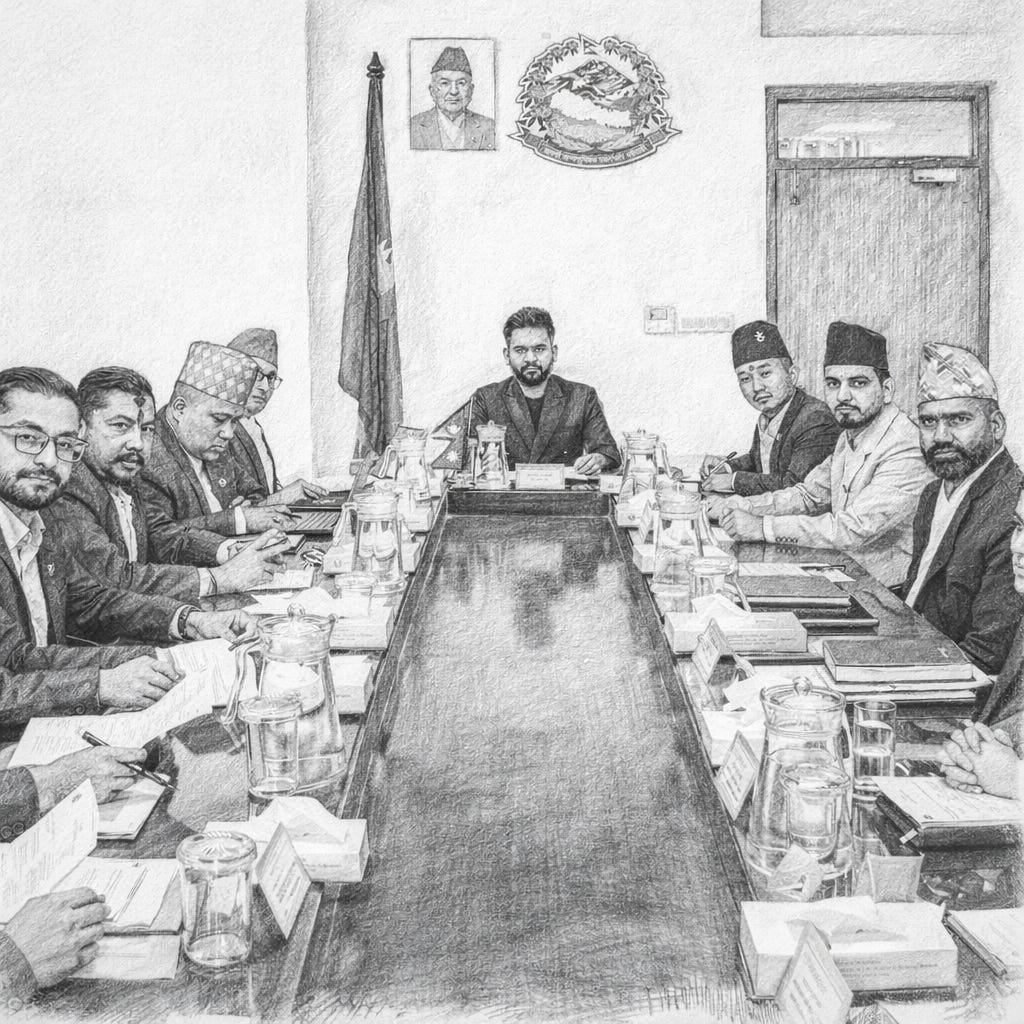
In a move unprecedented in speed, the Balen Shah government made public the property details of the Prime Minister and all 17 Cabinet members on April 13 — less than a month after taking office. PM Shah declared Rs 14.6 million in cash and cited social media as his main income source, alongside 190 tolas of gold received as his wife’s ancestral inheritance from Morang. The disclosures quickly became the most talked-about topic in the country. Home Minister Sudhan Gurung declared 89 tolas of gold, land across three districts — including 221 ropani in Gorkha listed under his grandfather’s name — and shares worth crores. Finance Minister Dr. Swarnim Wagle disclosed properties in Sanepa, Bhainsepati, Dhulikhel, and Bandipur valued collectively at over Rs 127 million. The reaction has been split: supporters praise the transparency, while critics — and a biting Nepal News analysis titled “Elites in Power” — ask whether an anti-establishment movement has produced its own wealthy governing class. Either way, no previous cabinet has opened the books this quickly (Kathmandu Post, Nepal News, Himalayan Times).
National Commitment + Zero Pending Files — The Reform Machine Doesn’t Stop
On Naya Barsha itself (April 14), the government unveiled an 18-point “National Commitment” document — a unified development roadmap synthesising the election manifestos of all six nationally recognised parties. The plan covers 18 sectors, from economic reform and agricultural self-reliance to e-governance and climate change, and will guide budgets starting FY 2026/27. Among the sharpest provisions: assets of all public officeholders since 1991 will be audited transparently, political affiliations in the civil service will be eliminated, and federal ministries remain capped at 17. The document has already sparked political debate — some parties objected to language describing Nepal as a “buffer state” and references to the Mahendra Highway. In parallel, the government launched a “Zero Pending File Week” (April 13–20), requiring every government desk to clear files within three days or trigger automatic review. Employees who clear backlogs get commendations; those found deliberately sitting on files face departmental action. It’s the kind of granular bureaucratic reform that rarely makes headlines but directly affects how fast a passport or citizenship certificate reaches your family (Kathmandu Post, Nepal News, Radio Nepal).
In Brief: The political churn continues on all fronts.
Balen Shah made TIME’s 100 Most Influential People of 2026, appearing in the Leaders category alongside Trump and Xi Jinping. TIME described the 35-year-old as a former hip-hop star whose “landslide victory was galvanized by deadly street protests led by a Gen Z determined to purge a political old guard perceived as venal and out of touch.” It’s the first time a sitting Nepali leader has appeared on the list (TIME, Fiscal Nepal).
CPN-UML’s internal revolt is escalating. A formal signature campaign demanding a Special General Convention to replace Oli as chairman has been launched after the party was reduced to just 9 direct seats — with 11 of its 15 Kathmandu Valley candidates losing their deposits. Acting Chairman Ram Bahadur Thapa issued an ultimatum to halt the drive, but the pressure is mounting (Khabarhub, Review Nepal).
Nepali Congress remains stuck in a power struggle over its parliamentary party leader. The election, scheduled for April 17 after multiple delays, pits President Gagan Thapa’s pick (Mohan Acharya) against VP Bishwa Prakash Sharma’s (Bhishmaraj Angdembe). The main opposition still can’t organise itself (Kathmandu Post).
🌍 Diaspora & Globalisation
NRN Citizenship — 11 Years of Constitutional Promise, Zero Implementation
Spotlight Nepal published a stinging analysis on April 16 examining why the Non-Resident Nepali citizenship provision enshrined in Article 14 of the Constitution remains unimplemented — 11 years after the Constitution was adopted. The provision grants NRN citizenship to persons of Nepali origin who have acquired foreign nationality, with economic, social, and cultural rights to be defined by federal law. The problem? That federal law has never been written. The article argues that practical steps are possible without a constitutional amendment — what’s missing is political will. The Annapurna Express echoed the point in a companion piece: “Small, practical steps on NRN citizenship — not big talk on dual citizenship.” For the millions in the diaspora who want to buy property, invest, or simply feel legally connected to Nepal, this isn’t an abstract debate — it’s the single biggest unresolved policy question affecting their relationship with home. The new government’s 18-point National Commitment mentions NRN engagement, but whether it translates into the legislation that has eluded every previous administration remains to be seen (Spotlight Nepal, Annapurna Express).
Gulf Airspace Closes Again — Nepal Airlines Cancels Doha Flights
The Gulf migrant corridor took another hit this week. Nepal Airlines cancelled all Kathmandu–Doha flights from April 13 to 15 after Qatar tightened airspace restrictions amid the ongoing US-Iran conflict. The Doha route is critical — the majority of Nepali migrant workers heading to Qatar and neighbouring Gulf states for construction, hospitality, and domestic work depend on this corridor. With flights suspended at short notice, workers found themselves stranded in Kathmandu or facing uncertain onward journeys from alternative transit points. The US-Iran ceasefire that began on April 8 has paused — but not ended — the military conflict, and a patchwork of airspace restrictions across Iran, Iraq, Kuwait, Qatar, Bahrain, and the UAE continues to disrupt commercial aviation. Meanwhile, bodies of deceased workers remain stranded across the region awaiting repatriation, and over 86,000 Nepalis have registered on the government’s emergency evacuation platform. Labour permits remain frozen for 12 countries (Travel and Tour World, Kathmandu Post).
In Brief: More diaspora developments worth watching.
Nepal Discourse at Harvard (April 25–26) — the first-ever Nepal summit at an Ivy League institution — expects ~400 participants and ~30 speakers including F1Soft’s Biswas Dhakal, Fusemachines’ Sameer Maskey, and the World Bank’s David Sislen. Themes span AI, diaspora engagement, and institutional resilience. It’s backed by Leadership Academy Nepal and Kantipur Media Group (Kathmandu Post).
The US Supreme Court is hearing TPS arguments this month on the Haiti and Syria cases, with a decision expected by early July. The ruling could shift the legal landscape for 7,000+ Nepalis whose TPS was effectively terminated after the 9th Circuit stay in February. Meanwhile, 585 Nepalis have been deported since Trump’s second term began (Kathmandu Post).
💸 Economy & Development
Five Fuel Hikes in 31 Days — Nepal Now Among the Costliest in South Asia
The numbers are relentless. Nepal Oil Corporation hiked fuel prices for the fifth time in 31 days on April 16, pushing diesel and kerosene up by Rs 30 per litre to Rs 234.50 in the Kathmandu valley. Petrol was held at Rs 219 — already a record. To put that in perspective: diesel was Rs 139 in early March — a 68% jump in barely five weeks. Despite the repeated hikes, NOC is still losing Rs 99 per litre on diesel and haemorrhaging Rs 5.75 billion every fortnight. The cascading effects are everywhere: public transport fares are up 16.71%, cargo rates up 15–22%, and the Kathmandu Post reports that Nepal now has among the highest fuel prices in South Asia. The government’s response has been two-pronged: it halved customs duty on petroleum imports in early April and, on April 6, introduced a two-day weekend (Saturday–Sunday) for all government offices and schools — partly to reduce fuel consumption. Nepal Rastra Bank adjusted banking hours to match. It’s the most tangible lifestyle change the fuel crisis has produced, and for many Nepalis, the first two-day weekend in the country’s modern history (Kathmandu Post, Kathmandu Post, Al Jazeera).
The Spending Gap — Only 23% of Capital Budget Used in Nine Months
The government has big plans. Spending them is another matter. In the first nine months of FY 2025/26, Nepal managed to spend just Rs 96.19 billion on capital projects — 23.58% of the Rs 407 billion annual target. Total government spending sits at Rs 1.059 trillion, or roughly 54% of the Rs 1.964 trillion budget, with only three months left in the fiscal year. The shortfall is partly structural — the September 2025 protests and March 2026 elections disrupted infrastructure timelines — and partly driven by the fuel crisis itself: bitumen shortages have stalled road projects across the country. For a government that has set 7% annual GDP growth as its five-year target and committed to transformative infrastructure, the gap between ambition and execution is the single biggest risk to credibility. Finance Minister Wagle has ordered 100-day action plans from every ministry. The clock is ticking (Clickmandu, World Bank).
In Brief: A few more economic signals this week.
Nepal launched its second-ever National Economic Census on April 15, deploying 5,000 enumerators across 84 district offices. The census covers everything from small shops to large industries and will update the GDP base year from 2010/11 to 2022/23 — the first such update in over a decade. Final report expected FY 2026/27 (Peoples’ Review).
NEPSE introduced a new circuit breaker system from April 17, widening the daily price fluctuation limit to 15%. The index closed the week stable around 2,832 (ShareHub).
Gold hit Rs 302,800 per tola — a record domestic price driven by global safe-haven demand amid Middle East uncertainty (Rising Nepal Daily).
⭐ Social & Cultural
Naya Barsha 2083 — A New Year, a New Nepal?
Nepal rang in Bikram Sambat 2083 on April 14, and this year the celebrations carried an extra charge. In Bhaktapur, the ancient chariots of Bisket Jatra rolled through the streets as they have for centuries — the idols of Kal Bhairav and Bhadra Kali pulled in the traditional tug-of-war, the 25-metre lingo erected and toppled in Pottery Square. In Thimi, Sindoor Jatra drenched the dawn in vermillion. In Kathmandu, the Thamel Road Festival brought 32 stalls to Tridevi Marg, showcasing traditional food and local products. And across the diaspora — from New York to Sydney to London — Nepali communities gathered to mark the occasion with music, food, and the familiar greeting: Naya Barsha ko hardik shubhakamana. This is the first New Year under the Balen Shah government, and for many, the mood is cautiously hopeful. Whether that hope survives the fuel crisis, the spending gap, and the hard work of governing remains to be seen — but on Baisakh 1, at least, the country was celebrating (Annapurna Express, Khabarhub).
Cricket Comes to Kirtipur — Nepal Hosts Crucial World Cup League 2 Tri-Series
Mark the calendar. Nepal hosts the ICC Men’s Cricket World Cup League 2 tri-series at TU International Cricket Ground, Kirtipur, from April 25 to May 5, taking on Oman (3rd in standings) and UAE (8th). A second tri-series follows from May 12 to 22 against table-toppers USA and second-placed Scotland. The stakes are enormous: the top four teams at the end of the competition earn automatic spots at the Cricket World Cup 2027 Qualifier, and captain Rohit Paudel’s side currently sits 7th with just 5 wins from 20 matches. The tri-series was originally scheduled for March but was postponed due to the Middle East conflict — a reminder of how the Gulf crisis touches even Nepal’s sporting calendar. For a country that barely played cricket a generation ago, hosting back-to-back international series is a statement. Now the Rhinos need the results to match (ICC, Ratopati).
In Brief: A few more stories to round out the week.
Nepal’s women’s football team withdrew from the FIFA Series, with players expressing frustration as politicking in sports bodies and the government’s suspension of ANFA cost them a major international opportunity. The Kathmandu Post called it evidence of “the rot in Nepali football” (Kathmandu Post).
Nepal’s women’s cricket team returned winless from the Women’s Asia Cup Rising Stars in Bangkok — a disappointing campaign that underscores the investment gap in women’s sport.
The Manjushree Trail Race kicks off April 17–19 at Chandragiri, featuring five categories from 100 miles to 10 km. If you’re in the valley and feeling brave, there’s still time.
Naya Barsha 2083 ko hardik shubhakamana! Happy Nepali New Year to you and yours.
Until next week, stay connected!
Let’s connect
Enjoying this issue? 📩 Share it with a friend & let’s keep Nepalis worldwide in the loop! Got thoughts? Hit reply—we’re all ears! Or let us know what you think via our Feedback form or follow us on Facebook | LinkedIn
P.S. Got a story or issue you’d like us to cover next week? Drop us a reply — we’re building this space together.
About Nepali Diaspora Digest:
The Nepali Diaspora Digest connects the global Nepali community with curated news, insights, and stories that matter most. Join us as we celebrate and explore the diverse voices and achievements of Nepalis worldwide.
Partner shout out
belayat.uk: helping Nepalis connect in the UK on jobs, housing, events and finding local Nepali owned businesses


