



Enjoying the Digest? We pour a lot into each issue. The best way to help us grow is to forward this email to one friend or family member who’d like it. Thank you.
Namaste, diaspora family! It was budget day back home, and Finance Minister Swarnim Wagle went big: a Rs 2.12 trillion package, the largest in Nepal’s history, promising 7 percent growth, tax relief, and even a sovereign AI computing center. But the number that should worry every one of us reading from abroad is a different one. A draft NRN Act now circulating would bar non-resident Nepalis from voting or standing for election, and diaspora groups want it scrapped before it ever reaches a vote. Meanwhile remittances kept the lights on at Rs 7 billion a day, Kathmandu’s women charged into a volleyball semifinal at home, and the festival halls of Thamel filled up with film. Let’s get into it.
🌍 Diaspora & Globalisation
The Draft That Tells the Diaspora to Sit Down
A draft of the new Non-Resident Nepali (NRN) Act now circulating among overseas communities has set off a revolt, and for once the anger is unanimous. In its present form the bill bans NRNs from both voting and standing for election, and the NRN Association warns that more than 500,000 Nepalis could be stripped of their political rights. Diaspora bodies, including NRNA New Zealand, are not asking for amendments. They want the draft thrown out and rebuilt from scratch around the principle that once a Nepali, always a Nepali. The irony is hard to miss: the same people the bill would silence sent home a record share of the Rs 1.66 trillion that is currently holding the national economy together. There is legal history here too. Back in March 2018 the Supreme Court ordered the government to enable overseas voting within two years, an order that remains unfulfilled eight years on (The Kathmandu Post).
The Australia Study That Names the Problem
If you have ever wondered whether your NRN card actually does anything, a new study has your answer, and it is not reassuring. A report from the Institute for Integrated Development Studies (IIDS), released this month, looks at the more than 213,000 Nepal-born residents now living in Australia, one of the fastest-growing Nepali populations anywhere. Respondents described the NRN card as largely symbolic in practice: the investment, property, and inheritance rights it is supposed to unlock are poorly communicated, inconsistently applied, and often unenforceable when it counts. The study puts hard data behind a frustration most of us already feel, and it lands at exactly the moment the draft NRN Act is under fire. Taken together, the message from the diaspora is consistent: stop offering symbolic cards and unenforceable promises, and start delivering rights people can actually use (Nepal News).
In Brief: A few more threads pulling at the diaspora this week.
Small steps over big slogans. A widely shared column argues Nepal should deliver incremental, practical NRN-citizenship reforms now rather than chase headline dual-citizenship promises that never arrive (The Annapurna Express).
Protection across the whole journey. A national policy dialogue brought government, unions, and development partners together to push for social protection that follows migrant workers before departure, during work abroad, and after they return (ILO).
The map is shifting. Migrant worker numbers fell 3.36 percent this year even as remittances soared, with more Nepalis heading to Europe, Japan, Australia, and the US instead of the traditional Gulf (Nepal News).
🏛️ Politics & Governance
Congress Picks a Fight With Itself
With the 15th National Convention on the horizon, the Nepali Congress is once again fighting hardest with its own people. On May 25, senior leader Shekhar Koirala floated a five-point plan to settle the party’s long-running membership disputes, the centrepiece being a merger of the Central Working Committees from the 14th National Convention and the Special National Convention. General Secretary Gagan Thapa is having none of it, arguing that stitching the two bodies together would create an unlawful committee of nearly 400 members, well outside what the party statute allows. The disagreement is procedural on the surface, but underneath it is the familiar Congress story: rival camps using the rulebook as a weapon ahead of a leadership contest. For a party that still styles itself as the steady hand in Nepali politics, the optics of an internal stalemate are not great (Nepal News).
An Opposition That Won’t Let the House Sit
Parliament spent another week going nowhere. The chief whips of the Nepali Congress, CPN (UML), the Nepali Communist Party, and the Rastriya Prajatantra Party agreed to keep disrupting proceedings in the House of Representatives until the government enforces a mandatory prime minister’s question hour, a fixture in many parliaments where the head of government has to face direct questions on a set schedule. The opposition frames it as basic accountability; the government sees a coalition looking for leverage. Either way, the gridlock arrives at an awkward time, with a record budget and a stack of bills waiting for debate. For a young post-election government still proving it can govern, a stalled chamber is exactly the image it does not want (Nepal News).
In Brief: The rest of the week under the dome.
Cleaning up the rolls. The National Assembly unanimously advanced the Voter Roll (First Amendment) Bill, 2026, for formal consideration, while the Film Bill-2025 moved to the lower house (Nepal News).
Order, order. A session of the Koshi Provincial Assembly turned physical when former Chief Minister Rajendra Rai tried to wrench a microphone from the rostrum and throw it (Nepal News).
A generational read. A CSIS analysis frames March’s election as a generational break and a new strategic moment in the Himalayas, worth a read if you want the big-picture view (CSIS).
💸 Economy & Development
Wagle’s Rs 2.12 Trillion Bet
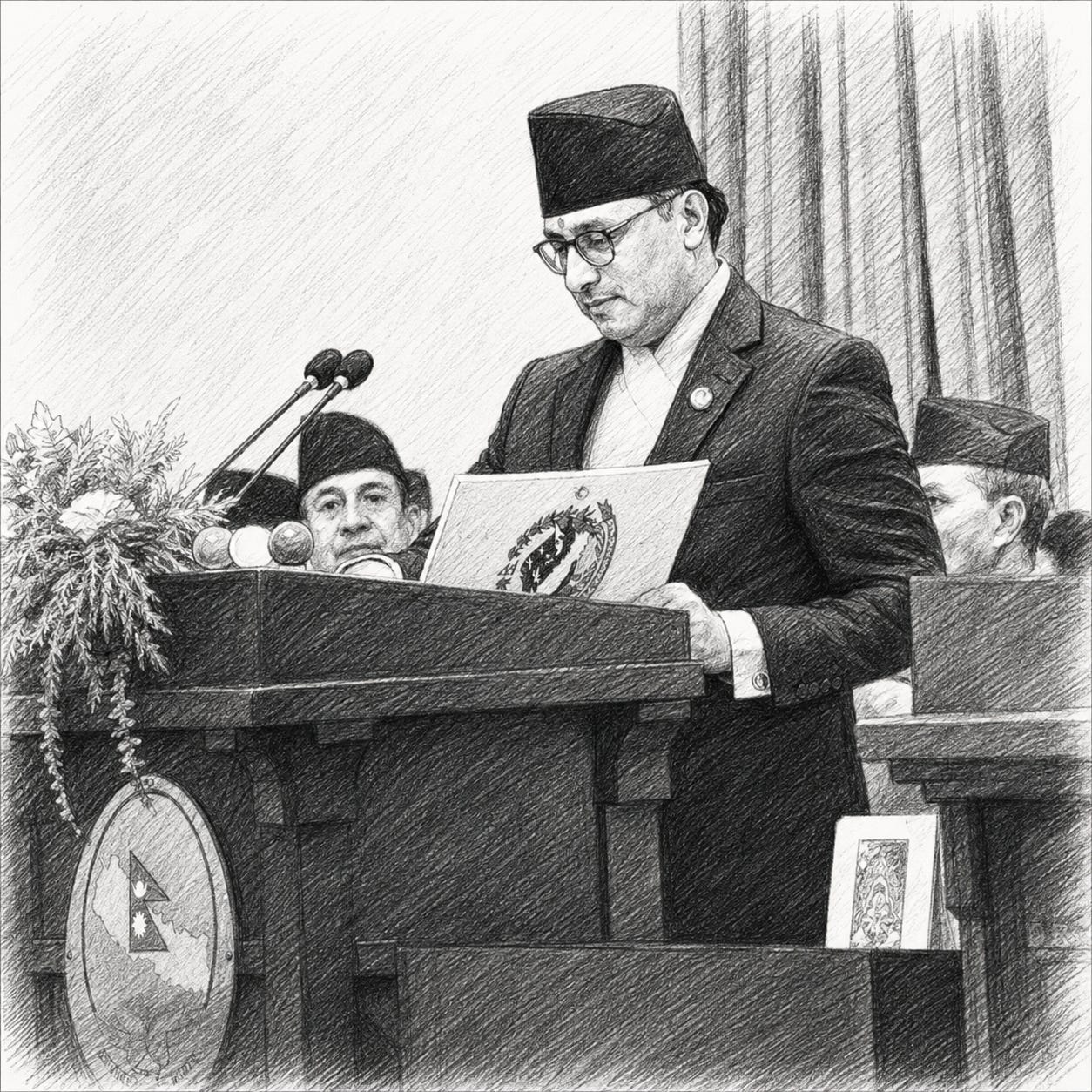
On the morning of May 29, Finance Minister Swarnim Wagle tabled a Rs 2,124.34 billion budget for fiscal year 2026/27, the biggest in Nepal’s history and a 25.2 percent jump on this year’s revised figures. The ambition is just as large: 7 percent growth, inflation held under 6 percent, fewer ministries, and a sweep of tax reforms. The headline relief for ordinary earners is a personal income tax exemption on annual income up to Rs 1 million, and the headline curiosity is a proposed sovereign AI computing center in Syuchatar, Kathmandu. The hard part, as ever, is the gap between the document and the delivery. Capital spending is set at just over 20 percent of the budget, and Nepal’s long record of under-spending its capital allocation is the reason economists are reading this one with cautious eyes. A big number is a promise, not a result (The Kathmandu Post, OnlineKhabar).
Remittances Carry the Country, Again
The figure that makes the budget math even possible came in this month: remittances rose 39.1 percent to Rs 1.66 trillion (about USD 11.55 billion) in the first nine months of the fiscal year, with a record Rs 209.75 billion arriving between mid-March and mid-April alone. That is roughly Rs 7 billion landing in the country every single day, and it has pushed gross foreign exchange reserves up 30.5 percent. Here is the part that keeps economists up at night: this windfall arrived even as the number of migrant workers fell, and most of the money flows straight into consumption rather than into businesses, factories, or jobs at home. So the diaspora is, in the most literal sense, financing the country’s stability. The open question is whether any budget will ever turn that lifeline into lasting productive investment (Nepal News, The Kathmandu Post).
In Brief: Numbers and concrete that moved this week.
The real growth rate. The government’s Economic Survey pegs growth this fiscal year at 3.85 percent, a long way short of the new budget’s 7 percent target (The Kathmandu Post).
Power on the way. The 216MW Upper Trishuli-1 project marked its weir operation milestone with the Korean ambassador in attendance, a sign the long-delayed plant is nearing its mid-2027 finish (Nepal Press).
Storing for the future. The energy minister made reservoir-based projects the national priority for energy security and irrigation, as the 140MW Tanahu project crossed 63 percent completion (Peoples’ Review).
⭐ Social & Cultural
Kathmandu’s Women Spike Their Way to the Semis
The best sporting story of the week did not come from a mountain. Hosting the CAVA Women’s Volleyball Championship 2026, Nepal’s national side fought through the group stage with wins over Kyrgyzstan and the Maldives, shaking off a narrow opening loss to defending champion India to book a place in the final four. Their reward is a semifinal against an unbeaten Iran, played in front of a home crowd in Kathmandu that has turned out in real numbers for a women’s team. Whatever happens next, a host nation reaching the semis is the kind of result that gets girls in Dharan and Dhangadhi asking for a volleyball, and that may matter more than the medal (The Kathmandu Post).
Thamel Goes to the Movies
The Kathmandu International Mountain Film Festival (KIMFF) opened its 23rd edition this week, turning the QFX Chhaya Center in Thamel into a five-day window on the world. The programme runs to 50 features, documentaries, and short films from 29 countries, with the mountains as the connective thread rather than the only subject. For a festival that has quietly outlasted governments and grown into one of South Asia’s most respected mountain-film gatherings, the staying power is its own kind of achievement. For the diaspora, it is also a reminder that Nepal exports more than labour and tea: it exports stories, and people are watching (Nepal News).
In Brief: A handful of moments worth a smile.
A first on the summit. Makeup artist Nilam Poudel became the first openly LGBTQ+ Nepali to summit Everest, reaching the top on May 23, a quiet milestone on a crowded mountain (Nepal News).
Strings that travel. Sarod maestro Sudarshan Rajopadhyay was honoured with the Kalakshetram title in Pune, India, for his contribution to music (Nepal News).
Folk-rock goes global. Nepathya plays its first ever Malaysia concert at Zepp Kuala Lumpur on June 1, another diaspora crowd about to sing every word back (Nepal News).
Cricket on tour. The Cricket Association of Nepal named its ‘A’ squad for the 42nd All India Gold Cup in Uttarakhand, captained by Anil Kumar Sah (Nepal News).
Until next week, stay connected!
Let’s connect
Enjoying this issue? 📩 Share it with a friend & let’s keep Nepalis worldwide in the loop! Got thoughts? Hit reply—we’re all ears! Or let us know what you think via our Feedback form or follow us on Facebook | LinkedIn
P.S. Got a story or issue you’d like us to cover next week? Drop us a reply — we’re building this space together.
About Nepali Diaspora Digest:
The Nepali Diaspora Digest connects the global Nepali community with curated news, insights, and stories that matter most. Join us as we celebrate and explore the diverse voices and achievements of Nepalis worldwide.
Partner shout out
belayat.uk: helping Nepalis connect in the UK on jobs, housing, events and finding local Nepali owned businesses


