


Namaste, diaspora family! It was a heavy week back home. The anti-corruption drive that put establishment names on notice finally reached the main opposition, with former finance minister Bishnu Paudel arrested and his party calling protests. The war in West Asia kept tightening the Gulf job market that so many of our families depend on, and football took a blow few saw coming when FIFA locked Nepal out. But the week also handed us two reasons to smile, both shaped by the diaspora itself: a pair of stolen gods flew home from New York, and the courts moved Nepal closer to full marriage equality. Let’s get into it.
🌍 Diaspora & Globalisation
The Gulf Door Narrows
For two decades the Gulf has been the default answer to the question every young Nepali eventually asks: where do I go to earn? This week the data showed that door swinging halfway shut. Labour-permit approvals fell 19 percent in the first ten months of the fiscal year, to 367,100 from 452,311 a year earlier, as the US-Israeli war on Iran and post-Gen Z visa tightening drained demand. The UAE, long the single biggest destination, saw its share of new permits collapse from nearly 40 percent to 25 percent. Qatar recruitment dropped from roughly 30,000 a month to a few thousand, and halted construction at Saudi Arabia’s NEOM added to the freeze. New paperwork costs are piling on too, with Saudi skills-verification and UAE police-certification fees adding close to Rs 30,000 between them. “Most hotels are not even 20 percent booked right now,” said one Nepali hotel worker in the Emirates, Suraj Sharma. For a country where roughly 1.9 million people worked the Gulf before the conflict, this is the labour map being redrawn in real time (The Kathmandu Post).
A Hard Warning From Japan
If the Gulf is the old frontier, Japan is the new one, and this week brought a sobering account of its cost. Foreign Ministry figures show 67 Nepalis died in Japan in roughly ten months, between mid-July 2025 and the start of June, and 25 of those deaths were suicides. Most of the dead were student-visa holders, young people juggling classes with the part-time work that a 28-hour weekly cap is supposed to limit. Japan now hosts about 116,000 Nepali students and some 309,000 Nepalis in all, alongside an estimated 6,000 Nepali-run restaurants and hotels, so this is no longer a fringe destination. “Living costs in Japan are high, and earnings from 28 working hours a week are not enough for rent, food and tuition,” said NRNA Japan secretary Sachin Acharya. Because many students never hold formal labour permits, embassy help is harder to give, and bringing a body home can cost around Rs 1.2 million. The dream of Japan is real, but so is the pressure underneath it (The Kathmandu Post).
In Brief: A few more notes from across the diaspora.
The map shifts east. As the Gulf cools, Malaysia has been Nepal’s top labour destination for four straight months, and a remarkable 61,072 Nepalis received foreign-employment permits in the single May-to-June window. Officials credit better wages, overtime and insurance under Malaysia’s revised policies (Nepal News).
A blast in Ras Laffan. An explosion and fire at the Barzan gas plant in Qatar killed 13 people and injured 66, including Nepali workers, none of them reported among the dead. QatarEnergy’s chief executive called it a “technical accident” rather than sabotage, a small reassurance for families who feared the worst (The Kathmandu Post).
Korea pulls up the ladder. South Korea cut its 2026 EPS intake to 80,000 worldwide, down 52 percent from 2024, which could push Nepali placements from around 18,000 to as few as 6,000. Selected workers already left in limbo have begun protesting, and a labour-ministry delegation is preparing for talks in Seoul (EPS Nepal).
🏛️ Politics & Governance
The Crackdown Reaches the Opposition
The anti-corruption wave that carried Balendra Shah’s government to power has spent months working through bureaucrats and middlemen. This week it reached a heavyweight. On June 22, the Department of Money Laundering Investigation arrested CPN-UML vice-chair and former finance minister Bishnu Prasad Paudel in Surkhet, an eight-time minister and one of the most senior figures in the main opposition. Investigators allege he leaned on a businessman to sell company shares far below value, a stake worth around Rs 300 million handed over for Rs 37.5 million, to a firm tied to the controversial businessman Deepak Bhatta, in exchange for official favours. A Special Court remanded him for seven days, and on June 25 the Supreme Court declined to order his immediate release, issuing a show-cause notice instead, with a full hearing set for June 30. The UML is not taking it quietly. The party announced nationwide protests and party chair KP Sharma Oli branded the arrest “politically motivated” and “illegal.” Whether this is reform reaching the untouchable or a government settling scores is now the argument consuming Nepali politics, at home and in the diaspora (The Kathmandu Post).
A Party That Wants to Rewrite the Rules
While one party fought a courtroom battle, another used its big week to question the system itself. At its first general convention in Chitwan, the Rastriya Swatantra Party re-elected Rabi Lamichhane as chair unopposed, with PM Balendra Shah among those proposing him. More striking than the coronation was the agenda. Lamichhane tabled proposals to scrap the parliamentary system for a directly elected executive, adopt a fully proportional electoral system, and turn the National Assembly into a non-partisan house of experts chaired by the Vice President. “We support a fully proportional electoral system instead of the current, highly expensive one, to ensure the representation of all communities,” he said. The old guard pushed back fast. Nepali Congress leader Pushpa Bhusal countered that “the parliamentary system is the one that remains closest to the people,” and the UML argued stability is achievable within the existing rules. For a diaspora that has watched coalition after coalition collapse, the question of whether Nepal needs a new operating system, not just new operators, is more than academic (The Kathmandu Post).
In Brief: The rest of the week in governance.
The passport case goes to court. The CIAA filed a Rs 10.13 billion graft case against 18 people over rigged e-passport procurement, naming the passport department’s former director general and executives of the German firms Muehlbauer and Veridos. Former foreign minister Arzu Rana Deuba, summoned last week, was not listed as a defendant, though the inquiry into her continues. Passport booklet stocks have meanwhile fallen below 47,000 (The Kathmandu Post).
A hundred days, graded. A near-100-day review of the Shah government found real wins on plumbing, ministries cut from 25 to 17, e-procurement rolled out, exam results published on time, betting sites shut overnight, but weak revenue, soft investment and a warning that actual corruption convictions “will take much longer” (Peoples’ Review).
An old idea stirs again. A new campaign for a Hindu state and the return of the monarchy is taking shape, with former RPP figure Dhawal Shumsher Rana and activist Durga Prasai planning to launch it from Madhesh Province on July 6 (Nepal News).
💸 Economy & Development
Someone to Mind the Market
After years in which Nepal’s stock market has felt like a casino with no one watching the floor, the government finally named a referee. On June 19, the Cabinet appointed Dr Gopal Prasad Bhatt, a former Nepal Rastra Bank executive director and capital-market analyst, as chairman of the Securities Board of Nepal. The seat had sat vacant long enough that brokers openly called it a source of investor unease. He arrives at a low moment. The NEPSE index has slid to around 2,660, down roughly 8 percent since March after a post-election rally fizzled, and share turnover over the first eleven months of the fiscal year fell about 22 percent year on year. The stock exchange itself only just got a new chief after six weeks without one. None of this is fixed by an appointment, but the budget’s promises of capital-market reform and diaspora bonds need a functioning regulator to mean anything, and many NRNs are among the retail investors who have been waiting for one (ShareSansar).
The Gap Only Remittances Can Hide
The fiscal year’s near-final trade numbers tell the same story Nepal has told for years, only larger. In eleven months the trade deficit widened to Rs 1.616 trillion, up almost 16 percent. The good news is genuine, exports grew 12.28 percent to Rs 277.97 billion, the kind of figure officials like to quote. The trouble is that imports grew faster, climbing past Rs 1.89 trillion, with petroleum still the single biggest line. India accounts for the bulk of the imbalance, a deficit of close to Rs 864 billion, with China adding another Rs 381 billion. What keeps this from becoming a crisis is the one number that always rescues Nepal’s accounts: remittances, now running near a third of the entire economy. It is a precarious kind of stability, an import-hungry country kept solvent by the earnings of the people it sends abroad, and this week’s data is a reminder of how thin that cushion really is (New Spotlight).
In Brief: A few more figures worth filing away.
The lifeline holds. Even as worker outflows fall, remittances hit a record Rs 1.916 trillion in ten months, up 41.2 percent year on year, with a single-month peak above Rs 257 billion. Fewer people are leaving, yet those already abroad are sending more than ever (Nepal Rastra Bank).
The off-season that wasn’t. Heat-fleeing Indian travellers turned the slow season into a boom, with Mustang drawing nearly 66,000 visitors in a month, 94 percent of them Indian, and Pokhara hotels so full that some visitors slept in tents by the lake (Nepali Times).
Industry’s wishlist. The Confederation of Nepalese Industries handed the central bank its asks ahead of the new monetary policy, calling external indicators “encouraging and strong” but the domestic economy “out of rhythm,” and pressing for cheaper credit, a startup loan facility and a modernised interest-rate system (Ratopati).
⭐ Social & Cultural
FIFA Locks Nepal Out
This was the week Nepali football fans dreaded and could see coming. On June 24, FIFA suspended the All Nepal Football Association until further notice, citing “third-party interference” by the government-linked National Sports Council, which had refused to recognise ANFA’s own electoral process and forced its election to be postponed. The consequences are blunt. Until the ban lifts, no Nepali team can play in any FIFA or AFC competition, the men’s side, the women’s side, the age-group squads and the domestic clubs all locked out, and the funding, coaching courses and development money that flow from world football stop with them. FIFA and the AFC had warned the Sports Council to back off in March and again in April, so the suspension is less a bolt from the blue than the end of a slow collision. The way out is equally clear: the council must withdraw and recognise ANFA’s independence, and the ban can be reversed before the next FIFA Congress. Until someone in Kathmandu blinks, a footballing nation sits on the sidelines of its own sport (The Kathmandu Post).
Two Gods Fly Home, and We Brought Them
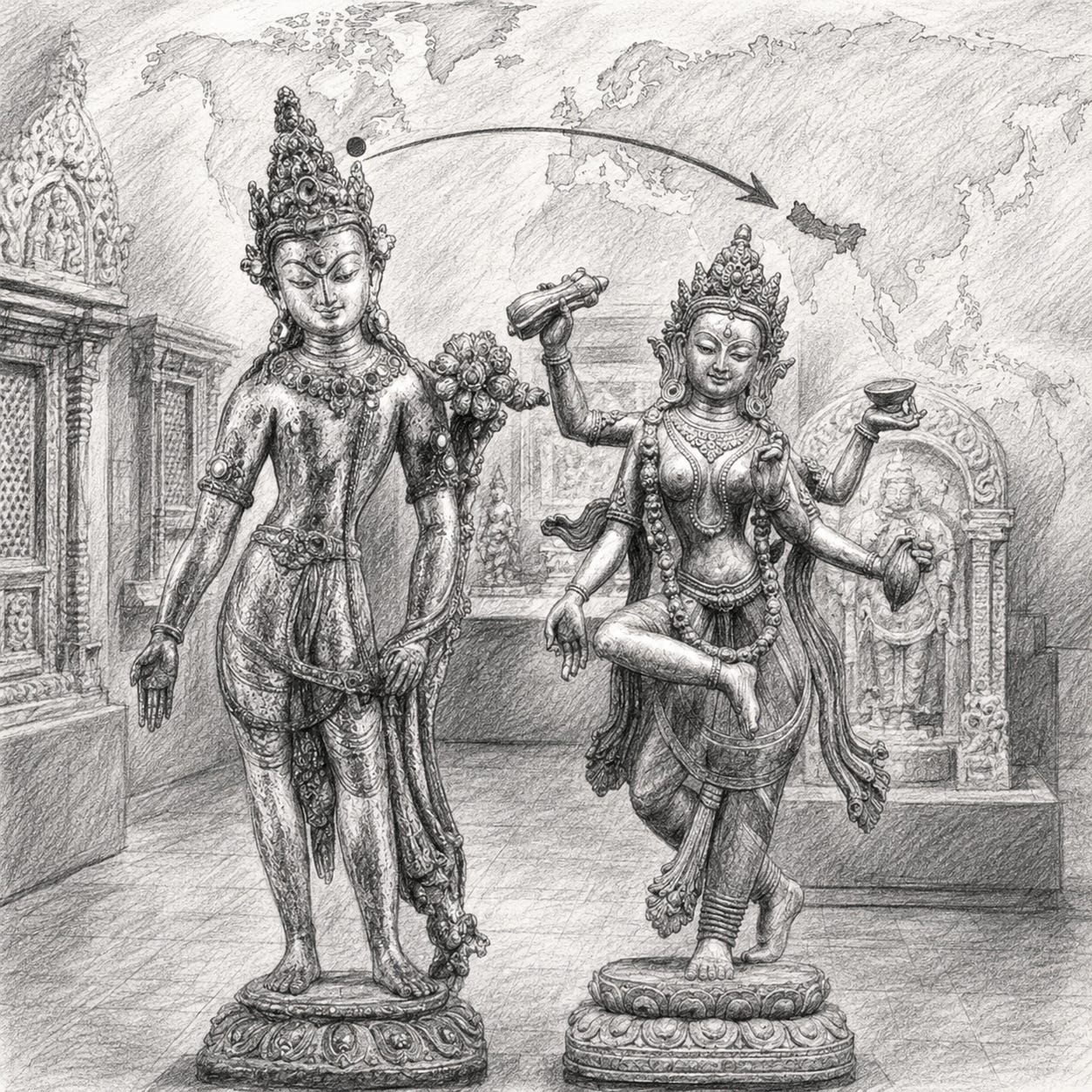
Here is the week’s reason to feel proud, and it has the diaspora’s fingerprints all over it. At the Nepali Consulate in New York on June 23, US authorities formally returned two sacred statues looted decades ago: a 13th-century bronze of Padma Pani, taken from Tham Bahil in Kathmandu sometime in the 1970s, and a 16th-century wooden figure of Nrityadevi, the goddess of dance, trafficked from a Patan courtyard and later recovered from the Metropolitan Museum of Art. Consul General Dadhiram Bhandari and Colonel Matthew Bogdanos of the Manhattan District Attorney’s antiquities unit signed the handover, but Bhandari was quick to share the credit, pointing to “the longstanding contributions of the Nepali diaspora, particularly Newa Guthi, New York.” The community group did more than lobby; it helped coordinate the journey and accompanied the gods on the flight home, where they were handed to the Department of Archaeology on June 25. For a diaspora that often worries about what its children will inherit of Nepal, here is an answer: sometimes you are the ones who carry it back (Spotlight Nepal).
In Brief: A few more moments from the week.
A step toward equality. Following a Supreme Court ruling that Nepal must extend full marriage rights to same-sex couples, moving beyond the limited 2023 registration and putting Nepal among the first in Asia to do so, the Blue Diamond Society urged Parliament to update the civil code. “The Supreme Court has spoken clearly,” said executive director Manisha Dhakal (Washington Blade).
A scare in Jawalakhel. The country’s only zoo closed for at least two weeks after an H5N1 outbreak killed more than 40 animals, including a common leopard. The zoo had stayed open for five days after a positive test, and its chief was relieved of duty and placed under investigation for allegedly concealing the outbreak (Mongabay).
Medals beyond the mountains. On Olympic Day, the Nepal Olympic Committee handed out its annual awards, naming karateka Arika Gurung and wushu athlete Bijaya Sinjali the year’s best, a welcome reminder that Nepali sport runs deeper than cricket and climbing (The Kathmandu Post).
Let’s connect
Enjoying this issue? 📩 Share it with a friend & let’s keep Nepalis worldwide in the loop! Got thoughts? Hit reply—we’re all ears! Or let us know what you think via our Feedback form or follow us on Facebook | LinkedIn
P.S. Got a story or issue you’d like us to cover next week? Drop us a reply — we’re building this space together.
About Nepali Diaspora Digest:
The Nepali Diaspora Digest connects the global Nepali community with curated news, insights, and stories that matter most. Join us as we celebrate and explore the diverse voices and achievements of Nepalis worldwide.
Partner shout out
belayat.uk: helping Nepalis connect in the UK on jobs, housing, events and finding local Nepali owned businesses


