


Namaste, diaspora family! It was a heavy week back home, and a revealing one. The Supreme Court stepped in and froze the Balen Shah government’s flagship anti-corruption commission, a reminder that even a popular crackdown has to answer to the constitution. In the numbers that shape so many of our families, the map of where Nepalis go for work kept shifting west, with Europe now pulling workers the Gulf once took for granted. And at home the monsoon turned deadly while a young driver’s death put a human face on the quiet desperation of Nepal’s gig economy. Let’s get into it.
🌍 Diaspora & Globalisation
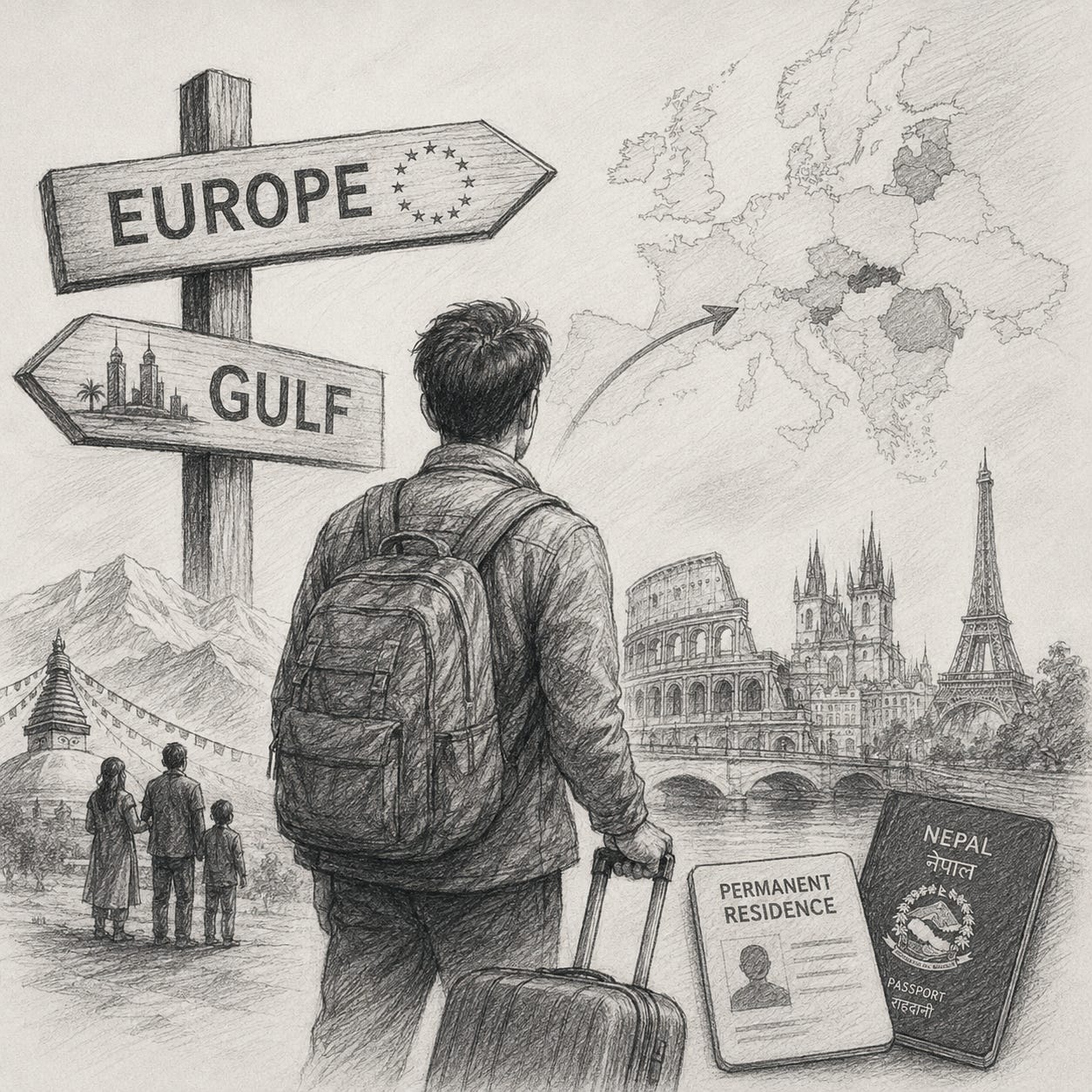
The Map Now Points to Europe
For a generation, the answer to “where will you go” was the Gulf. This week the data made plain how fast that is changing. In the first eleven months of the fiscal year, 53,951 Nepalis took new labour approvals for 24 European nations, lifting Europe to 14.7 percent of all outbound workers, up from just 8.69 percent a year earlier. Romania is the new frontier, drawing 24,767 workers alone, with Cyprus, Portugal, Malta and Bulgaria filling in behind. The Gulf still holds the majority at 55.4 percent, but its grip is loosening as tensions across West Asia make old destinations feel less certain. What is striking is why people are choosing Europe: not just wages, but a road to permanent residency and, eventually, family. As one worker put it, “once I secure a permanent residence card, I can bring my family over.” For a diaspora built on separation, that is the sentence that matters (The Kathmandu Post).
The Lifeline Hits a Record
Even as the destinations change, the money keeps setting records. Remittances reached Rs 2.12 trillion in the first eleven months of the fiscal year, up a remarkable 38.2 percent on the year before, or about $14.59 billion in dollar terms. That flood has pushed Nepal’s foreign exchange reserves to a record $24.68 billion, up more than a quarter, enough to keep the rupee steady and the shelves stocked. It is the reason the central bank feels confident forecasting 7 percent growth for the year ahead. Behind the number sits a simple, humbling arithmetic: roughly three million Nepalis abroad, about 2,230 more leaving every single day, all of them wiring home what now amounts to close to a third of the entire economy. The diaspora does not just support Nepal’s finances anymore. It largely is Nepal’s finances, and that is both a source of pride and a quiet worry (Xinhua).
In Brief: A couple more notes from across the diaspora.
Who counts as one of us. The debate over the draft NRN bill and its citizenship provisions rumbles on, with critics arguing that “once a Nepali, always a Nepali” should mean something firmer in law. It is a live question for millions who carry Nepal in their hearts but another passport in their pockets (The Kathmandu Post).
A more skilled diaspora. Fresh analysis is a reminder of how the community abroad has changed: more than half of Nepali Americans now hold a college degree, and experts are pressing Kathmandu to update a diaspora policy still built for an era of only sending money home (NepYork).
🏛️ Politics & Governance
The Court Says Not So Fast
The showpiece of the government’s first hundred days ran into the wall of the courts this week. On July 11, a Supreme Court bench issued an interim order freezing the Property Investigation Commission, the five-member body the Balen Shah government set up in April to chase hidden wealth accumulated by politicians, bureaucrats and security officials going back two decades. The court told the commission to hold the status quo: it may not compel anyone to submit their asset details, nor recommend any action, until a full three-judge bench rules on whether the whole exercise is even constitutional. Petitioners argued it trampled privacy rights and stepped on the anti-graft body’s turf. It is a genuine test. The commission had already gathered 13,660 asset declarations and more than 1,500 complaints before it went dark. For a diaspora that cheered the promise of a cleaner Nepal, this is the harder, more grown-up lesson: a crackdown that ignores the constitution is not reform, it is just power by another name (The Kathmandu Post).
The Cell Door, Still Shut
The most prominent target of the crackdown, meanwhile, is still behind it. The Supreme Court this week dismissed a habeas corpus petition seeking the release of Bishnu Prasad Paudel, the CPN-UML vice-chair and eight-time former finance minister arrested on June 22 in a money-laundering probe, and instead demanded the case files be produced. The Special Court has now extended his custody for a fifth time. The contrast with the story above is the whole drama of this government in miniature: one arm of the state pushing hard against alleged corruption, another arm insisting that even that push obey the rules. Which impulse wins will define whether this reckoning is remembered as a genuine cleaning of the house or a settling of political scores. From abroad, it is worth watching closely, because the answer will shape the Nepal our remittances are building (Nepal News).
In Brief: The rest of the week in governance.
A hand extended to the right. Prime Minister Shah sat down with RPP chairman Rajendra Lingden, who signalled his royalist-leaning party would back the government if it moved to amend the core structure of the constitution. It is an early hint of the coalition math that may shape the term (Nepal News).
A perk quietly returns. The Cabinet restored the provision letting MPs appoint personal secretaries, reversing one of the austerity cuts made by the Gen Z-era interim government. Small on its own, it is the kind of walk-back that a public in an anti-privilege mood tends to notice (Nepal News).
💸 Economy & Development
The Detour That Costs Two Airports
Here is a piece of good news wrapped in a long-overdue conversation. Nepal and India have agreed to resume talks on new air entry routes after nearly a decade of silence, with senior officials due to meet in August. The stakes are concrete: roughly 90 percent of international flights still funnel into Nepal through a single congested corridor over Simara, forcing aircraft bound for Bhairahawa to detour some 300 kilometres and Pokhara-bound flights up to 185 more. That bottleneck is why two gleaming international airports, built for over Rs 60 billion, still sit almost empty of scheduled foreign flights. Nepal wants three new gateways, at Janakpur, Bhairahawa and Nepalgunj, though India has long resisted on security grounds near its Gorakhpur air base. If the talks succeed, the payoff would ripple straight to the diaspora: cheaper fares, shorter journeys, and finally a real alternative to Kathmandu’s crush when you fly home (The Kathmandu Post).
Strong Numbers, Cautious Money
The macro story remains a study in contrasts. The central bank is projecting 7 percent growth for the coming year, reserves are at record highs, and banks are awash in liquidity. And yet the money on the ground stays cautious. The NEPSE index has been grinding sideways, closing around 2,576 on July 14 after weeks with little conviction, and credit flow to businesses remains sluggish even with cash piled up in the banks. Inflation, too, has crept back up to 5.22 percent, nearly double where it sat a year ago. The picture is a country whose headline figures look enviable while its own investors and lenders wait to see whether the political turbulence settles. For NRNs weighing whether to bring capital home, that gap between the numbers and the nerve is exactly the thing to keep an eye on (Nepal News).
In Brief: A couple of figures worth filing away.
Pokhara gets its wings. Flydubai has announced daily Pokhara-Dubai flights starting September 23, a genuine breakthrough for an airport that has struggled to attract international carriers, and a new tourist information centre has opened to greet the arrivals (Travel And Tour World).
Prices edge up. Consumer inflation rose to 5.22 percent year on year in the month to mid-June, driven by both food and services, a reminder that the cost of living at home keeps climbing even as the big reserve numbers dazzle (Nepal Rastra Bank).
⭐ Social & Cultural
A Driver’s Death, and a Warning About the Gig Economy
The saddest story of the week was also one of the most revealing. Ganesh Nepali, a 25-year-old ride-sharing driver from Mugu who had bought his motorcycle on loan to support an ailing mother, set himself on fire in Kathmandu’s Tripureshwar and later died at Bir Hospital. The trigger was small and crushing at once, a Rs 1,000 traffic fine and a clamped bike, the last straw for a man whose livelihood had been quietly collapsing. Ride-share fares in Nepal have fallen roughly 60 percent in two years as apps undercut one another, while platform commissions of 10 to 15 percent and proposed new taxes eat into what little remains. His death has forced a reckoning over the tens of thousands of Nepalis who drive, deliver and freelance with no job security, no social protection, and labour laws that never imagined them. “His death reflects the suffering of the entire driving community,” said Muktinath Phuyal of the Independent Drivers Foundation. For a diaspora whose remittances helped build this app-driven urban economy, it is a hard look at who gets left unprotected inside it (The Kathmandu Post).
The Rains Count Their Toll
The monsoon has settled into its cruellest stretch. Over the past three months, disaster-related incidents have claimed 163 lives across the country, and this week alone brought a grim single-day tally of 73 incidents, with landslides doing the most damage across dozens of districts. Among the dead were Mandir Saud, 46, and Lal Bahadur Saud, 76, buried by a landslide in Kalikot’s Sannitriveni. Peak monsoon is only now arriving, which means the season’s ledger is far from closed. For families abroad, this is the summer worry that never quite lifts, the phone call to check that the house above the river, or below the hill, is still standing (Xinhua).
In Brief: A few last notes to close the week.
Football, and the deadline that passed. The clock we have watched for a month finally ran out. With the FIFA suspension of the football association still in force past July 13, Nepal was left out when the AFC drew the U17 Women’s Asian Cup qualifiers on July 16, a squad of teenagers shut out of their tournament by a governance feud they had no part in (The Kathmandu Post).
Cricket carries the flag. On a brighter note, the men in blue keep the tricolour flying. Nepal has travelled to Utrecht for an ICC World Cup League 2 tri-series against the Netherlands and Namibia from July 21, another step on the long road toward the sport’s bigger stages (ESPNcricinfo).
Art with a national accent. In Kathmandu, the Kala Mahotsav 2083 exhibition has opened under the theme “Celebrating Nepali Nationality and Culture,” a five-day show of works drawn from the country’s heritage, landmarks and landscapes, and a welcome bit of colour in a rain-soaked month (Nepal On The Web).
Let’s connect
Enjoying this issue? 📩 Share it with a friend & let’s keep Nepalis worldwide in the loop! Got thoughts? Hit reply—we’re all ears! Or let us know what you think via our Feedback form or follow us on Facebook | LinkedIn
P.S. Got a story or issue you’d like us to cover next week? Drop us a reply — we’re building this space together.
About Nepali Diaspora Digest:
The Nepali Diaspora Digest connects the global Nepali community with curated news, insights, and stories that matter most. Join us as we celebrate and explore the diverse voices and achievements of Nepalis worldwide.
Partner shout out
belayat.uk: helping Nepalis connect in the UK on jobs, housing, events and finding local Nepali owned businesses


