

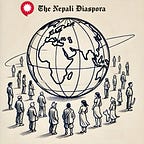

Namaste, diaspora family! This week the anti-corruption story that has been simmering for months reached one of the biggest names in Nepali politics, with the CIAA summoning former Foreign Minister Arzu Rana Deuba over the e-passport contract. There was lighter news too, and some of it touches our wallets directly: India and Nepal switched on a remittance link that lets money move home in seconds, and a small Nepali film made history at Cannes. Add seven provincial budgets, a tourism charm offensive, and a quiet rise in the price of daal, and you have a week that ran from the courtroom to the red carpet. Let’s get into it.

🌍 Diaspora & Globalisation
New Rails for the Money We Send Home
For anyone who has stood in a remittance queue or watched a transfer take three days to clear, this is the development of the week. India and Nepal have switched on a direct link between India’s UPI and Nepal’s National Payments Interface, allowing instant, person-to-person money transfers between bank accounts and digital wallets in both countries. What makes it notable is the word “person-to-person.” Earlier UPI tie-ups abroad mostly let Indian tourists pay shopkeepers; the Nepal corridor is the first to send money both ways, directly between individuals. The plumbing was built by NPCI International on the Indian side and Nepal Clearing House on ours, and it makes Nepal the ninth country wired into India’s payments network. For the millions of Nepalis whose lives straddle the open border, and for families splitting earnings across Kathmandu and Indian cities, it promises cheaper, faster transfers and one less reason to carry cash across a checkpoint. The real test, as always, will be the fees and the daily limits, but the direction of travel is clear (Asia News Network).
The Gulf State That Keeps Calling
If India was the week’s big structural story, the Gulf supplied its diplomacy. On June 18, the UAE’s ambassador to Nepal, Abdulla Saeed Mubarak Jarwan Al Shamsi, called on Speaker Dol Prasad Aryal, and the agenda read like a summary of the diaspora’s whole relationship with the Emirates: employment, investment, trade, tourism, air services, even artificial intelligence. Aryal used the moment to press a very practical grievance, asking the UAE to ease the police-report requirement that slows down visas for Nepali workers, a piece of paperwork that costs time and money for people who can spare neither. He also welcomed the start of daily Pokhara to Dubai flights from September 23, a real boost for the new international airport that has struggled to fill its schedule, and floated reviving the Dubai to Bhairahawa route. The UAE is home to a large share of Nepal’s migrant workforce, so easier visas and direct flights are not abstractions. They are the difference between seeing family once a year or once every two (Nepal News).
In Brief: A few more notes from across the diaspora.
The other side of the wire. As remittances break records, the workers behind them are feeling the Gulf’s downturn. Reports this month describe Nepalis sent on unpaid leave, salaries frozen and contracts canceled as regional conflict slows construction and tourism, with one group of 36 workers in Qatar left unpaid for eight months (The Kathmandu Post).
A community that keeps growing. NRNA Australia welcomed the new budget’s provisions for migrant workers, from skills recognition to social-security enrolment, as fresh figures put Australia’s Nepali-born population at 213,580, nearly double the 2021 count (Nepal News).
A new dot on the map. Himalaya Airlines began direct scheduled flights between Kathmandu and Shenzhen, opening another link to southern China for traders, students and tourists (Travel and Tour World).
🏛️ Politics & Governance
The Passport Scandal Reaches a Deuba
The corruption case that has slowly engulfed Nepal’s passport department took its most politically charged turn yet. On June 18, the Commission for the Investigation of Abuse of Authority summoned former Foreign Minister Arzu Rana Deuba over the e-passport procurement contract, serving notice at her Budhanilkantha home and giving her three days to appear. The CIAA alleges that close to Rs 8 billion in irregularities ran through the printing and supply deal, and more than thirty-five people are now under its lens. Several are already in custody, including the passport department’s former director general Tirtharaj Aryal, a director, and the Nepali agent of the German firm Muehlbauer; the agent of a second German firm is reported to be absconding. The pressure does not stop at her. Her husband, former Prime Minister Sher Bahadur Deuba, faces a parallel money-laundering inquiry. Deuba, a senior Nepali Congress figure, replied by email that she is abroad for medical treatment and cannot meet the deadline, but pledged to cooperate. For a government that rode to power on an anti-corruption wave, watching the establishment’s biggest names answer summonses is exactly the spectacle its voters wanted (The Kathmandu Post, OnlineKhabar).
Seven Provinces, One Calendar
While the capital chased a scandal, the rest of the federation did its annual arithmetic. On June 15, the first day of Asar, all seven provincial governments tabled their budgets for the coming fiscal year, as the constitution requires them to. The numbers map the country’s uneven geography of money. Bagmati, anchored by Kathmandu, unveiled the largest at Rs 66.93 billion, with Lumbini at Rs 37.38 billion and Gandaki at Rs 32.99 billion. None of this happens in isolation: the federal budget set aside Rs 424.27 billion in transfers to sub-national governments, split between the seven provinces and the country’s 753 local units. The provincial plans lean on the familiar promises of roads, clinics, irrigation and tourism, with pledges to keep day-to-day spending in check. Ten years into federalism, these budgets are less about headline drama and more about whether the system can actually deliver closer to home, a question the diaspora, much of which left because services never reached their villages, has a personal stake in (Rising Nepal Daily).
In Brief: The rest of the week in governance.
A crack on the bench. The senior-most Supreme Court justice, Sapna Pradhan Malla, stayed away from a Full Court convened by Chief Justice Manoj Kumar Sharma to finalise the judiciary’s digital plans, a public sign of friction at the top of the court (Nepal News).
The remark that lingers. Opposition parties kept disrupting parliament, demanding that PM Balendra Shah retract his earlier comment that Nepal too had encroached on Indian land, a line they say undercuts Nepal’s own border claims (The Himalayan Times).
Money for classrooms. Education and sports drew Rs 218.3 billion, or 10.28 percent of the national budget, funding skills training, school buildings, smartboards in community schools and the midday meal programme (Nepal News).
💸 Economy & Development
Wiring a Country That Sells Light
Nepal’s defining economic ambition is to turn falling water into exportable power, and this year’s energy program lays out how far that dream still has to travel. The Energy Ministry’s plan for the new fiscal year aims for 15,000 MW of generation by 2030, a target that would move Nepal from chronic shortage to surplus and seasonal export. The less glamorous half is the wiring: extending 66 kV transmission lines to 7,808 circuit kilometres and 33 kV lines to 8,429, with a dozen major transmission projects slated for completion, plus modest additions of 43 MW from micro-hydro and 99 MW from solar. Transmission is where Nepal’s hydropower story has repeatedly stalled, with finished plants left unable to sell because the lines to carry their power were years behind. The big builds still in progress, Arun 3 at 900 MW and Betan Karnali among them, will only matter if the grid catches up. For a diaspora that pays the country’s bills in remittances, a Nepal that earns from electricity rather than only exporting workers is the more hopeful future (Investopaper).
A Decade On, the Quake’s Last Repairs
Ten years after the 2015 earthquake flattened homes, clinics and temples, the rebuilding reached a milestone this month. India’s External Affairs Minister S. Jaishankar formally handed over 72 health facilities and 12 cultural heritage sites reconstructed under the post-quake programme, after talks with Foreign Minister Shishir Khanal. The same meeting launched the UPI to NPI remittance link and signed an agreement between India’s Bhashini platform and Kathmandu University to build a “voice first” Nepali-language translation tool, a small but interesting bet on technology that works in Nepali rather than only English. The handover is a reminder that earthquake recovery, so urgent in 2015, became a slow decade of paperwork and half-finished sites. Completed clinics and restored monuments are real gains, even if they arrive long after the headlines moved on. They also sit inside a wider India-Nepal agenda of hydropower, connectivity and trade that quietly shapes daily life on both sides of the border (New Spotlight).
In Brief: A few more figures worth filing away.
The cost of living creeps up. Year-on-year inflation reached 5.04 percent in the tenth month of the fiscal year, up from just 2.77 percent a year earlier, a reminder that record remittances are landing in households whose grocery bills are rising too (Nepal News).
Markets hold their nerve. The NEPSE index steadied near 2,736 after an early-week dip, though banking stocks stayed soft under the weight of rising bad loans (Nepal News).
Business likes the budget. The Nepal-India Chamber of Commerce endorsed the Rs 2.124 trillion federal budget, backing a higher tax-free income ceiling, a lower top rate, and the new diaspora bonds meant to draw NRN savings into Nepal (Nepal News).
⭐ Social & Cultural
Nepal Walks the Croisette
Here is the week’s reason to feel proud.
, the debut feature by director Abinash Bikram Shah, has become the first Nepali film to win an award at the Cannes Film Festival, taking the Jury Prize in the Un Certain Regard section. On June 12, the French Ambassador to Nepal, Virginie Corteval, hosted a reception for the cast and crew at her residence, with Acting Kathmandu Mayor Sunita Dangol among the guests, turning an international honour into a hometown celebration. The film itself refuses the postcard version of Nepal. Set in the Terai plains, it follows Pirati, the leader of a marginalised Kinnar community, whose world unravels after one of her daughters disappears. A co-production spanning Nepal, France, Germany, Brazil and Norway, it carries a story that rarely reaches a screen this big. For a film industry long overshadowed by its Bollywood neighbour, and for diaspora parents who want their children to see Nepal as a place that makes art, not just news, the win lands as something close to validation (The Kathmandu Post).
Selling the Mountains, Again
Nepal spent the week reminding the world it is open for visitors. The Nepal Tourism Board took a delegation of eight tourism firms to ITE Hong Kong from June 11 to 14, pitching the country’s mix of heritage, adventure and wellness travel to one of Asia’s busiest source markets. At home, the sixth Himalayan Travel Mart wrapped up after drawing more than 600 delegates from 27 countries and arranging some 2,400 business meetings between Nepali operators and foreign buyers. Running underneath it all is a new Wellness Tourism Strategy for 2026 to 2035, an attempt to sell Nepal as a place to slow down and heal rather than only to climb. The pitch makes sense for a country whose biggest tourism risk is being seen as a one-trip destination for hardcore trekkers. Whether the strategy translates into hotel rooms booked and yoga retreats filled is next year’s question, but the diaspora, often the first to bring foreign friends home, is part of how that story spreads (Travel and Tour World).
In Brief: A few more moments from the week.
Music without borders. The International Music Festival 2026, hosted by Tribhuvan University’s Lalitkala Campus, gathered musicians, scholars and teachers from several countries, putting Nepali classical traditions and instruments in front of a global audience (Manasukh Dhvani).
Monuments come home. Among the India-funded reconstruction handovers were 12 cultural heritage sites rebuilt after the 2015 quake, restoring temples and monuments that anchor both faith and tourism (New Spotlight).
A meal and a smartboard. The headline education number had a human edge: continued funding for community-school smartboards and the midday meal that keeps many children in class through the lean months (Nepal News).
Let’s connect
Enjoying this issue? 📩 Share it with a friend & let’s keep Nepalis worldwide in the loop! Got thoughts? Hit reply—we’re all ears! Or let us know what you think via our Feedback form or follow us on Facebook | LinkedIn
P.S. Got a story or issue you’d like us to cover next week? Drop us a reply — we’re building this space together.
About Nepali Diaspora Digest:
The Nepali Diaspora Digest connects the global Nepali community with curated news, insights, and stories that matter most. Join us as we celebrate and explore the diverse voices and achievements of Nepalis worldwide.
Partner shout out
belayat.uk: helping Nepalis connect in the UK on jobs, housing, events and finding local Nepali owned businesses


