


Namaste, diaspora family! This was a week when the big stories moved fast. The most prominent target of the anti-corruption drive, Bishnu Paudel, was formally charged and then walked out of custody on the very same day, a twist that has everyone asking what the crackdown actually has in hand. A government task force quietly delivered the most sweeping proposal to rewrite the constitution since 2015, including, for the first time, a serious push for overseas voting. And in the happier column, Nepal’s electricity trade posted its best year ever. Let’s get into it.
🌍 Diaspora & Globalisation
Fewer Bags at the Airport
For the first time in three years, fewer than 800,000 Nepalis took labour approvals to work abroad. The Department of Foreign Employment counted 792,187 permits in the fiscal year that ended in mid-July, down 5.6 percent from 839,266 the year before. The UAE was the top destination with 183,580 workers, followed by Malaysia (132,646), Qatar (132,051) and Saudi Arabia (124,583). Some of the dip reflects tensions across West Asia making Gulf jobs harder to get, and some reflects the slow westward shift we covered last week, as workers hold out for European routes that offer residency instead of just wages. But a cooling outflow is a real signal either way. Nepal’s economy runs on the roughly 2,200 people who leave every day; if that number keeps sliding, the remittance arithmetic that props up the reserves, the rupee and millions of households will eventually feel it. Worth watching closely over the new fiscal year (Peoples’ Review).
The Recruiters Finally Face a Reckoning
If you have ever helped a relative untangle a dispute with a manpower agency, this one is for you. From July 17, the Department of Foreign Employment stopped renewing the licences of recruitment agencies that have unresolved complaints against them, effectively barring them from sending workers abroad until they settle up. The backlog is staggering: around 44,000 institutional and individual complaints are pending, some dating all the way back to 2000. These are the cases behind so many familiar stories, fees that ballooned after signing, jobs that never matched the contract, wages that arrived short or not at all. Agencies are protesting that the rule punishes the compliant along with the crooked, but worker advocates have waited decades for consequences with actual teeth. For the diaspora, the test is simple: does the next cousin who flies out get a fairer deal than the last one did (The Kathmandu Post)?
In Brief: A couple of community notes from around the world.
Kathmandu on Tokyo Bay. Japan’s Nepali community, one of the fastest growing anywhere, threw its biggest party of the year as Nepal Festival 2026 filled Odaiba’s Shiokaze Park from July 18 to 20 with dal bhat, dohori and three days of free entry (iwafu).
A crown in the capital. The Miss Nepal North America 2026 finale lands in Washington, DC this Sunday, July 26, with twenty finalists from across the US and Canada competing on a platform built around scholarship and community representation (NepYork).
🏛️ Politics & Governance
Charged in the Morning, Free by Evening
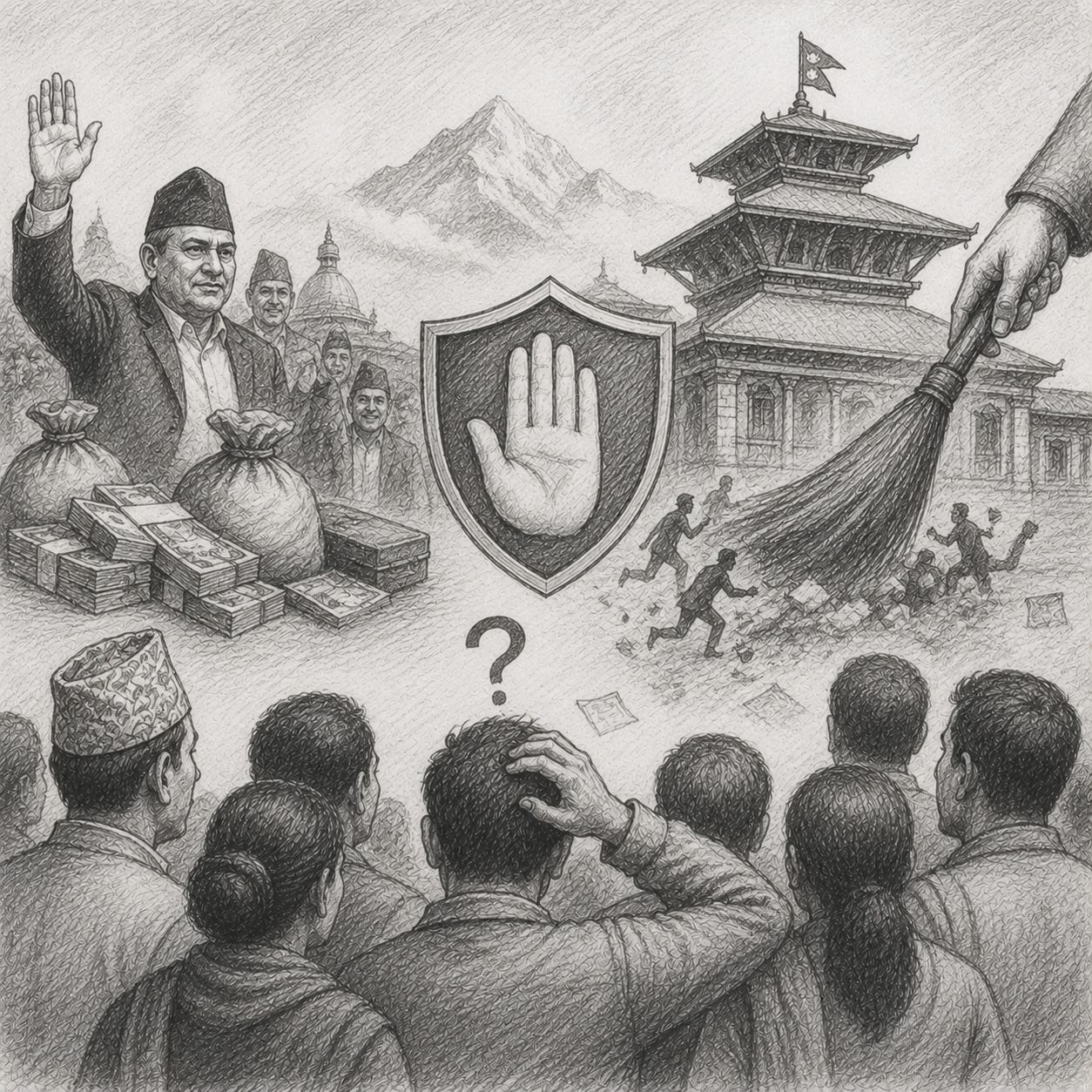
The strangest day of the anti-corruption drive so far came on July 17. The Department of Money Laundering Investigation filed its long-awaited charge sheet against Bishnu Prasad Paudel, the CPN-UML vice-chair and eight-time finance minister, naming 16 defendants in total, six individuals and ten companies, over the alleged concealment of assets tied to businessman Deepak Bhatta. Hours later, the Special Court ordered Paudel released on general bail, without a deposit, after 25 days in custody, ruling that the evidence presented so far “did not establish” his involvement. He was back on a public stage within the week. UML supporters call it vindication and proof of a political vendetta; the government’s defenders note a bail order is not an acquittal, and the trial is still coming. Either way, the same question from the commission freeze two weeks ago now hangs over the marquee prosecution: is the evidence as strong as the arrests were dramatic (New Spotlight)?
245 Articles on the Operating Table
With far less drama, the week’s most consequential document may have been the 500-page report a government task force handed Prime Minister Balendra Shah, proposing amendments to 245 of the constitution’s 308 articles. The headline ideas are enormous: a directly elected executive president, a smaller parliament, a restructured judiciary, a rethink of federalism, and, of particular interest to readers of this digest, voting rights for Nepalis overseas. The panel met 184 experts, from former presidents to party chiefs, over 22 formal sittings. But consensus is nowhere in sight. Three parties, including the Nepal Communist Party, walked out of the process entirely, and the RPP wants changes that go further still. Rewriting a constitution that took a decade and two Constituent Assemblies to produce is not a weekend project, and this report is a discussion paper, not a draft bill. Still, the fight it frames, over how Nepal is governed and who gets a say, including the three million of us abroad, will likely define this government’s term (The Kathmandu Post).
In Brief: The rest of the week in governance.
A quiet chamber. The House of Representatives adjourned for two weeks, with the next sitting set for Shrawan 14 (July 30), giving parties time to digest the amendment report before the shouting starts (Khabarhub).
A win for the press. The Supreme Court struck down a directive that had funnelled all public-service advertising to state-owned media, restoring a revenue stream private outlets depend on and drawing a line under a quietly worrying squeeze (Khabarhub).
Coalition math continues. Prime Minister Shah sat down with RSP chair Rabi Lamichhane for talks on governance cooperation, another data point in the slow assembly of alliances around the government’s reform agenda (Khabarhub).
💸 Economy & Development
The Rivers Are Paying Rent Now
Here is a number to savour: Nepal earned a record Rs 29.32 billion selling electricity to India and Bangladesh in the fiscal year just ended, up 68 percent on the year before. With imports falling by nearly a third, the net electricity trade surplus hit Rs 18.76 billion, roughly quadruple last year’s Rs 4.54 billion. The monsoon rivers that flood the headlines are also, quietly, becoming an export industry. And the ceiling just lifted: at a joint meeting in Pokhara, Nepal and India agreed to raise export capacity on the Dhalkebar cross-border lines from 1,100 to 1,650 megawatts, which means less wet-season surplus wasted and more of it billed. After decades of load-shedding jokes and imported diesel, Nepal selling power at Rs 7.56 a unit to its giant neighbours is a genuine structural shift, the kind of economic story that does not depend on anyone’s remittance. More transmission lines are on the drawing board to keep it growing (The Kathmandu Post).
The Money That Stayed Away
The mirror image of that success arrived a day earlier in the foreign investment numbers. FDI commitments for the year came in at Rs 58.01 billion across 1,116 projects, down about Rs 7 billion from the year before, and officials are not mincing words about why: a year of political turbulence, from the Gen Z transition to this summer’s court battles, has investors waiting on the sidelines. The composition tells its own story. Agriculture and forestry led with Rs 23.2 billion, tourism drew Rs 14 billion, while ICT attracted the most projects (727) but only Rs 2.8 billion, mostly small bets. Remember these are commitments, not cash; actual inflows historically run at a fraction of pledges. For NRNs weighing an investment back home, the gap we flagged last week between strong macro numbers and cautious money just showed up in the official data. Confidence, it turns out, is the scarcest currency in Kathmandu (The Kathmandu Post).
In Brief: A few more entries for the ledger.
A train changes the map. The first direct freight train from Kolkata port rolled into Biratnagar’s customs yard on July 20 carrying 40 containers of canola for a Nepali oil producer, opening a corridor expected to cut transit costs by 20 to 30 percent (The Kathmandu Post).
Cash-rich banks, credit-poor villages. Even with record liquidity in the banking system, reporting this week showed poor households still cannot access formal loans, the very gap that pushes families toward the loan sharks in our story below (The Kathmandu Post).
The price of an ana. New government land valuations for the fiscal year put prime Kathmandu main-road plots at about Rs 7.6 million per ana, up from Rs 7.2 million, a figure worth knowing if a family land matter is on your horizon (Nepal News).
⭐ Social & Cultural
They Walked From Janakpur, and Kathmandu Blinked
Nine days after setting out on foot from Tritiyagachhi in Janakpur, hundreds of loan-shark victims called off their March for Justice on July 17, when the government signed a nine-point agreement with their representatives. The commitments are substantial: loan sharking will be declared an economic crime, a dedicated Predatory Lending Crime Control Act criminalising fourteen abusive practices is to be drafted within three months, fraudulent loan documents will be invalidated, and all pending complaints are to be resolved within six months, overseen by a high-level committee in the Prime Minister’s Office. Anyone with roots in the Tarai knows the world behind this march: informal lenders charging ruinous interest, thumbprints on blank paper, families losing land over debts already repaid many times over. Remittance money too often goes straight into these pits. Victims have heard promises before and suspended, not ended, their movement. But a signed deal with deadlines is more than they have ever extracted, and they walked every kilometre of the way to get it (The Kathmandu Post).
Hard Nights in Utrecht, and a Door Held Open
Nepal’s cricketers are having a rough tour of the Netherlands. In their ICC World Cup League 2 tri-series opener in Utrecht on July 21, Nepal were bowled out for 157 and Namibia knocked off the runs with eight wickets and 74 balls to spare. Two days later the hosts beat them too, captain Scott Edwards steering a comfortable chase with an unbeaten 61. Two games, zero points, and matches against the same opponents on July 27 and 29 to salvage some pride. And yet the week still delivered good news from Edinburgh, where the ICC approved a revamped pathway for the 2028 T20 World Cup: Nepal earned direct entry into the 16-team Global Qualifier, skipping the regional grind, alongside the likes of the Netherlands, Namibia, Oman and the USA. That is a meaningful nod to how far the team’s standing has climbed. The route to a third straight T20 World Cup just got shorter; the batting, on current evidence, needs to catch up with the scheduling (The Himalayan Times).
In Brief: A few last notes to close the week.
The rains, an update. The monsoon’s toll since mid-June now stands at 27 dead, one missing and 69 injured, with landslide debris blocking several highways including key links between Kathmandu and the Tarai. Peak season is still ahead; keep checking in on home (Business Recorder).
Pedal power in the hills. Lamjung will host the inaugural Tour de Lamjung cycling race from September 4 to 6, with around 400 riders expected on a course built to show off the district’s trails, homestays and hospitality (Nepal News).
Still looking for home. Fifteen squatter families displaced from Kathmandu’s riverbanks were moved this week from a Red Cross holding centre in Banepa to another temporary shelter at Ichangu Narayan, a reminder that the city’s cleanup drives leave long human tails (The Kathmandu Post).
Let’s connect
Enjoying this issue? 📩 Share it with a friend & let’s keep Nepalis worldwide in the loop! Got thoughts? Hit reply—we’re all ears! Or let us know what you think via our Feedback form or follow us on Facebook | LinkedIn
P.S. Got a story or issue you’d like us to cover next week? Drop us a reply — we’re building this space together.
About Nepali Diaspora Digest:
The Nepali Diaspora Digest connects the global Nepali community with curated news, insights, and stories that matter most. Join us as we celebrate and explore the diverse voices and achievements of Nepalis worldwide.
Partner shout out
belayat.uk: helping Nepalis connect in the UK on jobs, housing, events and finding local Nepali owned businesses


