



Namaste, diaspora family. Four weeks since the Bhotekoshi came down, and this was the week the numbers moved in opposite directions. On Wednesday the disaster authority added nearly a thousand names to the missing list after checking the district registers, and the count now stands at 6,145. On Thursday morning, at six o’clock, the first car in eighteen days drove through Krishnabhir and the Prithvi Highway was a highway again. A cooking-gas cylinder in Kathmandu got cheaper by lunchtime.
In between, a panel of climate scientists said there is “no doubt” what loosened the mountain; forty of Sher Bahadur Deuba’s own people walked across to Gagan Thapa; Malaysia and Nepal fell out over who is allowed to send 400,000 workers; and Kent gave the Brigade of Gurkhas the Freedom of the County. On Saturday morning in Kuala Lumpur, Aasif Sheikh scored a hundred and Nepal beat the UAE by 44 runs. Bangladesh, 2027. We are going to the Asia Cup.
Tomorrow is Constitution Day and the Asian Games open in Nagoya. On Tuesday the Prime Minister flies to New York. We start, as we have for a month, with the count.
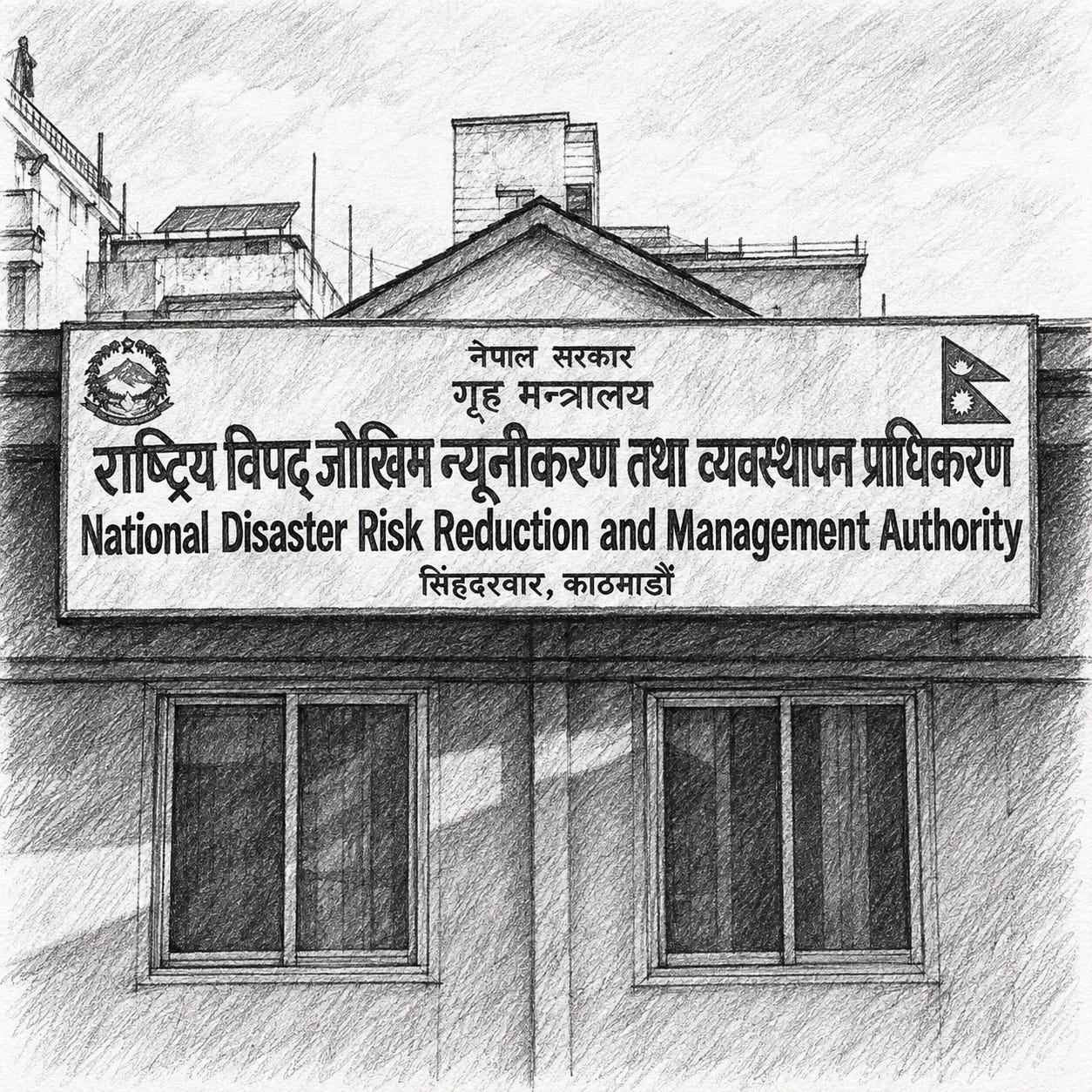
Where Things Stand
Figures from the National Disaster Risk Reduction and Management Authority as of 7pm on Thursday 17 September, unless stated:
Dead: 1,410. Of those, 549 are men, 336 are women and 525 are remains that have not been identified. Chitwan 364, Nawalparasi East 232, Nawalparasi West 222, Nuwakot 203, Rasuwa 199 (Nepal News, webindia123).
Missing: 6,145, of whom 587 are foreign nationals. On Wednesday the authority raised the figure from 5,179 to 6,150 in one step. “We have been collecting details on the missing people from the district offices and revised the data after verification,” said spokesperson Shanti Mahat. The two-definition problem we flagged last week has been resolved in the direction of the larger number (Courthouse News).
Identified: 110 bodies returned to families. DNA samples: 1,286 from the dead, 1,944 from relatives. The relatives’ samples now outnumber the bodies, which is the right way round and was not the case a fortnight ago.
The bill: the rapid damage assessment puts it at $4.7 billion, 65 percent of it infrastructure. Thirteen hydropower plants and five solar plants are out, 783 megawatts, a fifth of what the country could generate before 26 August (Nepali Times).
Housing: the cabinet has approved Rs 15,000 a month for every displaced family of up to four, plus Rs 2,000 for each additional member, until permanent homes are built. Forms have gone to ward offices. Those who would rather have a temporary shelter than cash can choose that instead (Nepal News).
Shelter: 27 holding centres remain, with 832 people in Nuwakot, 817 in Rasuwa and 94 in Dhading. An Acrow bridge is open at Devighat.
Solukhumbu: the Hunga Khola dam we reported on Friday began overtopping about three hours after it formed and the immediate danger eased, though police have kept the downstream warning in place (The Kathmandu Post).
🌍 Diaspora & Globalisation
Four Hundred Thousand Jobs, Twenty-Five Agencies
There are about 400,000 Nepalis working in Malaysia, the third-largest foreign workforce there after Bangladesh and Indonesia, and since 22 August Nepal has not cleared a single new demand letter for more. The reason is a list. On 21 August, Malaysia’s Foreign Worker Centralised Management System named 25 Nepali recruitment agencies as “principal recruitment agencies,” each allowed up to ten affiliates, and told Nepal about it a week later. Nepal’s Labour Ministry objected the next day, ordered the embassy in Kuala Lumpur to stop certifying demand letters from the chosen 25, and had the Department of Foreign Employment halt prior approvals. There are roughly 1,100 licensed agencies in Nepal. “Equal opportunity, fair competition and business rights must be guaranteed,” said Dik Bahadur Chhetri of the recruiters’ association, which is a fair point and also a self-interested one. This week the ministry escalated: spokesperson Mira Acharya said Nepal “disagrees with the way recruitment agencies have been selected” and asked Malaysia to convene the two countries’ joint technical committee and hand over the selection criteria in writing. Malaysia says the system is about transparency and worker protection. Meanwhile the first month of the fiscal year shows what is at stake. Remittances rose 21.2 percent to Rs 215 billion, but new labour approvals fell to 42,693 from 44,466, and re-entry approvals, workers going back to jobs they already had, rose 17 percent. Fewer first-timers, more returners. That is what a corridor narrowing looks like (The Kathmandu Post, The Kathmandu Post, Nepal News).
For those already there, a note. Malaysian immigration checked about 2,500 foreigners at Kotaraya in Kuala Lumpur on Sunday and detained 472, eight of them Nepali. “Hundreds of undocumented workers are being arrested daily,” said Binod Thapa, the former NRNA president in Malaysia. The voluntary Migrant Repatriation Programme, which lets an undocumented worker pay a fine of RM500 and go home without a detention record, has been extended to 31 May 2027. If you have a relative in Malaysia whose papers have lapsed, that programme is a better route out than a raid (The Kathmandu Post).
Seventy Americans, a Letter to DHS, and Tuesday’s Flight
About 70 American citizens remain unaccounted for in the flood zone, three weeks on. Eighteen who had been on the list reached safety by Monday. “The safety of Americans in the affected area remains our highest priority,” the State Department said, adding that the number could still change either way. The United States has now sent a cargo drone to the Armed Police, 5,000 victim-recovery kits, 500 first-aid kits, a four-member military civil-affairs team and FBI forensic specialists to work with Nepal Police on identification, and has put an additional $1 million into that forensic work, taking its aid past $5 million (NepYork). In Washington, Congressman Thomas Suozzi, four of whose constituents are among the missing, has written to Homeland Security Secretary Markwayne Mullin asking for a fresh Temporary Protected Status designation for Nepal “so that eligible Nepali nationals currently in the United States are not forced to return while their country confronts this disaster.” The previous TPS, granted after the 2015 earthquake, was terminated in June last year, and the Ninth Circuit upheld the termination in February. The campaign is being run by attorney Keshab Raj Seadie, whose GoFundMe we mentioned last week; Senator Schumer’s office is said to be looking at it. A letter is not a designation, and this administration has not been in a designating mood. But the request is on the record (NepYork). The Prime Minister leaves for New York on Tuesday, arrives Wednesday, meets António Guterres, is invited to President Trump’s reception that evening, speaks to the General Assembly on Thursday the 24th and is back in Kathmandu on the 26th. Foreign Minister Shisir Khanal goes ahead on Sunday. No diaspora event is on the published schedule, and the Nepali American Business and Investment Summit that was to have coincided has moved to 20 to 22 November because of the floods (Nepal News, NepYork).
In Brief: Kent, Riyadh and Pokhara.
The Freedom of Kent. On Thursday, Kent County Council voted 69 in favour with two abstentions and none against to grant the Brigade of Gurkhas the Freedom of the County, only the second time the honour has been given. The motion came from the council’s Reform UK leader Linden Kemkaran and passed with every party’s support; the 2nd Royal Gurkha Rifles are at Shorncliffe in Folkestone and the Queen’s Gurkha Engineers at Maidstone. “Kent should be really proud of providing a home for many of the Gurkhas,” said Liberal Democrat Richard Streatfeild. Three days earlier, ten veterans’ organisations had met Veterans Minister Calvin Bailey for the first time and given the government until 31 December on pension parity for those who served before 1993 and settlement rights for adult children. “I will try my best from my side,” Bailey told them (Nepal News, KentOnline, South Asia Time).
A lawyer in Saudi Arabia. Among Wednesday’s cabinet decisions: a power of attorney for a Saudi lawyer to pursue insurance and compensation claims on behalf of Nepalis killed or injured there. Families who have given up on a claim from Nepal now have somewhere to send it (OnlineKhabar).
Dubai to Pokhara, daily, from Wednesday. flydubai’s FZ1165 leaves Dubai at noon and lands at Pokhara at 6:15pm from 23 September, the first scheduled service from the UAE into the airport, with an Emirates codeshare. If your parents are in Kaski, the Kathmandu transfer just went away (flydubai).
🏛️ Politics & Governance
How Deuba Lost His Own Inner Circle
Three weeks ago we wrote that the Nepali Congress had split in two. This week it split in a way nobody had drawn on the whiteboard: down the middle of Sher Bahadur Deuba’s faction. On Sunday, Gagan Thapa’s central working committee agreed to take in all 31 members of the central committee elected under Deuba at the 14th convention, on condition they join the convention process starting this weekend, and to find room for the 111 office-bearers and members left out after the January special convention. By Wednesday, the Post counted around 40 of Deuba’s people heading for the party headquarters in Sanepa: Mahalaxmi Upadhyay Dina, Gandaki chief minister Surendra Pandey, former Bagmati chief minister Indra Bahadur Baniya and, the one that matters, Purna Bahadur Khadka, the man Deuba had made acting president, who stopped coming to faction meetings in early September and refused to lead a breakaway. “When the whole house has collapsed and turned to ashes,” said Deepak Kuikel, one of the crossers, “there is little point in arguing over which room is bigger.” Deuba’s answer, on Tuesday, was a statement telling leaders and cadres to boycott what he called an “illegal” process, and a separate convention of his own on 7 to 9 December, announced by Shashank Koirala. Shekhar Koirala has declared himself neutral. On Thursday Thapa made the appeal that tells you who holds the cards: “My respected leader and former party president Sher Bahadur Deuba, I would like to make an appeal to you. If the former party president inaugurates the convention on the day it begins, it would be a matter of honour for us.” Ward conventions run in 6,743 wards this weekend, and the 15th General Convention opens at Khula Manch on 2 October. The Supreme Court, which recognised Thapa’s convention in April and agreed in August to review that ruling, has not said when it will. The party has split before, in 1953 and 2002, and come back both times; the difference now is that it is fighting over itself from the opposition benches, facing a government with 182 seats (The Kathmandu Post, The Kathmandu Post, The Kathmandu Post, myRepublica, OnlineKhabar).
A Photograph at the Vivanta
While the Congress was subtracting, the left was thinking about adding. On Wednesday, UML secretary Sherdhan Rai posted a photograph of himself with Barshaman Pun of Pushpa Kamal Dahal’s Nepali Communist Party at the Hotel Vivanta in Lalitpur, and two weeks of quiet conversation became public. “The top leaders on both sides appear ready for unity or cooperation,” Pun said afterwards. “At the middle level, we still need to discuss how to move forward and what more needs to be done.” The options on the table run from an electoral alliance to a full merger through a joint convention, and one senior leader told OnlineKhabar that former President Bidya Devi Bhandari is being discussed as the figure who could lead a combined party in place of KP Sharma Oli. Anyone with a memory will recall the last time UML and the Maoists did this, in May 2018, when they merged into the Nepal Communist Party on the back of a near two-thirds majority and lasted three years before the Supreme Court dissolved it and the two chairmen went back to loathing each other. Between them the two parties still run five of seven provinces: UML in Koshi, Bagmati and Lumbini, the NCP in Karnali and Sudurpaschim. Oli, for his part, spent the weekend telling the Federation of Nepali Journalists that the Balen Shah government is “oppressive” and “anti-media” for cutting public-welfare advertising, which is the sort of thing you say when you are looking for allies (OnlineKhabar, Nepal News).
In Brief: Maps, rules and a Monday sitting.
“Not baggage.” Asked in the House on Tuesday by Congress MP Sita Thapaliya whether the “old baggage” he had spoken of in India meant the 2020 constitutional amendment that put Lipulekh, Kalapani and Limpiyadhura on Nepal’s map, Foreign Minister Shisir Khanal said the map “represents a shared national commitment” and “cannot be regarded as a burden under any circumstances.” It passed Parliament unanimously; he was not going to be the one to reopen it (The Kathmandu Post).
Two cabinets. Wednesday’s approved rules to digitise the government’s own decision-making, set advance tax on share gains at 3.5 percent for holdings over a year and 5 percent under, and adopted a procedure for a revolving relief fund. Friday’s moved the Department of Hydrology and Meteorology out of the Agriculture and Environment ministry and into Energy, a week after Energy Minister Biraj Bhakta Shrestha said he wants to start draining the most dangerous glacial lakes (OnlineKhabar, Nepal News).
Dates. The House sits again at 1pm on Monday 21 September. Army chief Ashok Raj Sigdel is in Beijing until Saturday for the Xiangshan Forum. And tomorrow, 19 September, is Constitution Day, the eleventh, which will be marked with a government that got there by winning under the document rather than by rewriting it (Nepal News).
💸 Economy & Development
The Road Comes Back. The Border Does Not.
At 6am on Thursday, all traffic was allowed through Krishnabhir in both directions, 18 days after the hillside took the Prithvi Highway into the Trishuli. What they are driving on is a 270-metre gravel track cut into the slope above the collapse by about fifty workers from the Malekhu-Mugling Road Project on 12- to 16-hour shifts, opened to gas tankers on trial from Sunday and to everyone else once the last gravel went down on Wednesday evening. “Krishnabhir has always been a difficult landslide zone,” said roads director-general Bijaya Jaishi. “The new track is not a long-term solution.” It gets two weeks of monitoring before blacktopping; the 12-kilometre road on the far bank between Benighat and Fisling has 1.5 kilometres left and a four-month target; a tunnel or a bypass bridge will be decided within six months. The effect was immediate: the Oil Corporation dropped the transport surcharge and a Kathmandu cylinder went from Rs 2,165 back to Rs 2,060 the same day. The Post’s editorial, published while the track was still being gravelled, made the point that will outlast it: the diversion had meant ten hours for the hundred kilometres from Hetauda, and the Army’s Kathmandu-Tarai expressway, begun in 2017, is less than half built. Then there is the other road. Forty kilometres of the Galchhi-Rasuwagadhi highway and 41 bridges are gone; the Department of Roads puts the damage at Rs 30 billion and rebuilding at Rs 50 billion, and wants a temporary track to the Chinese border before Dashain. It will not get the border. Tatopani, the other crossing, has been shut by China since 29 August on landslide grounds and traders say it will not reopen before the festivals. Everything is coming over the 4,650-metre Korala pass in Mustang instead: 641 electric vehicles and 434 containers in fifteen days, Rs 1.78 billion in customs revenue, and a queue of more than 200 vehicles at a border post with no proper customs yard, four to five days to Kathmandu against four to five hours from Tatopani. The Dashain EVs, electronics and apples are somewhere on that road (The Kathmandu Post, The Kathmandu Post, The Kathmandu Post, The Kathmandu Post, myRepublica, Nepal News).
“No Doubt”: The Case Nepal Takes to New York
The Prime Minister will stand up in the General Assembly on Thursday with a number, $4.78 billion, and, since Wednesday, with a finding. World Weather Attribution, the consortium that works out how much climate change contributed to a given disaster, published its analysis of Langtang Lirung this week. Its answer, in Friederike Otto’s words: “There is no doubt that climate change is one of the drivers.” The mechanism is what Nepali scientists have been saying for a month, now with figures. July and August were the warmest on local record, about 5°C above normal. The freezing line on the high Himalaya has been climbing roughly 100 metres a decade, exposing permafrost that had held the rock together for tens of thousands of years. Unusually heavy snow last winter added meltwater; the 2015 earthquake had probably already cracked the face. “When you combine high-elevation permafrost degradation with glacier retreat and record summer heat,” said Utrecht’s Walter Immerzeel, “the structural integrity of these mountain walls is compromised.” What came off was 116 million cubic metres, moving at up to 100 miles an hour and cresting 300 feet, five times the size of India’s Chamoli disaster of 2021. The study’s recommendations are practical and cheap by comparison: radar and satellite scans of every river corridor with infrastructure in it, rock-movement sensors, seismometers, cameras. Nepal’s own preparation for New York happened in Jomsom, where 431 local governments met on Monday and Tuesday and issued the Gharapjhong Declaration from the bank of the Kali Gandaki, asking that climate finance be called what they think it is, compensation for loss and damage, not aid. “Nepal will not only ask for assistance at international forums,” said Environment Minister Gita Chaudhary. The Loss and Damage Fund has about $350 million available against $800 million pledged, which is less than a tenth of this one flood. That is the argument. Finance Minister Swarnim Wagle is making a version of it in Delhi this weekend, where he saw Nirmala Sitharaman on Thursday and S. Jaishankar on Friday and is asking about concessional loans on the 2015 model, when India put up a billion dollars (Al Jazeera, Inside Climate News, The Kathmandu Post, The Kathmandu Post).
In Brief: The first month’s numbers, the winter’s electricity, and a new fifty.
Rs 215 billion in, prices up. The central bank’s first-month report is a mixed sheet. Remittances up 21.2 percent to Rs 215.05 billion ($1.4 billion). Exports up 61.7 percent, with shipments to China nearly quadrupling. Reserves at $25.84 billion, enough for 21.8 months of imports. But inflation has jumped to 5.96 percent from 1.68 percent a year ago, with cooking oil and ghee up 15.6 percent and transport up 13.2 percent, and the trade deficit is up a quarter. If you are sending money home this Dashain, it is buying less than it did last Dashain (Nepal News).
654 megawatts from India. New Delhi has approved exports of up to 654MW to Nepal for 18 hours a day from 13 September to the end of December, most of it on the Dhalkebar line, to cover a dry-season shortfall the Electricity Authority puts at 350 to 400MW after the flood. Some of what still works cannot get out: the destroyed Nuwakot substation has stranded 176MW. The Authority’s board has also voted Rs 50,000 immediately and half-salary for six months to the families of its 47 staff and workers still missing. “This money cannot heal such a deep wound,” said Energy Minister Shrestha, “but I hope it provides some relief” (The Kathmandu Post, The Kathmandu Post, The Kathmandu Post).
Land, and a note. Real estate transactions grew 4.74 percent last fiscal year after a contraction the year before, and the value changed hands nearly doubled to Rs 721 billion; in Kathmandu Metropolitan City the number of deals rose 156 percent. The central bank also put a new Rs 50 note into circulation on Friday, with Everest on it, a rhododendron watermark and a snow leopard, and gold went back over Rs 300,000 a tola (The Kathmandu Post, Nepal News).
⭐ Social & Cultural
Potatoes in Gre
Twenty-four days after the flood, three wards of Amachhodingmo Rural Municipality in upper Rasuwa are eating potatoes. Wards 1, 2 and 3, around Gre village, roughly 960 households, lost their suspension bridges on 26 August and have been reachable since only by the smallest helicopters, which carry fifteen sacks of rice a trip. The larger World Food Programme aircraft go to wards 4 and 5. “Only after repeated appeals did some relief reach wards 4 and 5,” said the municipality chair, Buchung Tamang. Wards 1 to 3 have had between 30 and 70 sacks each. The rice people had is gone or has rotted. “We have been surviving on potatoes in the morning, during the day and at night,” said Jandra Tamang, whose husband Tashi Wangden died in the flood. Lakpa Kami Tamang, the ward 2 chair, who lost eight members of his family: “We are now starving.” The school hostel, which housed more than 200 children, has closed because it cannot feed them, and residents have started asking to be moved down to the displacement camps, which is not a thing people say about their own village unless they mean it. Lower down, the problem is the opposite: as Bidur’s schools reopened, families who had been sleeping in classrooms were asked to leave, and the collective shelters now hold twenty or more to a room. Sabitri Tamang of Aangitar, who lost eight relatives and has one son left, remembers “a black plume of muddy water” coming from the sky. The land they were promised for resettlement has not been identified, and the cash allowance announced this week is for rent in places where there is nothing to rent. The Nepali Times counted the other losses: of more than 80 temples, shrines and ghats the Nepal Heritage Documentation Project had recorded along the river, 21 are gone entirely, the cremation ghats among them. “Heritage in this part of the world is also a method of caring for people in trauma,” said the project’s Rajan Khatiwoda. In Gre, they would settle for rice (The Kathmandu Post, The Kathmandu Post, Nepali Times).
313, a Century, and Bangladesh Next Year
It rained in Kuala Lumpur, as forecast, and it did not matter. Nepal batted first at Bayuemas Oval on Saturday and made 313 for 9, the kind of total that last week’s edition doubted this batting order had in it. Aasif Sheikh made 102 off 106 balls, eight fours and four sixes, his second one-day century; Gulsan Jha hit 52 off 38 at the end; Arjun Kumal 43 and Rohit Paudel 40 did the middle. Rahul Chopra’s unbeaten hundred kept the UAE in it until Karan KC, with three wickets, and Lalit Rajbanshi, with two, finished them for 269 in the last over. Nepal won by 44 runs, took the ACC Premier Cup for the second time, and with it the only place on offer at the 2027 Asia Cup in Bangladesh, where the full members will be waiting. Somewhere in the middle of it, captain Sandeep Lamichhane took his 300th international wicket, the first Nepali to get there, 158 in one-day cricket and 142 in T20s, and was named player of the series for the second Premier Cup running. The team landed in Kathmandu on Sunday night to a crowd at the airport and Paras Khadka, who used to do this for a living and now does it as CAN secretary: winning abroad, he said, proves the standard. Most of the same squad, with Dipendra Singh Airee as captain, is now in Japan, where the Asian Games open in Nagoya on Saturday; Nepal’s men play Afghanistan on the 25th and Japan on the 26th at Nisshin. The women’s volleyball team, at its second Games, has already lost in straight sets to Japan and Indonesia and goes into the classification round, though the 21-25 and 20-25 sets against Indonesia were closer than the scoreline (CricTracker, Gulf News, Nepal News, Radio Nepal, OnlineKhabar).
In Brief: An Oscar entry, a birth on a pavement, and a needle in Jhapa.
Elephants in the Fog goes to the Academy. Nepal’s selection committee chose Abinash Bikram Shah’s Cannes prize-winner over Gauthali as the country’s entry for Best International Feature at the 99th Academy Awards. A shortlist is a long way off; the entry is the first step Nepal has usually stumbled on. Meanwhile the Post surveyed a year of Gen Z art: Swoopna Suman’s farewell song “Yaad Haru Ma,” Neetesh Jung Kunwar’s “Speechless,” Katha Ghera’s playback theatre on 8 September, and a year-long exhibition, “के”, at Kaalo.101 in Lalitpur, open Wednesday to Sunday, 4 to 6pm, until next 8 September (Nepal News, The Kathmandu Post).
Rs 3,200. Babita Kumari Paswan, 30, arrived in labour at the government hospital in Rajbiraj at 1am. Staff asked for Rs 3,200 for tests; her husband had Rs 2,000. She gave birth to a boy on the pavement outside, over a drain, at about 4:30am. Six staff have been suspended and the Health Minister has been to the House about it. Delivery has been free in Nepal since 2009; laboratory tests are not, and that gap is where she fell (The Kathmandu Post).
Jhapa, Manaslu, Palpa. Japanese encephalitis has killed seven of 13 confirmed cases in Jhapa, and from Monday more than 500,000 people over 30 will be vaccinated at 900 centres; if your parents are there, tell them to go. On Manaslu, 466 foreign climbers hold autumn permits and the ropes are fixed to Camp 3. And the 237 inmates of Palpa prison have sent Rs 83,000 to the Prime Minister’s relief fund, earned from handicrafts, sewing and weaving (Nepal News, Nepal News).
How to Help
The verified list from three weeks ago still holds: the Prime Minister’s Disaster Relief Fund via opmcm.gov.np and nowhere else, Nepal Red Cross, and your NRNA national committee’s own channel rather than a forwarded link. This week’s additions are things to tell people rather than places to send money:
The housing allowance exists. Rs 15,000 a month per displaced family, plus Rs 2,000 per extra member, with forms at the ward office. If your relatives are in a shelter or with family in another district, make sure someone has filled one in.
If a relative worked for the Electricity Authority at any of the 13 damaged projects and is missing, the family is owed Rs 50,000 now and half-salary for six months. That covers daily-wage and contract workers, not only permanent staff.
If someone is missing: khozi.facetagr.com with a clear photograph, and a DNA sample from a close relative at a district hospital. Nepal Tourism Board hotline 1234 (toll-free in Nepal) or 1144.
Upper Rasuwa needs rice, not blankets. If your organisation is deciding what to fund, Amachhodingmo wards 1 to 3 are the most specific unmet need published this week, and the constraint is helicopter capacity. Ask the Red Cross or WFP Nepal what they can lift.
Our sponsor, belayat.uk, the UK Nepali community noticeboard, carries relief appeals and vigil notices alongside its jobs, housing and events listings. If your group is marking Constitution Day or Dashain, post it there.
Next week: Constitution Day and the Asian Games opening on Saturday, the Congress ward conventions this weekend, the Prime Minister’s speech in New York on Thursday, Indra Jatra from Wednesday, and Nepal against Afghanistan in Nisshin on Friday. We will keep the count, and we will correct anything here that turns out to be wrong.
Until next week, stay connected.
— The Nepali Diaspora Digest Team
nepalidiaspora.net
All figures in this edition are as reported by Friday 18 September 2026 and are expected to change.


