



Namaste, diaspora family. There is only one story this week, and it is the hardest one this digest has had to write.
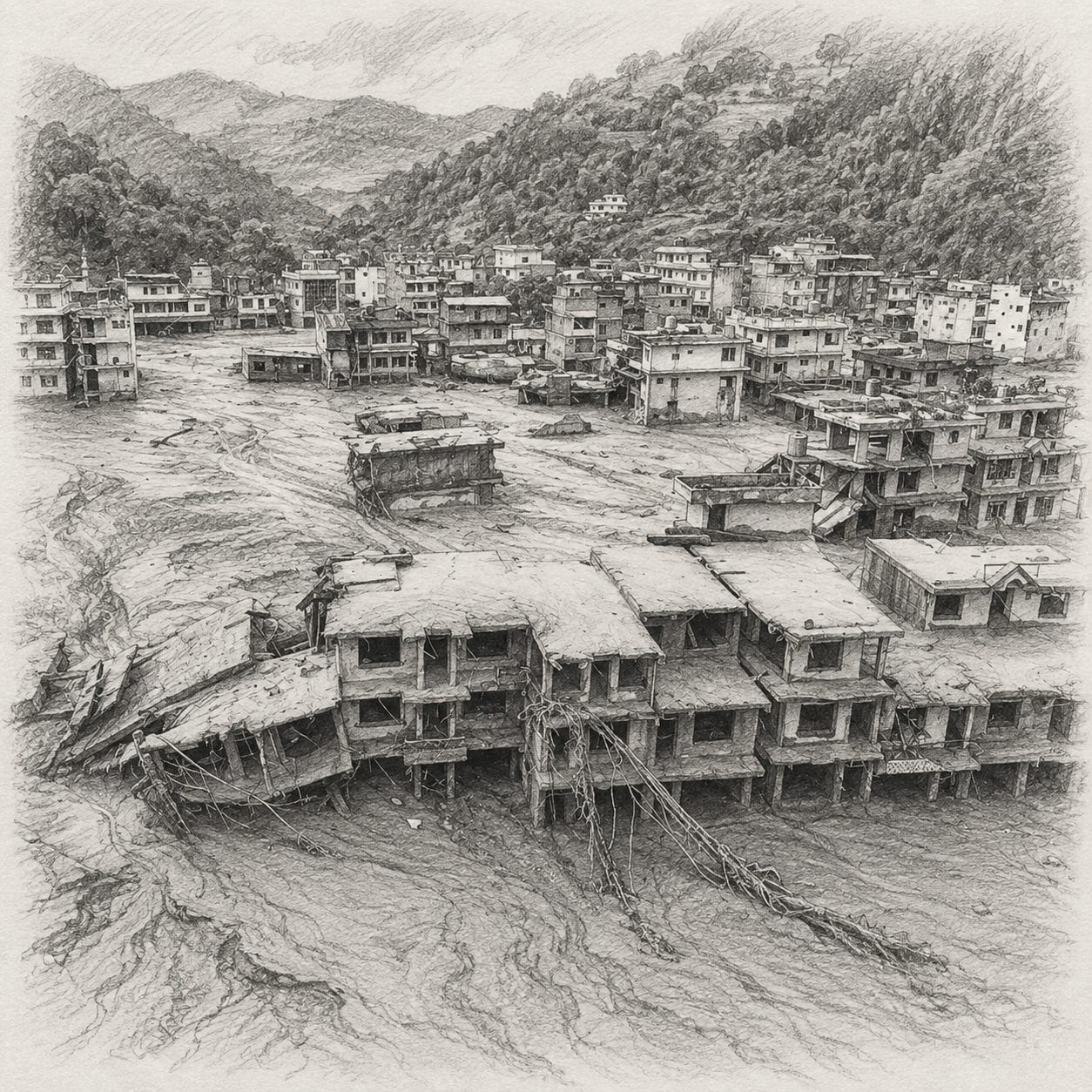
At about twenty to nine on Wednesday morning, a piece of glacier roughly six hundred metres wide came off the flank of Langtang Lirung and fell more than a kilometre onto the valley floor. What it set loose tore down the Bhotekoshi and Trishuli, took the border town of Timure off the map, and has killed more people than any single disaster in Nepal since the 2015 earthquake. Many of you have spent this week refreshing casualty lists and calling numbers that do not ring.
This edition is given over entirely to what happened, what it has cost, what we still do not know, and how to help. We have set aside everything else.
A note: this is a developing story
The figures below are still moving, and that affects how you should read them.
Search teams cannot reach much of the affected area. Bodies are being recovered up to 150 kilometres downstream, days after the event. And different agencies are counting different things, which is why totals published on the same afternoon do not match. Here is how the count has moved:
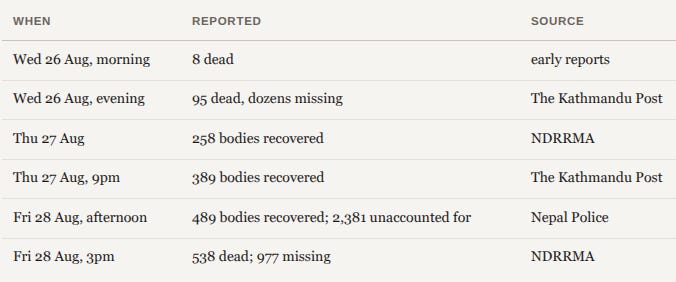
The last two rows are worth pausing on. On the same Friday afternoon, Nepal Police and the national disaster authority published counts differing by 49 dead and more than 1,400 missing. Both are internally consistent — each district breakdown adds up to its own total. They are counting differently: bodies recovered and logged by police, versus deaths confirmed through the disaster authority’s reporting chain, with “missing” defined narrowly in one system and broadly in the other.
Neither figure is wrong, and neither is final. Higher numbers are already circulating in international coverage, and the toll is likely to rise as access improves and the missing are reclassified.
We have used the NDRRMA figures as our anchor, named the agency and the time beside each number, and flagged where sources disagree. Please do the same when you share this. And please avoid circulating unverified lists of names — families are identifying relatives from photographs this week, and a wrong name travelling fast through a WhatsApp group does real harm.
🏔️ What Happened
Twelve Hundred Metres, Straight Down
The trigger was not rain. Satellite analysis indicates a section of glacier roughly 610 metres wide sheared away near Langtang Lirung and fell about 1,200 metres to the valley floor. The impact shattered the ice and mobilised rock, water and sediment into the Lhende Khola, a tributary that rises inside Tibet about 20 kilometres northeast of the Rasuwagadhi border post. The US Geological Survey has been clear that the seismic signal registered that morning, equivalent to a magnitude 5.2, was produced by the landslide itself and not by an earthquake, Nepal’s foreign minister had initially said the reverse, an early error worth remembering as more claims circulate. What arrived downstream was not a flood in any ordinary sense. Debris moved at roughly 50 metres per second, around 180 km/h. A helicopter pilot described waves of five to six metres. It reached Gyirong Port on the Chinese side seven minutes after the collapse (The Kathmandu Post, ThePrint).
The River Carried the Dead a Hundred Miles
The single most important thing to understand about this disaster is where the dying happened. Timure, Syabrubesi and the border settlements were destroyed — but only 12 bodies had been recovered in Rasuwa district itself by Friday. The rest were found far downstream, along the Trishuli and the Narayani, in districts most people would not associate with a Himalayan glacier at all. Of the 538 deaths confirmed by the disaster authority at 3pm Friday, 221 were recovered in Chitwan, 134 in Nawalparasi East, 46 in Gorkha, 37 in Nuwakot, 33 in Dhading, 28 in Tanahun and 27 in Nawalparasi West. Read that carefully: these are the places bodies were found, not where people lived or died. Most were swept from the border area and carried a hundred miles and more. Seven bodies have since been recovered from rivers in Maharajganj and Kushinagar in Uttar Pradesh, across the Indian border. It is a grim measure of the force involved, and it is why the search will run for months (The Kathmandu Post, Outlook India).
The People Who Went In
More than 9,000 security personnel were deployed in the first days, roughly 4,200 from the Nepali Army, with police deployment reported at 8,380 — though these counts moved as well, the disaster authority’s early updates putting the total at 7,415. By Friday they had rescued or assisted 1,473 people across Nuwakot, Rasuwa and Dhading, at least 351 of them lifted out by helicopter from valleys where the road had simply ceased to exist. Some of those closest to it never had the chance to respond at all: 45 Nepali Army personnel, 28 Nepal Police, 13 Armed Police Force officers, 15 customs staff and 4 immigration officers are themselves among the missing, most of them at their posts at the border complex when the wave came through. Downstream, hospital and morgue staff in Chitwan and Pokhara have been working past capacity for three days, and recovery teams are still walking the banks of the Trishuli and the Narayani, finding people a hundred miles from where they were swept in (The Kathmandu Post, The Kathmandu Post).
In Brief: The threat that has not fully passed.
The barrier lake. The avalanche dammed the river behind it, forming a lake of roughly 2 million cubic metres at the confluence of the Chhochen Khola and Purepu Tsangpo, with another 3 million expected to drain in over three days (Al Jazeera).
And here the accounts diverge. Rasuwa Chief District Officer Narendra Pariyar said on Friday that the Nepali Army had informed him the lake had breached. The government’s spokesperson, Education Minister Sasmit Pokharel, said there was no information that the dam itself had collapsed and that China had indicated no immediate major threat. Both statements were made the same day. Treat the situation as unresolved (The Kathmandu Post).
What a breach would mean. A sudden release would send “a fast-moving debris-laden flood with very little warning for downstream communities,” warns Pawan Bhattarai of Tribhuvan University — into a valley now full of rescuers, survivors camped near the water and hydropower crews in tunnels. Helicopters are staged at Dhunche for aerial reconnaissance (Al Jazeera).
🌍 Diaspora & Globalisation
Who Is Missing
Of the 977 people the disaster authority listed as missing on Friday, 517 are foreign nationals and 127 are Nepali citizens living abroad who were home visiting. Rasuwagadhi is the overland gate to Kailash Manasarovar and the road toward Gosaikunda, and late August puts pilgrims, trekkers and returning families on that route in numbers.
Nepal Tourism Board’s tally of missing tourists runs to 540 foreigners from 31 countries inside Nepal, plus around 260 more in Tibet’s Gyirong county — roughly 667 travellers in total. The reported breakdown includes 288 Indians, around 100 Chinese, 65 Americans, 53 Ukrainians, 51 to 55 Malaysians, 33 Britons, 25 Canadians and 25 to 34 Australians, with smaller numbers from Singapore, South Korea, Russia, Germany, Latvia, South Africa, Japan and New Zealand, and sixteen further countries reporting at least one. Note the ranges: the US figure was reported as 90 earlier in the week before the tourism board settled on 65, and Australia’s foreign minister gave 34 where the board lists 25. There has been better news too — 117 foreign tourists were rescued from Rasuwa, among them 85 Indians, 16 Chinese, 9 South Koreans, 2 Americans and 2 Italians. If someone you know was on that road, the Nepal Tourism Board lines are 1234 (toll-free) and 1144, and Tourist Police can be reached on +977 9851289445 (The Kathmandu Post, Reuters factbox).
Support from Abroad
Away from the rescue itself, the organised response from the diaspora moved quickly. The NRNA convened an emergency meeting and committed Rs 50 million in immediate assistance, formed a relief and rescue committee under President Dr Hemraj Sharma, and moved to deploy a medical team for primary treatment and medicines; founder president Dr Upendra Mahato pledged a specialist team of doctors with supplies. National committees in the UK, Canada, the Netherlands, Switzerland, Australia, Japan, Seychelles, Saudi Arabia, the UAE and China have all pledged funds. In Canberra, the Australia–Nepal Friendship Society held a candlelight vigil on the Parliament House lawns on Friday evening; NRNA New South Wales called one in Sydney for Saturday; and a large Nepali cultural celebration planned for September in Australia was cancelled outright, its budget redirected to relief. In the United States, the Embassy in Washington and the Consulate General in New York issued a joint appeal. Nepal’s diaspora numbers more than 2.1 million, and a good deal of the early fundraising and medical coordination this week ran through it (OnlineKhabar, The Australia Today, NepYork).
In Brief: Around the response.
Help from outside. Pledges include £5 million from the UK, $5 million each from the Asian Development Bank and South Korea’s Doosan Group, €2 million from the EU, $2 million from the UN’s emergency fund, $1 million each from South Korea and Sri Lanka, $500,000 and a disaster response adviser from the United States, and CHF 1 million from the IFRC. India has delivered more than 47 tonnes of material across two consignments; Bangladesh sent tents, dry food and body bags (UN News).
Eyes from orbit. The International Charter on Space and Major Disasters and the EU’s Copernicus system have both been activated — which is how the glacier collapse was identified as the cause so quickly (Al Jazeera).
🏛️ Politics & Governance
The Warning That Never Came
Nepal has a flash-flood warning system on this river. It did not fire. The reason is uncomfortable and worth understanding, because it determines whether this happens again. The network is built around water-level gauges designed for monsoon flooding — a river rising over hours, which is the hazard Nepal has historically faced. A glacier collapse produces a wall of debris moving at 180 km/h, and the upstream stations that might have caught it were swept away before they could send anything. Worse, the hazard did not begin in Nepal at all. It began roughly twenty kilometres inside Tibet, on a mountain no one had been asked to watch. After the July 2025 Rasuwa flood, also from the Chinese side, Nepal built a channel to exchange information about that river; it covered water, not mountains. As a Kathmandu Post column put it this week, Nepal is far better at tracking floods “once they enter monitored rivers than detecting the high-mountain hazards that create them,” and any serious cross-border system has to extend beyond weather to river blockages, glacial-lake instability, landslides and ice-rock avalanches. Xi Jinping has publicly called for improved warning systems. Whether that becomes a bilateral mechanism with instruments on it, or a sentence in a communiqué, is the question worth watching (The Kathmandu Post, Nature India).
The State’s Response, and What Parliament Wants Next
The mobilisation has been substantial. Figures here move too — the disaster authority reported 7,415 security personnel deployed in its early updates, and later counts put the total above 9,000, including some 4,200 from the Nepali Army. By Friday, 1,473 people had been rescued or assisted across Nuwakot, Rasuwa and Dhading. The government has declared the area a disaster zone for three months, ordered free medical treatment through the health ministry, the army and government hospitals, and directed the Finance Ministry to prepare a relief and rehabilitation package for affected households and businesses. Rs 10 million each has gone to Rasuwa and Nuwakot and Rs 5 million to Dhading as immediate district grants. Prime Minister Balendra Shah and his entire council of ministers are depositing a month’s salary into the Prime Minister’s Disaster Relief Fund, and Shah travelled to Nuwakot on 27 August. A Rescue Coordination Centre is running at Tribhuvan International Airport under Law Minister Sobita Gautam. In Parliament, the Prime Minister’s scheduled question hour was set aside so the House could turn to the disaster; members on both benches pressed for faster search and recovery, clear compensation, and a real cross-border early-warning mechanism rather than another committee. The response has been creditable. The preparedness that should have preceded it is what is now under scrutiny (The Kathmandu Post, OnlineKhabar).
In Brief: Context that makes this harder to file away as bad luck.
We were told. ICIMOD, headquartered in Kathmandu, published two reports in March this year warning that accelerating glacier melt across the Hindu Kush Himalaya was raising the risk of exactly this class of disaster. Glaciers in the region have lost up to 27 metres of ice thickness since 1975, and the rate of loss has doubled since 2000 (Down To Earth).
The glue is failing. “Permafrost has been the cryospheric glue that’s held the rock and the ice and the glaciers together for millennia,” says Alton C. Byers of the University of Colorado Boulder, “and now we’re getting increasing evidence that it’s being weakened by warming trends” (PBS NewsHour).
A one-sided picture. Almost everything known about the Tibetan side comes from Chinese state media, which has focused on military relief; residents’ own videos from Gyirong were removed from Chinese platforms. Around 260 travellers and 558 people in total are reported missing there — figures we cannot independently check (Al Jazeera).
💸 Economy & Development
Four Hundred and Thirty-One Megawatts, Gone
Six weeks ago this digest reported Nepal’s best year ever in electricity: Rs 29.32 billion in exports and an Rs 18.76 billion trade surplus in power. A good portion of the machinery behind that number is now under silt. The Nepal Electricity Authority counts twelve operational projects totalling 431.1 megawatts knocked out — 406.1 MW of hydropower plus a 25 MW solar plant — with Rasuwagadhi (111 MW) the worst hit, its powerhouse and substation reported destroyed, alongside Chilime, Upper Trishuli 3A, Sanjen, Trishuli, Langtang, Mailung and Devighat. Transmission took a beating too, including the Chilime 220 kV hub tower. Counting projects under construction, the damaged total reaches 901.1 MW. The Energy Ministry puts the loss at about 8 percent of national generation capacity; the NEA’s own framing is above 12 percent of a hydro fleet of roughly 3.2 gigawatts. The timing is the problem: Nepal’s run-of-river plants generate least in the dry winter months, exactly when this capacity would have mattered most. Kul Man Ghising has warned that prolonged outages at major plants put nationwide load-shedding back on the table, and the authority is reported to be weighing additional imports from India. For households at home, and for everyone abroad paying their bills, that is a consequence of this flood that will arrive in January (OnlineKhabar, myRepublica).
Rasuwagadhi Is a Riverbed, and Dashain Is Six Weeks Away
“There is no infrastructure left there; everything has been reduced to a riverbed,” says Jayant Kumar Agrawal of the Nepal Overseas Exporters and Importers Association. He is describing Nepal’s principal overland trade gate to China. Somewhere between 200 and 300 containers were destroyed or swept away, along with hundreds of container trucks and vehicles from the customs yard — including more than 700 vehicles imported specifically for Dashain and Tihar. Nepal brought Rs 45.73 billion of goods through Rasuwagadhi last fiscal year, and Rs 31.74 billion came from China in Shrawan alone. Fourteen customs officials are missing. The crossing had only partly recovered from the July 2025 flood that destroyed the border bridge, and none of Nepal’s three main China trade points were fully operational even before Wednesday. Traders are rerouting through Korala in Mustang, where daily traffic has jumped from one or two containers to eight or ten — but transport costs roughly double, prices are expected to rise around 50 percent, and the customs office there is running ten staff against eighteen sanctioned posts. The sea route via Kolkata takes six weeks. If you send money home for the festival, expect it to buy less this year (OnlineKhabar, myRepublica).
In Brief: The bill, so far — and every figure here is preliminary.
The headline number. The government’s initial estimate of infrastructure damage is Rs 200 billion, around $1.3 billion, explicitly described as preliminary with no full assessment yet completed. Businessman Binod Chaudhary has suggested the eventual cost could reach $5 billion (OnlineKhabar).
Roads and bridges. At least 22 concrete bridges and five Bailey bridges were washed away, and the Department of Roads says the entire 42-kilometre road from Betrawati to the Rasuwagadhi border has been destroyed at multiple points. Replacement Bailey bridges are already going in (OnlineKhabar).
The rebuild money. The World Bank has signalled up to Rs 25 billion in emergency assistance, the largest single commitment so far (Nepal News).
⭐ Social & Cultural
“Beautiful Timure Was Reduced to Ruins”
The people who lived through it were, for the most part, at work. Raju Budhathoki, a customs agent from Manthali in Ramechhap, was asleep in Timure when the ground moved. “I was asleep when the whole hillside suddenly started shaking as if there had been an earthquake,” he said from a hospital bed in Trishuli; he ran in the clothes he was wearing and tore his hand open on a police post fence. Prakash Gautam, another customs agent, from Gokarneshwar in Kathmandu, heard the rumble and then lost the light entirely as the market went under. He ran without knowing where. Airlifted out on Thursday morning and taken to Bidur, he said simply: “The injury does not matter. At least I survived.” Tulsi Bahadur Bhandari from Dolakha was caught in the black mud and thrown sideways into the hillside by the current — “if the current had not thrown me towards the slope, I would not be alive today.” Kapil Pakhrin watched police posts, customs offices, hotels, shops and parked vehicles go past him. One agent described bodies scattered in the water and a town that no longer existed: “beautiful Timure was reduced to ruins” (The Kathmandu Post, Nepal News).
The Quiet Crisis in Bharatpur
Because the river carried the dead so far, the hardest logistical problem of this disaster is not rescue but identification. Morgues across the affected districts hold thirty to fifty bodies between them; Pokhara’s facilities, built for 88, were already holding 93 brought in from downstream. “By the numbers, we are already above capacity,” said Kaski Chief District Officer Kuman Singh Gurung. Authorities have converted an unused institute building on Vidhyut Road in Bharatpur-10, Chitwan into a temporary facility for around 250 bodies, cooled to 2–6°C with air conditioning and dry ice; Devghat’s electric crematorium is the fallback if that fills. Remains keep for only ten to fourteen days even refrigerated, so police are photographing, fingerprinting and taking DNA samples, recording clothing, jewellery and tattoos, and circulating photographs publicly so families can compare them against missing-person reports. DNA goes to the Nepal Academy of Science and Technology and the Police Central Forensic Science Laboratory. Where no one comes forward, bodies will be buried with a tag number so they can be matched later. For families abroad, this is the practical reality: identification may take weeks, it may require a DNA sample from a relative, and free accommodation is being arranged for families travelling to Chitwan to search (The Kathmandu Post, Outlook India).
In Brief: Two last notes.
The autumn season, precisely. The Nepal Tourism Board advises postponing travel along the Galchhi–Nuwakot–Rasuwa–Syabrubesi corridor. But the geography matters: the flood came down the Bhotekoshi, while the main Langtang Valley trekking trail follows a different river, and the walking route above Syabrubesi is largely intact. The damage is on the road corridor. Langtang’s season runs October–November, which gives repair crews some weeks. The overland route to Kailash Manasarovar via Kerung is finished for this season. If you are booked, talk to your operator before cancelling — Langtang’s guides and teahouse families rebuilt once already after 2015 (operator advisories).
The programmes that were cancelled. Nepali community organisations from Sydney to Washington have called off September cultural events and redirected the money to relief. If your local society does the same, that is why (The Australia Today).
How to Help
First, a warning worth reading before you give anything. On 27 August, Nepal Police issued an alert about scams targeting flood donations. They describe fake bank accounts set up under the Prime Minister’s Disaster Relief Fund name, counterfeit QR codes copying government formats, bogus pages and groups on Facebook, WhatsApp, TikTok, Instagram and Viber, phishing calls offering to “register” people for relief in exchange for personal details, and links built to harvest one-time passwords. Their advice is simple: take account details only from the Prime Minister’s Office official website or its verified accounts, never trust a QR code or account number that arrives in a forwarded message, never share a PIN or OTP with anyone, and if a message claims a relative urgently needs money, call that person directly before sending a rupee. Suspected scams go to the Nepal Police Cyber Bureau. Fundraising fraud clusters in the first 48 to 72 hours after a disaster, which is exactly where we are (The Kathmandu Post).
With that in mind, these are the channels we were able to verify independently:
Prime Minister’s Disaster Relief Fund — the official government fund, covering rescue, treatment, relief, rehabilitation and infrastructure restoration. Bank details and QR codes are published on the Office of the Prime Minister’s own page: opmcm.gov.np. Take them from there and nowhere else.
Nepal Red Cross Society — more than 200 staff and volunteers already working in the affected districts, with a donation portal of its own. The IFRC has released emergency funding through its disaster response fund and is accepting donations too.
Direct Relief — rated A+ by CharityWatch and four stars by Charity Navigator, with 90 percent of its cash budget going to programmes and a cost of $5 to raise each $100 (EIN 95-1831116). It has a dedicated Nepal floods response (Charity Navigator).
GlobalGiving — four stars from Charity Navigator; its Nepal Flood Relief Fund passes money to vetted local partners on the ground.
Save the Children — A− from CharityWatch, four stars from Charity Navigator, and long established in Nepal.
Also accredited against all twenty BBB Standards for Charity Accountability and currently raising for Nepal: the American Red Cross, Catholic Relief Services, International Medical Corps, Oxfam America, Project HOPE, UNICEF USA and World Relief (Give.org).
NRNA — through your own national committee, using that committee’s official channels rather than a link someone forwarded you.
If you would rather check something yourself before giving, both CharityWatch and the BBB’s Give.org have published guidance specific to this disaster, and the Kathmandu Post has a running list of verified channels.
If someone you know is missing: Nepal Tourism Board on 1234 (toll-free) or 1144; Tourist Police on +977 9851289445. Contact your own foreign ministry as well — several are running dedicated casework for this event. If you are asked to provide a DNA reference sample, that is a normal part of the process described above, not a sign of bad news.


