



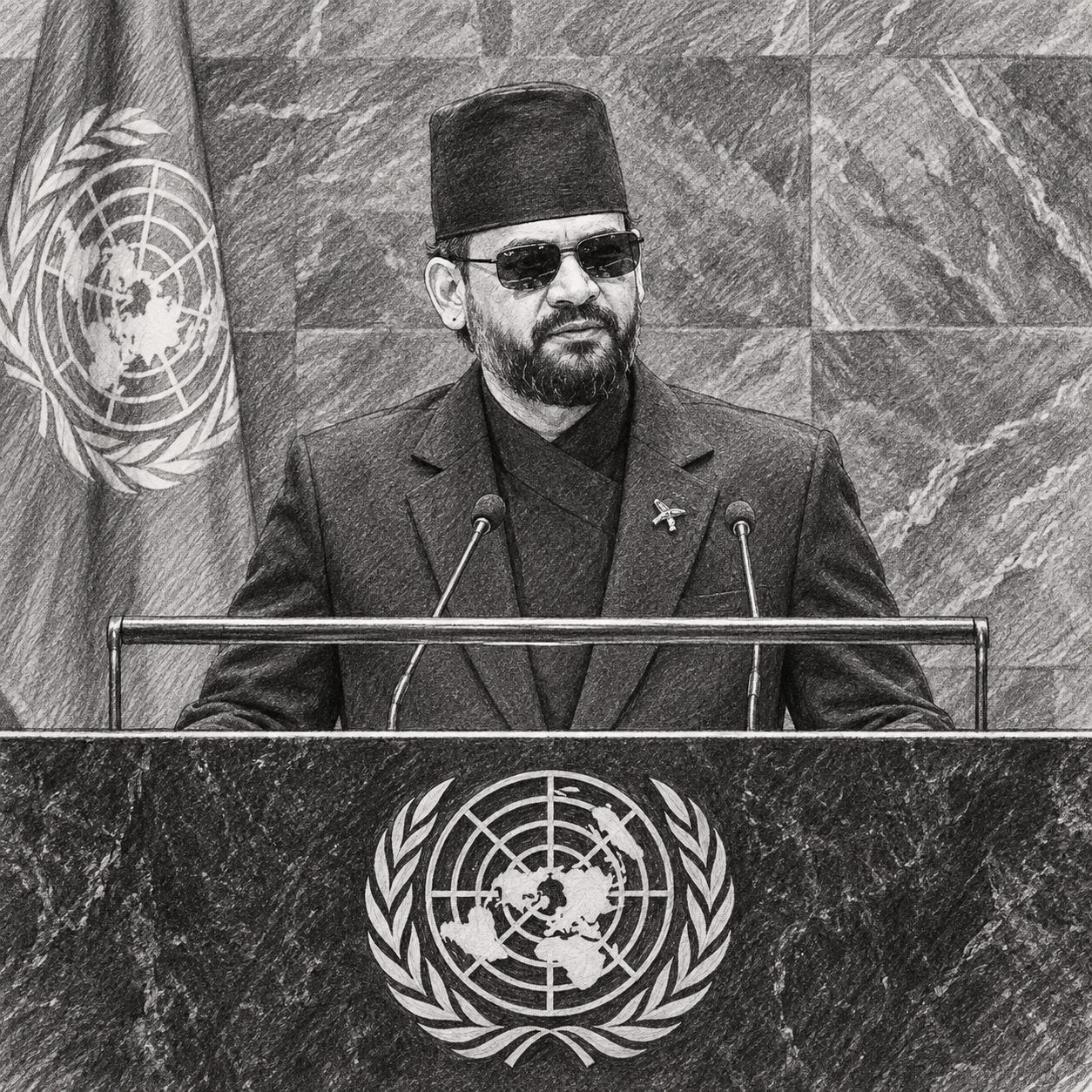
Namaste, diaspora family. A month ago the mountain came down on the Bhotekoshi. On Thursday afternoon in New York, which was the small hours of Friday at home, the Prime Minister stood at the green marble podium of the General Assembly and told the world about it. “Climate change does not recognize borders,” Balendra Shah said. “Glaciers and floods do not travel with a visa stamped on passports.” In the fourth-floor gallery, a good number of the people listening were Nepali, and they clapped.
It was the kind of week where the news kept arriving from abroad. Fifty-seven members of the US Congress asked the White House to let Nepalis stay while the country rebuilds. A Boeing from Dubai landed in Pokhara on a scheduled flight for the first time. In Aichi, Japan, a young karateka from a rented room in Boudha won Nepal’s first medal of the Asian Games, the women’s kabaddi team won a second, and on Friday morning Nepal beat Afghanistan at cricket for the first time since 2014.
At home, the missing count went down, and we explain below why that is not the good news it looks like. And as we publish, the rain has come back: flights are grounded, buses out of Kathmandu have stopped, and the Koshi barrage has all 31 gates open. We start, as we have for five weeks, with the count.
Where Things Stand
Figures from the National Disaster Risk Reduction and Management Authority as of Monday 21 September, unless stated:
Dead: 1,451. Chitwan 367, Rasuwa 236, Nawalparasi East 232, Nawalparasi West 222, Nuwakot 203, Gorkha 79, Dhading 72, Tanahu 38. By Friday, AP’s count was 1,453 (The Tribune, WTOP/AP).
Missing: 5,786, including 636 foreign nationals from 35 countries, down from 6,145 last Friday. AP put it at about 5,550 by Friday. This is not people being found alive. On Monday the authority began removing duplicate names: families had registered the same missing person in their home district and in Rasuwa or Nuwakot. Joint Secretary Balaram Niraula has told every district administration to check its list and enter only confirmed names in the Setu App. Expect the number to keep moving, in both directions (Nepal News, Ratopati).
At the dams: more than 800 workers at hydropower sites are still unaccounted for, Energy Minister Biraj Bhakta Shrestha told the House on Wednesday. At Upper Trishuli-1 alone, 439 of 1,433 workers are missing (The Kathmandu Post).
Identified: about 111 bodies returned to families. About 1,292 have been buried after DNA samples were taken, to be exhumed and handed over as matches come through. Police hold 3,283 samples (Nepal News).
Shelter: the Rs 15,000 monthly rent allowance is now being paid, and people are leaving the camps. Holding centres are down from 37 to 20, with 1,661 people: 786 in Rasuwa, 324 in Nuwakot, 121 in Dhading (Ratopati).
Land: a government committee has identified 277 plots, about 3,279 ropani (roughly 168 hectares), on which to resettle families who cannot go back: 177 plots in Rasuwa, 94 in Nuwakot, six in Dhading. The criterion is safety first, closeness to the old village second (Nepal Press).
Counting the cost properly: more than 250 officials with tablets began the full post-disaster needs assessment on Sunday. The House has set up a 15-member special committee on the flood and Himalayan climate change (Nepal News, HimalPress).
The rain, again: heavy to extremely heavy rain is forecast until Sunday. On Friday domestic flights were halted nationwide, public buses in and out of Kathmandu were stopped, all 31 gates of the Saptakoshi barrage were opened, and schools were closed in Chitwan, Butwal, Biratnagar and elsewhere. Flash-flood forecasts now run 48 hours ahead, up from 24. If your family is on the road, tell them to stop at night (Nepal News, The Kathmandu Post).
🌍 Diaspora & Globalisation
“Glaciers and Floods Do Not Travel with a Visa”
Balendra Shah had been Prime Minister for six months and had never left the country in the job. His first trip abroad was to the United Nations, and his first sentence there was this: “I come before you from Nepal, a distant country in the Himalayas, carrying a close warning for humanity.” In English, he walked the General Assembly through what he called a “Himalayan Tsunami”: at least 1,400 dead, more than 6,000 missing, recovery needs of about 10 percent of GDP, from a country that produces “less than 0.1 percent of global greenhouse-gas emissions.” “We did not create this crisis,” he said. “Yet we are paying a colossal price for it.” The asks were specific. Money should come as grants, not loans: “When the house is burning, we do not ask the family to complete fifty forms. We act.” And he proposed a Himalayan Climate Resilience Mechanism in which Nepal, India and China share satellite data, monitor glacial lakes together and join up their early warnings: “Let the Himalayas become a laboratory of international cooperation, rather than a frontier of fragmented information.” The sharpest passage was about something else: the gas and fertiliser shortages that wars elsewhere have caused at home. Nepal, he said, had been “hit by the climate we did not warm, and again hit by the wars we did not start.” Then: “We have built a world with flawless logistics for war and broken logistics for food.” He ended in Nepali, asking Pashupatinath’s blessing on the world (The Kathmandu Post).
Back home, the reviews were almost unanimous, which in Nepali politics is itself news. “The Prime Minister did not go representing any one party,” said Nepali Congress spokesperson Devraj Chalise. “He went representing the country and spoke the country’s language.” The UML’s Gokul Baskota called it “firm, meaningful, and strong,” and Baburam Bhattarai said the content was “correct!” (Ratopati). The dissent came from the analysts. In Nepal News, Binod Dhakal praised the Himalayan mechanism as genuinely new but noted that it has no secretariat, no funding formula and no sign yet that Delhi or Beijing have agreed to it. He also pointed out that the speech named no dollar figure. His verdict: “rhetoric is not a strategy and eloquence alone cannot finance a recovery” (Nepal News). Writing from New York, Ujjwal Prasai said the stronger message was solidarity rather than accusation, but “a powerful speech at the UN does not, by itself, produce a major achievement for Nepal” (OnlineKhabar). Shah’s only scheduled meeting was with António Guterres, who offered “deep sympathy,” recalled visiting Nepal as a tourist in 1978, and discussed the country’s graduation from least-developed status. Australia’s Anthony Albanese met him on the sidelines. He skipped the dinners. Foreign Minister Shisir Khanal did the rest: about forty engagements, and diplomatic relations with Grenada and Namibia, taking Nepal’s count to 187 countries. Earlier in the week, outside the building, Nepali activists had joined a climate-reparations rally. “The floods swept away our homes and lands but not our identity,” said Anisha Buda Magar of the National Indigenous Women Forum. Inside, from the fourth-floor gallery, the diaspora supplied the applause. The New York Times, for its part, wrote about his sunglasses (myRepublica, NepYork, NepYork, The Kathmandu Post, Ratopati).
Fifty-Seven Signatures and a Deadline
Two weeks ago one congressman wrote to Homeland Security asking for protection for Nepalis in the US. This week it was fifty-seven. Representatives Judy Chu, Grace Meng and Raja Krishnamoorthi led a letter to President Trump and Secretary Markwayne Mullin, co-signed by 54 colleagues including Republicans Brian Fitzpatrick and Maria Elvira Salazar, asking for Nepal to be designated for Temporary Protected Status under the environmental-disaster provision. Failing that, they ask for Deferred Enforced Departure and a pause on removals to the flood districts, with a reply by 9 October. More than 200 organisations have endorsed it, Adhikaar and the National TPS Alliance among them (NepYork, Quiver Quantitative). There is a gap in the campaign, and diaspora groups spotted it: as far as anyone has reported, Kathmandu has not formally asked. On Monday United for TPS Nepal and Asian Americans Advancing Justice Southern California wrote to Foreign Minister Khanal, who was in New York that week, urging the government to back the request. They estimate 30,000 to 50,000 people could qualify, about 25,000 of them students on F-1 visas. No reply has been reported (NepYork). Aid moved faster than immigration. After Khanal met Under Secretary of State Allison Hooker on Tuesday, Washington announced $31 million more, taking the total past $36 million: $10 million for permanent bridges, $8 million for shelter, water and winter supplies, and $13 million for US-made drones. “After I pressed officials before the Appropriations Committee, $36 million in aid and rescue support is finally being delivered,” said Meng, who says the first offer was one adviser and $500,000 (The Kathmandu Post, NepYork). The State Department’s version is that Nepal at first said it did not need much help. “Initially, the government of Nepal informed us that they believed that their own capacity was enough,” said spokesman Tommy Pigott. “We did see that change.” About 70 Americans are still unaccounted for (NepYork). The TPS that followed the 2015 earthquake ended last year, and this administration has not been generous with new designations. But a bipartisan letter with a date on it is harder to ignore than a single one.
In Brief: Kuala Lumpur, the Gulf, and the ballot box.
“We do not like syndicates.” On Tuesday, Shah spoke by phone with Malaysia’s Anwar Ibrahim about the 25-agency recruitment list that has frozen new hiring from Nepal, where the Nepali workforce is already about 400,000 strong. “We do not like syndicates and the middleman system, and this is not acceptable under any circumstances,” Shah said. Anwar promised to “immediately instruct our labour minister.” By Thursday, Malaysia’s R. Ramanan and Nepal’s Ramji Yadav had agreed on a recruitment system that would “close off any room for exploitation and abuse,” and the two countries’ human rights commissions had renewed their migrant-rights pact. The list and Nepal’s freeze are both still in place (The Kathmandu Post, The Star, The Kathmandu Post).
60,042. That is how many labour permits were issued in the fiscal year’s second month, 68 percent of them for the Gulf, with the UAE alone taking 18,477. Dhanusha sent the most people and Manang the fewest. myRepublica’s editorial read the figures against the government’s promise to keep young people at home: “The permit data show how far that promise remains from everyday reality” (myRepublica).
On the ballot. Four Nepali Americans are running for state legislatures in November: Delegate Harry Bhandari and newcomer Satish Chapagain in Maryland, Bishwa Bahadur Shah in New Hampshire, and Assemblymember Sarahana Shrestha in New York. In Jackson Heights, Governor Kathy Hochul visited Cafe Catmandoo and Kasthamandap and heard about relatives missing in the flood and neighbours afraid to go to court. “No one should ever be afraid of walking in that door and fearing that someone from ICE is going to wait when they walk outside,” she said (NepYork, NepYork).
🏛️ Politics & Governance
Six Thousand Wards, Two Conventions
Last weekend the Nepali Congress held the first round of its 15th General Convention, and more than 6,000 wards showed up. The central election committee counts ward conventions completed in 6,132 wards across 73 districts over Saturday and Sunday. They brought 43,353 women onto ward committees and 10,270 people under thirty, and at least 6,743 Dalit representatives. Party president Gagan Thapa got himself elected a regional representative from Ward 30 of Kathmandu, like any other member. “This time, a small group, including the former president, is outside the process,” said General Secretary Gururaj Ghimire. “Given those difficulties, the turnout and enthusiasm are encouraging” (The Kathmandu Post). The former president is Sher Bahadur Deuba, and his small group is building a party of its own. This week it named central representatives in 76 of 77 districts, coordinated by Shashank Koirala, for a rival convention with ward rounds from 1 October and a central session on 7 to 9 December (OnlineKhabar). Purna Bahadur Khadka, once Deuba’s acting president, put it most bluntly on Sunday: “If no miracle happens, the party’s split is certain. Even so, we are making a final effort to prevent it.” He wants the Supreme Court to hurry up with its review of the April ruling that recognised Thapa’s January special convention, and he says his side will accept whatever it decides. (A correction: last week we counted Khadka among the Deuba loyalists crossing to Thapa. He is in fact boycotting Thapa’s convention, which he calls unconstitutional.) (Nepal News). Shekhar Koirala is telling his people to stay away from both. The rain has now got involved: constituency conventions due on Saturday may slip by three days, and Surkhet and Kailali have postponed. Spokesperson Devraj Chalise says the inauguration at Khula Manch on 2 October will happen “at any cost” (Ratopati, Peoples’ Review). Deuba’s side says the whole process is illegal until the court rules. Thapa’s side says the court has already ruled. Both are, for now, correct about something.
Oli Stays, Bhandari Returns
The UML also spent the week deciding what to do about its leader, and decided to keep him. On Sunday the party’s election-review task force, which had been expected to ask KP Sharma Oli to take responsibility for March’s defeat, dropped its demand for his resignation. Member Damodar Bhandari said they still thought he was responsible; they just weren’t going to force him out (OnlineKhabar). Then came four days of central committee meetings at Rambagh Mahal in Lalitpur, mobile phones banned. Oli presented a political report that said “party reorganisation is not a matter of desire or impulse,” and on Thursday it passed unanimously. The push for change had come from Vice-Chair Bishnu Paudel and General Secretary Shankar Pokhrel, both former loyalists, and the party’s own statute makes it very hard to remove a chair between conventions (The Kathmandu Post). What the meeting produced instead was a promotion. Former President Bidya Devi Bhandari, whose name was floated as a unity figure in last week’s edition, was made “senior leader,” second in the hierarchy, and 33 new central committee members were nominated, 13 of them from other parties. Deputy General Secretary Yogesh Bhattarai tabled a proposal that Oli step down, and it was deferred to “future meetings.” “If Oli gives space to Bidya gradually in the party and moves forward, it may not be polarized,” said analyst Jhalak Subedi. The party also condemned what it called “political retaliation” against its leaders, criticised the government’s flood response and promised protests after Dashain and Tihar (Ratopati, Nepal News). Oli’s week included one more thing. Leaving the Chyasal meeting on Sunday, he told reporters that the “standard convention in journalism worldwide is to first ask whether a question can be posed.” Few reporters anywhere would recognise the convention (OnlineKhabar).
In Brief: A piece of paper, thirteen envoys and a habeas corpus.
“A piece of paper.” The Constitution turned eleven on Saturday. “However good a constitution may be, it becomes a piece of paper if those entrusted with implementing it are not honest and continuously active,” said Prime Minister Shah. President Ramchandra Paudel asked for “a political culture that respects dissent, learns from criticism and makes the state accountable to citizens.” The leaders split along a familiar line: Rabi Lamichhane and Gagan Thapa are open to amendments, and Baburam Bhattarai warned against amending “in anger or haste” (The Kathmandu Post, The Kathmandu Post).
Thirteen from 4,400. In Nepal’s first open competition for ambassadorships, the cabinet picked 13 envoys from more than 4,400 applicants, among them posts in the UK, the US, Japan, Malaysia, South Korea, Saudi Arabia and Oman, which are most of the places this newsletter’s readers live. Chiran Jung Thapa goes to Washington and Nishchal Nath Pandey to Delhi. The RPP’s Gyanendra Shahi says six of the nominees break the government’s own rules against recent foreign-funded employment. They now face parliamentary hearings (The Kathmandu Post, Nepal News).
Courts and bills. The Supreme Court ordered the release of analyst Bharat Dahal, arrested under the Electronic Transactions Act for claiming the Gen Z movement was foreign-backed. His comments, the justices said, were “a peaceful exercise of the right to freedom of thought and expression.” The House passed the Free Legal Aid and National Service Corps bills. And the families of those killed or critically injured in last September’s protests will get free education up to bachelor’s level (OnlineKhabar, Nepal News, OnlineKhabar).
💸 Economy & Development
Dubai Lands in Pokhara
At 6:18pm on Wednesday, a flydubai Boeing 737 MAX 8 landed, taxied through a water-cannon arch and became the first scheduled international passenger flight Pokhara International Airport has ever received. The airport opened on 1 January 2023, cost $216 million in China Exim Bank loans, and has spent almost three years being called a white elephant. More than a hundred passengers got off the first flight, among them workers home from the Gulf, and about 150 got on for the return. On the second day it was 135 in and 146 out. “Flying directly to Pokhara was far more convenient than first landing in Kathmandu and then travelling overland,” said Sita Gharti of Myagdi, home after ten years in Dubai. The government made it worth flydubai’s while. Landing, parking, navigation, passenger-service and tourism fees are all waived until September 2028, ground handling is half price, and jet fuel costs about a quarter less than in Kathmandu. Fares from Pokhara are Rs 3,000 to 7,000 cheaper than from the capital on major routes, and an Emirates codeshare connects on to more than 250 cities. Around fifty hotels are giving passengers 25 percent off for three months. “If we make this successful, we are confident that other airlines will also start services,” said Mukesh Dangol, director general of the Civil Aviation Authority (The Kathmandu Post, The Kathmandu Post, Nepal News). The Post’s editorial was cautious. Pokhara’s last international route, Himalaya Airlines to Lhasa, was suspended in March 2025. And a first-time migrant worker still has to go to Kathmandu for the medical and the paperwork, at which point “they find it feasible to fly from the capital.” The service is approved to 24 October for now. If your family is in Kaski, Syangja, Parbat or Myagdi, this is the route home, and every full flight makes the next one more likely (The Kathmandu Post).
Grants, Not Loans: Who Pays for the Flood
The Prime Minister’s line in New York was about money as much as climate: “When a climate-driven disaster destroys infrastructure of a poor country, the answer cannot simply be another mega loan or a patchwork of small grants” (Business Recorder/Reuters). This week showed what he is up against. The World Bank made up to $170 million available in emergency financing (Business Recorder/Reuters). The Asian Development Bank cut its growth forecast for this fiscal year to 4.1 percent from 4.5, “largely because of the August 26 floods,” raised its inflation forecast to 5.3 percent and now expects a fiscal deficit of 4.7 percent of GDP, up from 3.4 (The Kathmandu Post). Unlike after the 2015 earthquake, there will be no donor conference. The Finance Ministry will negotiate one lender at a time for a bill of $4.7 to $5 billion over three to five years (The Kathmandu Post). Swarnim Wagle came back from Delhi without an Indian package. Nirmala Sitharaman told him India would decide once the needs assessment is done, which is four or five weeks away. He goes to the Asian Infrastructure Investment Bank in Doha on 28 and 29 September and then to Washington, and he wants to talk about “debt-for-recovery swaps” (The Kathmandu Post, Peoples’ Review). The fund the Prime Minister criticised at the UN is the one Carbon Brief looked at. Nepal has asked the UN Loss and Damage Fund for $20 million, which is 0.7 percent of the damage and losses. The fund has 176 applications worth $2.8 billion against $822 million pledged, has paid nothing out, and next meets in December. Spent on reconstruction, said Nepal’s negotiator Raju Pandit Chhetri, it would be “a peanut” (Carbon Brief). One more number explains why the government is allergic to new loans. In the first two months of the year it spent Rs 85 billion servicing debt and Rs 7.66 billion on capital projects. Public debt stands at Rs 2.97 trillion, about 45 percent of GDP (myRepublica).
In Brief: A hacked exchange, a closed border and a warm winter promise.
NEPSE goes dark. The stock exchange stopped trading on Monday after ransomware hit Data Hub, the data centre used by 72 brokers. It is the third technical failure this year, after two false crashes in February and July. The securities board wants a report by 28 September. “Investors and brokers are always the ones who suffer,” said Narendra Raj Sijapati, a former head of the brokers’ association. Separately, the central bank cut the minimum period banks must hold shares they buy to 45 days (The Kathmandu Post, Nepal News).
The northern border. On Friday, Infrastructure Minister Sunil Lamsal asked Chinese Ambassador Zhang Maoming for help rebuilding the road to Rasuwagadhi; he says about 600,000 Nepalis depend on the northern crossings. China is “ready to provide all possible support” if Nepal submits a specific proposal. Tatopani has been shut for nearly two months, and the customs chief says China “had not yet provided a clear response.” Meanwhile Korala in Mustang has now cleared 1,090 electric vehicles, up from 641 last week (Khabarhub, Peoples’ Review, Nepal News).
Power, a loan and gold. The Electricity Authority promises “no load-shedding this winter,” and the 40MW Rahughat plant in Myagdi joined the grid on Friday. Whether VAT on electricity will be scrapped is unclear: the energy minister says it is being discussed, and the finance minister’s office calls reports of a deal “baseless.” For readers abroad, Prabhu Bank has launched a diaspora home loan of up to Rs 30 million over 25 years. Gold fell back below Rs 300,000 a tola, to Rs 298,600 on Friday (The Kathmandu Post, The Kathmandu Post, Nepal News).
⭐ Social & Cultural
Nisshin Feels Like Home
Afghanistan beat Nepal by eight runs in the 2014 Asian Games quarter-final, and Nepal had not beaten them at T20 since the World Cup in Bangladesh that same year. On Friday morning at Korogi Sports Park in Nisshin, Nepal won with room to spare. Kushal Bhurtel, who opens the batting and bowls a bit of spin when asked, took 4 for 21; Lalit Rajbanshi took the top three in the powerplay and finished with 3 for 13; Afghanistan finished on 102 for 7. Nepal lost Bhurtel for a duck and Aasif Sheikh for two, and then Sundeep Jora (34 off 35, three sixes) and Rohit Paudel (33 not out) steadied it. Gulsan Jha hit the winning run with 16 balls to spare. Nepal moved up to 14th in the T20 rankings. The stands were full of Nepalis from across Japan, and the players went round afterwards to wave and applaud them. If Nepal beat Japan on Saturday at 9am local time (5:45am in Kathmandu, 1am in London), they should be into the quarter-finals (The Kathmandu Post, Nepal News, Free Press Journal). The medals had already started. On Wednesday in Toyohashi, Tenzing Sherpa, 23, won bronze in the men’s +84kg kumite, beating Laos’s Xayasan Vatthana 9-1. It was the only medal from Nepal’s eight karatekas. He grew up in a rented room in Boudha with a single mother, Nir Kumari Shrestha Sherpa, who worked several jobs; his two sisters work in Dubai. She found out from his coach’s phone call, because she could not get the stream. “I have no guilt for the sacrifices I made,” she said, “because my children are giving me great reasons to be happy” (The Kathmandu Post). On Thursday, Manamati Bista’s women’s kabaddi team beat Sri Lanka 34-24 to guarantee a medal, then lost the semi-final to India, as they did in Hangzhou, and took a second bronze (Nepal News). There were disappointments. Erika Gurung, the silver medallist in Hangzhou and the team’s best hope of a first-ever gold, lost her bronze bout 8-7. The contingent is 135, about half of last time. At the opening ceremony a week ago, though, when the Nepali team walked in wearing black jackets, the Japanese crowd cheered them loudly, in solidarity after the flood (Asia News Network).
The Children of Rasuwa
Rasuwa’s private schools have published a count of their own. Thirty-eight students are missing: 19 from Gosaikunda Boarding School, ten from Modern Trinity and nine from Highland Residential. Modern Trinity’s founding principal, Suroj Dangol, is missing with them. And 201 parents are out of contact, and about two hundred children in these schools now have a mother, a father or both on the missing list: 46 at Gosaikunda, 42 at Highland, 41 at Namuna Evergreen, 33 at Modern Trinity. Five of the district’s seven private schools have reopened, and the children with no one to go home to are living in the hostels, where the schools have arranged food and free tuition (Nepal News). The government’s damage assessment is worse: 285 students unaccounted for in Rasuwa, and 224 students and eleven teachers in Nuwakot. Twelve schools are gone entirely. Neelkantha Secondary in Rasuwa now houses 80 flood-hit students, with counsellors. “Students have started staying in hostels and continuing their studies,” said Durga Silwal, the district’s education chief (OnlineKhabar). UNICEF says more than 14,000 children have had their schooling disrupted, and 48 temporary learning centres have brought 1,400 of them back into a classroom. “Returning to learning provides children with a sense of stability, routine and hope,” said its representative, Alice Akunga (UNICEF). For the adults, the problem is still getting across the river. With the bridges gone, people in Nuwakot and upper Rasuwa cross the Trishuli in a tuin, a basket slung from a steel cable, and wait their turn to haul the rope. Gokarna Adhikari waited five hours to take his father’s heart medicine across (The Kathmandu Post). One piece of good news to end on. Kabir Maharjan, who spent ten days trapped in the Upper Trishuli 3A tunnel before he was pulled out alive, was discharged from hospital on Friday and went home to Lalitpur, where the neighbours garlanded him (OnlineKhabar).
In Brief: A chariot in the rain, a mountain closed, and a premiere in London.
Indra Jatra, and Dashain’s dates. The lingo pole went up at Hanuman Dhoka on Wednesday, hundreds of small girls were worshipped as Kumari in Basantapur on Thursday, and on Friday the Kumari’s chariot was pulled through old Kathmandu as the rain threatened, with the President watching. Locals played the traditional Muali music for the first time in about twenty-five years. Dashain is late this year: the calendars put Ghatasthapana on 11 October and Tika on 21 October. Bus bookings will open only after the transport department has assessed the roads and the weather (WTOP/AP, Rising Nepal, Khabarhub).
Manaslu closes. On Saturday night, an avalanche buried the Camp 3 tent of Indian-German climber Dhruba Jyoti Guha and his guide, Phursemba Sherpa of the Makalu region, under two metres of snow. That makes four deaths this season. After two weeks of snow, the big operators cancelled the season on Tuesday, with 493 climbers holding permits. “In the mountains, nature always has the final word,” said Chhang Dawa Sherpa of Seven Summit Treks (The Himalayan Times, Explorersweb).
Screens and needles. UK readers: Elephants in the Fog, Nepal’s Oscar entry, has its UK premiere at the BFI London Film Festival on 17 October (Vue West End, 12:30pm) and 18 October (BFI Southbank, 6:40pm), and tickets are on sale now. In Trento, Rasuwa-born filmmaker Avash Rijal’s The Witness of Yara won best short documentary, and he dedicated it to the flood’s dead. In Jhapa, 21,746 people had the Japanese encephalitis jab on the first day of the campaign; none of the seven people the disease has killed there had been vaccinated (The Future of the Force, The Kathmandu Post, Radio Nepal).
How to Help
The verified list from four weeks ago still holds: the Prime Minister’s Disaster Relief Fund via opmcm.gov.np and nowhere else, Nepal Red Cross, and your NRNA national committee’s own channel rather than a forwarded link. This week’s additions:
Ask where the money went. The Prime Minister’s relief funds held Rs 15.53 billion by Thursday, including $25.4 million in foreign currency, much of it from you. About Rs 1 billion has been released. If your association gave, it is a fair question to ask what it paid for (Nepal News).
The allowance has a gap. The Rs 15,000 rent allowance goes to families who owned a home. People who rented a shop or a room get nothing, and more than 2,000 small traders were hit in Nuwakot alone. Januka Mijar sold madals in Bidur for 22 years: “Everything I had built over 22 years was washed away.” A small grant to a named trader through a group you trust goes a long way (The Kathmandu Post).
The orphaned students. PABSON Rasuwa is coordinating free schooling and hostel places for the 200-plus children whose parents are missing. Shesh Ghale’s MIT Foundation has pledged Rs 578.5 million for children orphaned by the flood. If your organisation wants to fund something specific, a hostel year is specific.
In the US: the TPS letter asks for a reply by 9 October. If you are a constituent of one of the 57 signatories, thank them; if your representative did not sign, ask why. Advice on eligibility: Adhikaar.
If someone is missing: khozi.facetagr.com with a clear photograph, and a DNA sample from a close relative at a district hospital. District offices are now merging duplicate entries; if you registered the same person in two places, it is worth telling the district administration office.
Our sponsor, belayat.uk, the UK Nepali community noticeboard, carries jobs, housing and events alongside relief appeals. If your group is organising a Dashain gathering or a trip to the Elephants in the Fog screening in October, post it there.
Next week: Nepal against Japan in Nisshin on Saturday morning, and a cricket quarter-final if that goes our way. The rain warning until Sunday. The stock exchange’s report on the 28th and Parliament back the same day. Wagle in Doha on the 28th and 29th. The Nepali Congress convention opening at Khula Manch on Friday 2 October, with or without Sher Bahadur Deuba. We will keep the count, and we will correct anything here that turns out to be wrong.
Until next week, stay connected.
— The Nepali Diaspora Digest Team
nepalidiaspora.net
All figures in this edition are as reported by Friday 25 September 2026 and are expected to change.


