



Namaste, diaspora family. This is the second week of the Bhotekoshi disaster, and the digest is still given over mostly to it.
The count passed a thousand on Tuesday. By Thursday noon the national disaster authority had recorded 1,252 dead, and only 95 of those bodies had been identified and returned to a family. On Friday morning, nine days after the water came, soldiers dug through the last of the debris blocking a hydropower tunnel in Nuwakot and brought two men out alive. About 115 of their colleagues are still inside.
This edition covers the search, the graves, a Parliament that turned on the government, a foreign minister who said “compensation” on Monday and stepped back from it on Friday, the first relief package for businesses, and the people carrying all of this: an 83-year-old priest in Rasuwa, a valley cut off for the second time in eleven years, and Nepalis from Leicester to Seoul who cancelled Teej and sent the money home instead.
We have also let a small number of non-flood items back in as briefs, where they matter to readers abroad. Everything else waits.
Where the Count Stands
The figures are still moving, and different bodies are still counting differently. This is how the week ran:
Sunday 30 August, 3pm: 788 bodies recovered; 2,502 missing (NDRRMA, via The Tribune)
Monday 31 August: 903 dead; 4,247 unaccounted for (NDRRMA, via The Kathmandu Post)
Tuesday 1 September: 1,003 dead; 3,916 missing (ABC News)
Wednesday 2 September: 1,204 dead; 1,114 bodies recovered (The Tribune; the Prime Minister to Parliament)
Thursday 3 September, noon: 1,252 dead; 4,216 unaccounted for; 95 identified (NDRRMA, via The Kathmandu Post)
Friday 4 September: 1,259 dead (ANI, via The Tribune)
The “missing” figure is the one to treat with most care. The Prime Minister told Parliament on Wednesday that 3,916 people were out of contact. The disaster authority’s wider count, which includes everyone reported unreachable by a relative, has gone above 5,000. Both are honest numbers describing different things. Chitwan, more than a hundred kilometres downstream, still holds the largest share of the dead: 355 by Thursday. On the Tibetan side, Chinese authorities report 21 dead and 541 missing, figures we cannot check (The Kathmandu Post).
🏔️ The Search
Nine Days Underground
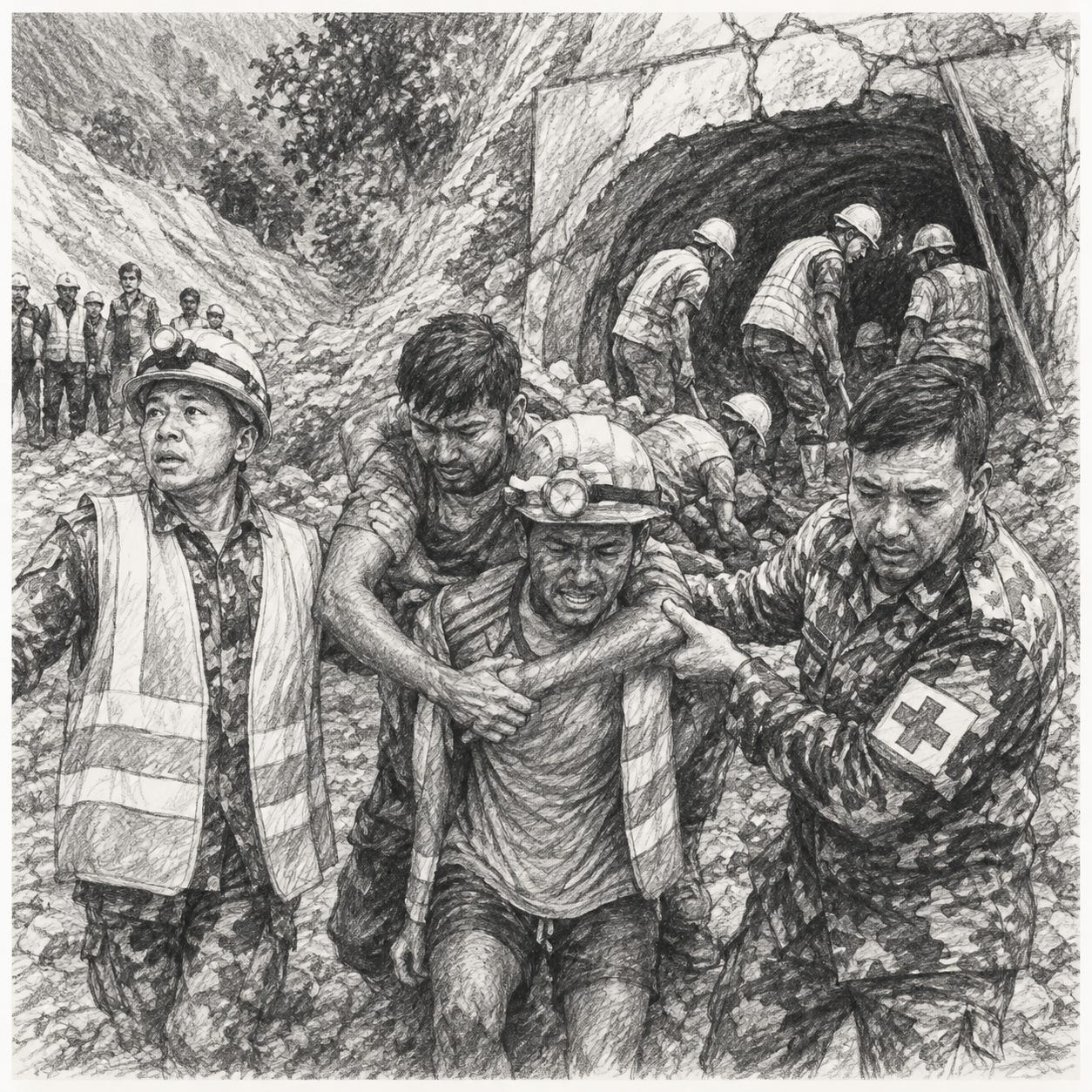
At about 7:30 on the morning of 26 August, Kabir Maharjan rang his wife from the Trishuli 3A hydropower project, where he had worked for seven years. An hour later the flood arrived. Down in the control room, Sanjay Sah, a 30-year-old mechanical foreman from Saptari, did what his job required. “I told everyone to run,” he said afterwards. “In doing that, my time was lost. In the end, I could not get out.” On Friday morning, after Nepali Army and Armed Police teams had dug through 50 to 60 metres of boulders and mud, both men walked out of the tunnel and were flown to Kathmandu in stable condition. “He has returned with a second life,” Hira Shobha Maharjan said. “We could neither eat nor sleep.” Sah believes three or four people near him may still be alive, with others deeper toward the powerhouse. Arnold Dix, the Australian tunnel engineer who led the Silkyara rescue in 2023 and is now advising in Nuwakot, has spent the week insisting that “silence is not evidence of death. It is only the absence of a signal.” About 115 workers are still thought to be in Trishuli 3A’s main tunnel, and roughly 500 across twelve projects. At Upper Trishuli 1, the largest construction site on the river, 557 of 1,433 people on site are still unaccounted for (Euronews, The Kathmandu Post).
Graves With Numbers
The hardest arithmetic of this disaster is now identification. Of the 1,252 bodies recovered by Thursday, 95 had been matched to a name and given back. Nepal Police say around 400 are partial remains. The river carried people so far, and the monsoon heat is so unforgiving, that morgues in Chitwan filled within days. So the state has begun burying the unidentified in forest trenches outside Bharatpur under Red Cross protocols: each body in its own place, a tag fixed to a remaining limb, a sequential code beginning BHF-01, a concrete marker, a GPS fix, a photograph and a video record. A DNA sample is taken from every one before burial. Families of the missing can give their own sample at any district hospital, and if it matches, the body can be recovered and returned for proper rites. A 19-member Indian forensic team has been working alongside Nepal Police since Monday. Some families have objected that burial is not the Hindu way; others have performed cremation rites over kusha-grass effigies while they wait. Writing in the Kathmandu Post, geneticist Dibesh Karmacharya argued that this is the moment to build a single coordinated identification system, combining DNA with fingerprints, dental records and belongings, rather than improvising district by district (The Tribune, The Kathmandu Post).
In Brief: Three things the search has taught us this week.
The satellites saw it coming. Geophysicist Manoochehr Shirzaei of Virginia Tech ran European Sentinel-1 radar data from 8 January to 18 August through the slope above Lhende Khola. The glacier and the rock beneath it were creeping at around 10 millimetres a month, and speeding up. “The acceleration is more important than the velocity,” he said. Nobody was watching that slope, because Himalayan warning systems are built for lakes bursting, not for mountains letting go (Gizmodo, ABC Australia).
The risk has not passed. Rain is continuing in the upper catchments and the Department of Hydrology and Meteorology kept the Bhotekoshi and Trishuli at high flash-flood risk on Thursday, with moderate risk on smaller rivers in 32 districts. The barrier lake that worried everyone last week drained slowly and was largely empty by 30 August (The Kathmandu Post).
Six hundred children. Education officials in Rasuwa count 280 students unaccounted for; Nuwakot counts 300 to 350. Twelve schools are gone entirely, 22 teachers and staff are missing, and in one ward of Amachhodingmo 58 parents are. “In some cases we have located surviving parents who cannot find their children,” said Bidur’s school inspector Navaraj Sapkota, “and in other instances surviving students are searching for missing parents” (The Kathmandu Post).
🌍 Diaspora & Globalisation
Still Missing, and Coming Home
Around 590 foreign nationals from more than thirty countries remained unaccounted for as of Wednesday, most of them last known to be in Rasuwa on the Gosaikunda and Kailash routes; a further 300 have been rescued, 273 of them by Army helicopter. The American figure, which the State Department put at 90 last week, had come down to about 75 by Tuesday, with 14 confirmed safe and no confirmed American deaths. Thirty-three Latvians, 33 Britons, 38 Australians and 32 Canadians are still on the lists. On the Tibetan side, some 2,500 Kailash pilgrims have been flown out through Lhasa. The week’s quiet good news came at Tatopani on Thursday, when Chinese officials handed 114 Nepalis who had been stranded in Gyirong back across the border at Liping, most of them from Rasuwa, and three buses took them to Kathmandu and on to whatever is left of home. Another 33 are expected to follow. If your relative is among the missing, the Nepal Tourism Board hotline remains 1234 (toll-free in Nepal) or 1144, and your own foreign ministry is running casework (The Kathmandu Post, ABC News, The Tribune).
What the Diaspora Did in Week Two
The first week was vigils. The second has been money, and organisation. In Britain, Tamu Dhin UK has pledged more than Rs 10 million, part of it from a charity trail walk on 11 to 13 September; the Nepalese Doctors’ Association UK gave Rs 1.1 million, IME London gave Rs 1 million and waived fees on relief transfers, and Bexley Nepali Samaj raised £6,500 at a single vigil. The two rival NRNA UK committees are each raising separately, one of them describing its role as “watchdog” over the other’s money, which tells you something about the state of that organisation. In South Korea, about 60 Nepali groups are collecting; twenty migrant workers from Sudurpashchim pooled 920,000 won between them, and NRNA Korea is setting up a memorial space near Dongdaemun. “Those of us earning money abroad should help our homeland when it is going through such hardship,” one of them said. In Canada, Teej celebrations in Toronto, Brampton and Calgary were called off, and the Nepali Canadian Women’s Society of BC turned $15,000 of ticket sales into relief. Canberra cancelled its 400-person Teej on 6 September. And inside Nepal, schoolchildren in Achham, Kapilvastu, Rautahat and Kathmandu gave up their snack money, a few hundred rupees at a time (OnlineKhabar, The Korea Times, CP24, The Kathmandu Post).
In Brief: Practical notes for readers abroad.
Where the money goes now. After a week of criticism, relief distribution in Rasuwa and Nuwakot was handed on 1 September from the security forces to local governments, working through six-party committees. The Prime Minister’s Disaster Relief Fund stood at about Rs 7.77 billion on Wednesday. The police warning about fake accounts and QR codes we carried last week still stands: take bank details only from the Prime Minister’s Office website (The Kathmandu Post).
The Prime Minister goes to New York. Balendra Shah will lead Nepal’s delegation to the UN General Assembly, his first foreign trip since taking office in March, to put the flood before the world as a climate case. The high-level debate opens on 22 September. Expect community events around it (The Kathmandu Post).
If you are in the United States, note the date. The new public charge rule takes effect on 18 September. From that day, immigration officers may weigh any means-tested benefit, including food or housing assistance, when deciding a green card or adjustment application, and applications postmarked on or after that date fall under the new test. If you are close to filing, talk to a lawyer this week (Federal Register).
🏛️ Politics & Governance
Parliament Turns on the Response
The House gave Wednesday to the flood, and the government did not enjoy it. Nepali Congress parliamentary leader Bhishma Raj Angdembe accused ministers of having “got caught up in social media” while failing to reach communities in time, and said families searching for relatives had been verbally abused. Pushpa Kamal Dahal put it in a sentence: “The army was mobilised, but the people were not.” He also went after Balendra Shah’s manner in the chamber: “He comes and leaves without looking at anyone’s face; what kind of attitude is this?” UML’s Ram Bahadur Thapa proposed two task forces, one for foreign aid and one for reconstruction. The criticism had been building outside the House too. On Monday, 31 civil-society figures including Kanak Mani Dixit and former minister Bimala Rai Paudyal signed a statement attacking the “one-door” relief system for sidelining elected local governments and civil society, and asking for parliamentary oversight of the relief fund and unrestricted media access. The government had, in fact, already conceded the central point: relief distribution went to local governments the same day. The Prime Minister’s reply on Wednesday was numbers, 11,993 rescued and 1,114 bodies recovered, thanks to India and China, and one flat denial: that refusing foreign help “was never considered” (OnlineKhabar, OnlineKhabar, Swarajya).
“Justice and Compensation,” Then a Step Back
On Monday, Foreign Minister Shisir Khanal told Kantipur Television that Nepal was “shifting our diplomatic framework from ‘aid’ to ‘justice and compensation’. This is not a matter of charity; it is a matter of legal and moral liability.” The Finance Ministry, he said, had written to the UN’s Fund for Responding to Loss and Damage asking for urgent release, since waiting for the fund’s board to meet in December “would be too late.” Finance Minister Swarnim Wagle has put the eventual rebuilding cost at up to Rs 762 billion, around $5 billion. Indian and international outlets read the interview as Nepal demanding money from India, China and the United States, the three largest emitters, and by Friday Khanal was clarifying: no compensation had been asked of any of the three, and “our call has been for the global community to look at this disaster from the perspective of climate change.” The retreat is understandable. India has flown in more than 70 tonnes of relief and a forensic team; China has promised 30 bridges. But the argument is not going away. Barshman Pun of the opposition communists wants the Prime Minister to “assert our rights and demand compensation” in New York, and the science published this week, showing the slope was measurably accelerating for months, will be cited on both sides (The Week, The Tribune).
In Brief: Elsewhere in government.
The phones. Nepal Telecom lost 83 towers and more than 60 kilometres of fibre at Timure; Ncell lost three sites outright. For days, calls needed several attempts and dropped mid-sentence. An Integrated Disaster Communication Plan was drafted after the 2015 earthquake. It was never implemented (The Kathmandu Post).
Ten thousand megawatts, on the record. Energy Minister Biraj Bhakta Shrestha tabled the Nepal–India long-term power trade agreement in the House on Thursday, the 2024 deal that frames Nepal’s plan to export 10,000MW within a decade. Law Minister Sobita Gautam tabled the UN high-seas biodiversity treaty alongside it (Radio Nepal).
Congress, Saturday. The Nepali Congress central committee meets on 5 September to discuss the flood and preparations for the party’s 15th general convention (Nepal News).
💸 Economy & Development
The First-Phase Package
The cabinet on Friday approved what it called the first phase of a recovery package for businesses in the Bhotekoshi basin. Firms whose trucks, buses or equipment were destroyed can deregister them and import replacements duty-free within six months; goods lost in transit can be replaced the same way. The tax filing deadline for the affected is pushed to 11 November, destroyed commercial property becomes a full business deduction, individuals directly affected are exempt from income tax on their estimated returns for the year just ended, and companies’ relief donations count as CSR spending. Banks must offer a one-time restructuring to flood-hit borrowers, and loans for replacement equipment are capped for a year at base rate plus half a percentage point. Insurers are told to pay up to 50 percent on a preliminary survey. The scale of what is being insured is coming into view: claims filed with Nepali insurers reached Rs 25.87 billion across 583 policies by Monday, most of it hydropower. The Independent Power Producers’ Association puts hydropower damage at Rs 25 to 30 billion; the Electricity Authority says “hundreds of billions.” Both are guesses until someone can reach the sites (The Kathmandu Post, Insurance Business Asia, The Kathmandu Post).
Power Exports Halved, Trade Over a 4,650-Metre Pass
Nepal was exporting about 1,000MW to India and Bangladesh when the river came down. It is now sending around 650MW, and the Bangladesh line, which was fed by the Chilime and Trishuli plants, is “effectively at zero,” acting NEA chief Dirghayu Kumar Shrestha said. A further 73.75MW from three western projects cannot be sold to India because Delhi’s approvals lapsed over the summer and were not renewed, a reminder that last year’s Rs 29.32 billion export record depended on paperwork as much as water. Trade with China is in worse shape. Rasuwagadhi is a riverbed, Tatopani closed to cargo on 31 August over landslide risk, and everything now goes through Korala in Mustang, a crossing at 4,650 metres with twelve customs officers, no X-ray machine, no scanner and no yard. It cleared Rs 14.4 billion of imports last year against Rasuwagadhi’s Rs 45.73 billion. Around 375 containers are being rerouted there from Kerung and Nyalam, freight has risen from Rs 250,000 to Rs 300,000 a container, and the road to Kathmandu takes two to three days. “We don’t have basic customs infrastructure or sufficient manpower,” said Mustang customs chief Bidur Chudal. Dashain is five weeks away (The Kathmandu Post, The Kathmandu Post).
In Brief: The bill keeps arriving.
Cooking gas. The Prithvi Highway caved in at Krishnabhir on Sunday, three days after the flood first cut it. Kathmandu uses 35,000 to 40,000 LPG cylinders a day and is getting about 24,500. A cylinder is expected to rise Rs 100 on transport costs alone, and the Restaurant Association says its members will start closing if supply does not improve next week. A bypass track above the collapse is planned (The Kathmandu Post).
#NepalCalling. The tourism ministry launched a campaign on Wednesday to stop autumn cancellations, after one Thamel hotel lost 20 percent of its bookings in a week. August arrivals were 85,444, down 3.65 percent on last year, and September to November normally brings 40 percent of the year’s visitors. Kathmandu, Pokhara, Chitwan, Lumbini, Annapurna and Everest are open. Langtang, Gosaikunda, Helambu and the Tamang Heritage Trail are not (The Kathmandu Post).
Where 8,317 households will live. Around 15 settlements were destroyed outright, and the National Planning Commission has begun a master plan for rebuilding them somewhere safer. “People cannot return to settlements that have been swept away,” said disaster authority chief Dharmaraj Upreti. Baburam Bhattarai and former reconstruction chief Sushil Gyewali both warned, from earthquake experience, that moving people far from their land does not work (The Kathmandu Post).
⭐ Social & Cultural
The Priest of Bharkhu
Thulo Bharkhu and Sano Bharkhu sit hundreds of metres above the Bhotekoshi in Rasuwa, high enough that the water never reached the houses. It reached the people anyway: 33 residents of the two villages were on the road, at the border, or at work below when it came. Their chief Buddhist priest, Singi Nurpu Lama, is 83. Among the dead are his eldest son, Chhelewangdi Tamang, and two daughters-in-law, Chhengku Tamang and Pratima Lama. None of their bodies have come back. Buddhist rites are performed on the seventh day, and so, without bodies, he has been going house to house performing them: a framed photograph draped in white cloth, butter lamps, incense, food set out for the dead. In the seventh week there will be a combined ceremony for all 33, “so their souls can rest in eternal peace.” Asked how the village decided to stop waiting, he said: “It was not an easy job to accept that our missing family members are no more. But how long could we wait?” For every family abroad whose relative is on a list rather than in a morgue, that is the question of the coming month (The Kathmandu Post).
Langtang, Cut Off Again
The Langtang Valley was not touched by the flood. Its river is a different one. But every road, bridge and trail that connected it to Dhunche has gone, and the valley’s 450 residents in 116 households, nearly all Tamang, are as isolated as they were after the 2015 avalanche buried the old village and killed around 300 people. It now takes two days on foot to reach Dhunche. The health post has medicines until about Dashain. Residents estimate food for a month to six weeks, and are already worried about cooking gas, salt and rice. Fifteen to twenty trekkers are still waiting for helicopter seats out. “There are no roads left,” said local MP Mohan Acharya. “It is impossible to bring supplies by vehicle.” Langtang took until 2018 to recover last time, and last year it drew 53,000 visitors. The October and November season, which pays for the year, is now in doubt not because the trail is damaged but because nobody can reach its start (The Kathmandu Post).
In Brief: The wider picture, and two things that carried on.
The appeal. The government and the UN have agreed a four-month Humanitarian Flash Appeal. OCHA counts 84,270 people affected across 17 municipalities, with 10,000 households in acute need; UN Women says 43,000 women and girls need immediate help and warns of trafficking risk in the camps. WHO is watching for dengue and scrub typhus. “Disaster meets inequality,” said UN Women’s Christine Arab. “The people already left behind are often the first to be swept away” (UN News).
Cricket. Nepal beat hosts Malaysia by six wickets at Bangi on Thursday in the ACC Premier Cup, bowling them out for 103 with Karan KC taking 4 for 23 and Arjun Kumal making an unbeaten 45. It was a second straight win after Bahrain. Hong Kong is next, on Sunday (OnlineKhabar).
Asian Games. Nepal is sending 140 athletes in 23 sports to Aichi–Nagoya, which opens on 19 September. The athletics squad of six includes Santoshi Shrestha and Purnalakshmi Neupane; the aim, set before the flood, was a first gold and a double-digit medal count (OnlineKhabar).
How to Help
Last week’s edition carried a full list of verified channels, and all of it still holds. Three updates:
The official fund is the Prime Minister’s Disaster Relief Fund. Bank details and QR codes are on the Office of the Prime Minister’s own page at opmcm.gov.np and nowhere else. Nepal Police are still reporting fake accounts and cloned QR codes.
Distribution on the ground is now run by local governments in Rasuwa and Nuwakot rather than the Army. If you are funding a specific village, your contact there should now be dealing with the municipality.
Diaspora channels named this week: NRNA UK’s GoFundMe (under president Rajendra Pudasaini), Tamu Dhin UK, the Nepalese Doctors’ Association UK, NRNA Korea, and the Nepalese Community Society of Vancouver Island. Give through your own community’s official page, not a forwarded link.
If someone you know is missing: Nepal Tourism Board 1234 (toll-free in Nepal) or 1144; Tourist Police +977 9851289445. Families of the missing can give a DNA reference sample at any district hospital in Nepal, or through your foreign ministry’s casework team; several embassies are collecting them.


