



Namaste, diaspora family! This was a week of records and reckonings. The money we send home hit a single-month high that even Nepal Rastra Bank seemed startled by, and yet in the same breath the central bank published a paper warning that our remittances may be quietly hollowing out the economy they keep afloat. Back in Kathmandu, Sudan Gurung walked back into the Home Ministry after a seven-week absence and, within a day, ordered a fresh look at the one case that has haunted the country for a quarter century: the Narayanhiti massacre. And on a cricket field in Singapore, a young Nepali side gave us a reason to simply cheer. Let’s get into it.
🌍 Diaspora & Globalisation
A Record Month, and the Hands Behind It
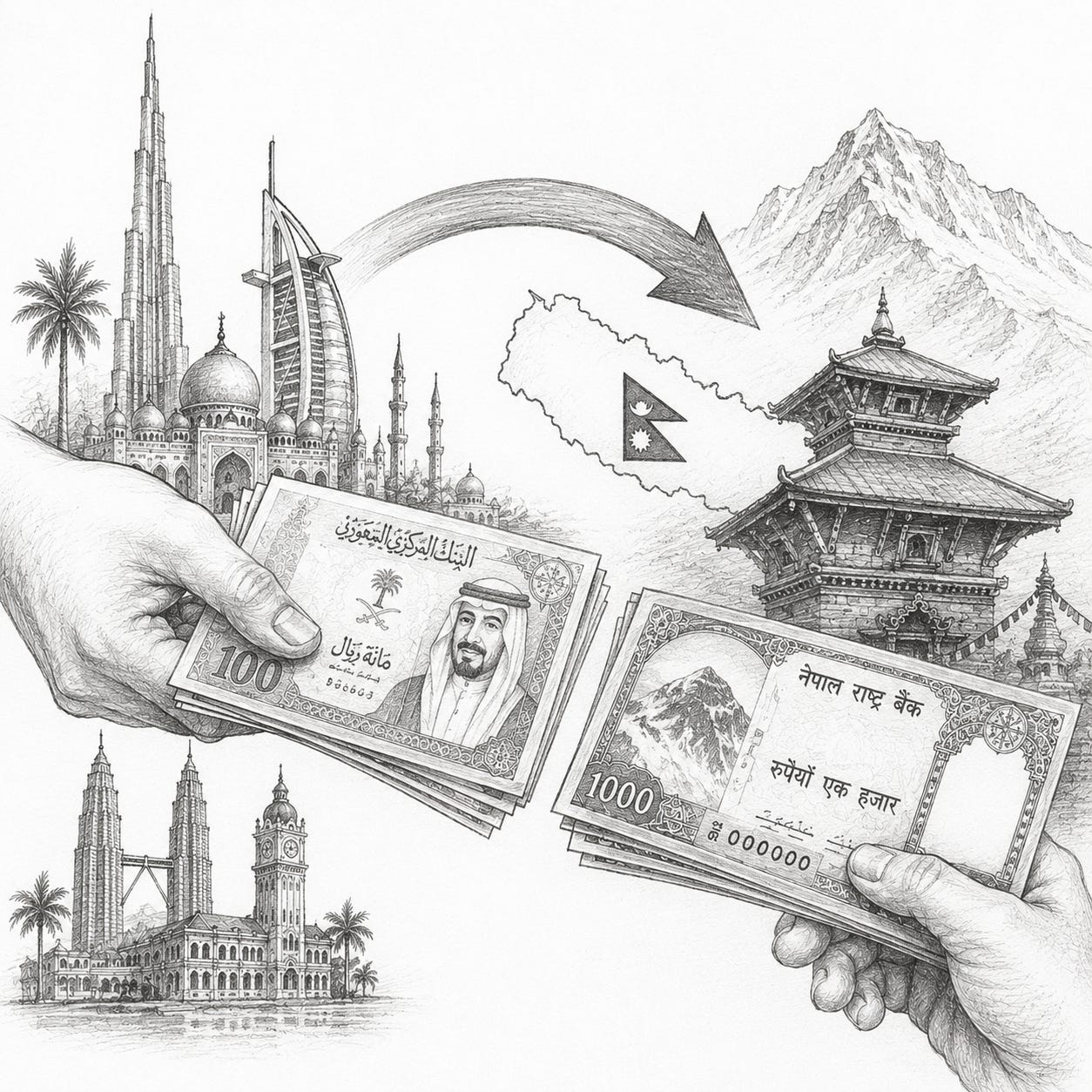
The numbers landed this week and they are staggering. In the first ten months of the current fiscal year, remittances rose 41.2 percent to Rs 1.917 trillion, according to Nepal Rastra Bank’s latest macroeconomic report. In dollar terms that is 13.26 billion, up a third on the year. The headline figure is the single month of Baishakh, mid-April to mid-May, which brought in Rs 257.49 billion, the highest monthly inflow Nepal has ever recorded and far above the Rs 165 billion of a year earlier. A year ago this same flow was growing at just 13.3 percent, so the acceleration is real, not a rounding quirk. Behind the money are the people: 335,510 Nepalis took first-time labour approvals and another 326,364 renewed theirs over the same period. Analysts credit a strong US dollar, a slow shift toward Western labour markets, and more of us sending money through formal digital channels rather than carrying cash. It is, on paper, the diaspora at its most generous. The harder questions about what that generosity is doing to Nepal come later in this issue (Himalayan Tribune).
The Cost of Sending That Money Home
While the inflows broke records, a sobering report reminded us what life can look like at the other end of the wire. Human Rights Watch, in a joint moment with Amnesty International on June 11, documented how Gulf governments have tightened surveillance and curbed free expression among migrant workers during the region’s recent conflict. Researchers interviewed 38 Indian, Nepali and Bangladeshi workers in March and 15 more in April across Bahrain, Kuwait, Oman, Qatar, Saudi Arabia and the UAE. One Nepali worker said his company ordered him to “delete all videos and pictures” from his phone before he flew home for vacation. In Kuwait, police carried out random phone searches, with fines reaching 1,000 dinar, roughly 3,200 dollars, and the threat of jail for anything deemed conflict-related. Amnesty counted more than 1,000 people arrested across the Gulf over such expression. HRW’s Michael Page warned that the crackdown is making it even harder for workers to speak up about the labour abuses many already endure. For families watching from Nepal, it is a reminder that the remittance figures are also a measure of risk (Human Rights Watch).
In Brief: A few more notes from the migration economy.
Where they are going. The same NRB data showed 661,874 total labour approvals in ten months, first-time and renewed combined, a quiet measure of how many households still see the answer abroad (Himalayan Tribune).
Korea narrows the door. South Korea has set its 2026 EPS quota at 80,000, down sharply from 165,000 two years ago, tightening one of the most sought-after destinations for Nepali workers (The Kathmandu Post).
Looking to Europe. The government is studying new labour destinations and bilateral deals in Europe, with Germany and Romania named as priorities, the latter already taking close to 28,000 Nepali workers in a single year (New Business Age).
🏛️ Politics & Governance
A Familiar Face Back at Home Affairs
The first real change to Balendra Shah’s cabinet since it took office in March came on June 9, when President Ramchandra Paudel administered the oath to two new ministers at Shital Niwas. The headline was a return: Sudan Gurung, the Rastriya Swatantra Party leader who had resigned as Home Minister on April 22 over questions about share investments and his asset declaration, was reinstated after a government committee reviewed his case and found little to fault in his landholdings. Stepping in beside him was a genuinely unusual appointment, Mahabir Pun, the independent lawmaker from Myagdi best known for bringing wireless internet to remote villages, who takes the new portfolio of Science, Technology and Innovation. Pun is not an RSP member, and his arrival gives a young, tech-forward government a recognisable face for its innovation agenda. Gurung’s reinstatement is more contested, given the unresolved financial questions, but it restores a key security post that had sat vacant for nearly seven weeks. For a government elected on a promise of clean competence, the optics cut both ways (The Kathmandu Post, OnlineKhabar).
Reopening Narayanhiti
Within a day of taking back the Home Ministry, Gurung reached for the case that no Nepali government has dared to truly close. He announced that the state would carry out a fresh investigation into the June 1, 2001 Narayanhiti Palace massacre, in which King Birendra, Queen Aishwarya and eight other royals were shot dead, by re-examining the original inquiry reports. The 2001 investigation, led by then-Speaker Taranath Ranabhat, concluded that Crown Prince Dipendra was the sole gunman, a finding many Nepalis have never accepted. The timing is striking: the announcement came just days after the country marked the twenty-fifth anniversary of that night, and from a minister listing it as one of four sweeping moves that also included reviewing old criminal files and weighing whether to drop charges against 2025’s Gen Z protesters. For now it is a statement of intent more than a plan. Gurung named no investigator, no timeline and no terms of reference, and analysts quickly noted the obvious hurdle: the prime suspect died within days of the killings. Still, for a diaspora that grew up under the shadow of that mystery, even the words carry weight (Nepal News, The Tribune).
In Brief: The rest of the week under the dome.
The border row cools. After roughly ten days of obstruction, opposition parties lifted their blockade of the House once Foreign Minister Shishir Khanal clarified that the PM’s earlier remark about Nepal encroaching on India referred only to minor cross-border occupation (Khabarhub).
Ordinances in doubt. With seven government ordinances stalled, including one that retroactively removed 1,594 political appointees, the Law Ministry is weighing whether to reintroduce them as ordinary bills the RSP majority can pass (The Kathmandu Post).
A second look at the protests. Among Gurung’s announcements was a task force to assess withdrawing charges against participants in the 2025 Gen Z demonstrations that helped bring this government to power (Nepal News).
Unions on notice. On June 12 the Supreme Court declined to extend an earlier stay, clearing the way for the government to dissolve party-affiliated trade unions in the civil service. A constitutional bench led by Chief Justice Manoj Kumar Sharma ruled that implementation would cause no “irreparable harm,” handing the government a notable win for its civil-service reform drive (Himalayan Tribune).
💸 Economy & Development
When the Lifeline Becomes a Trap
In the same week remittances broke records, Nepal Rastra Bank published a paper saying, in effect, be careful what you celebrate. Working Paper No. 63 argues that the country’s enormous remittance inflows are quietly pushing the economy toward consumption and away from the farms and factories that create lasting jobs. Most of the money, the central bank’s own researchers found, goes to household spending and paying off debt rather than productive investment, and the result is what economists call “Dutch disease,” a creeping loss of competitiveness, alongside a premature decline in manufacturing. The paper makes an uncomfortable point: Nepal’s decade of apparent macroeconomic calm, all those healthy reserves and steady inflows, has masked weak productivity growth and a shrinking industrial base. It is a rare moment of public candour from the institution that manages the very flows it is warning about, and it lands precisely as the new budget claims it will pivot the economy toward production and exports. The question the diaspora might fairly ask is whether anyone in Kathmandu has a plan to turn our remittances into something more durable than groceries (Nepal Rastra Bank).
The Gap That Will Not Close
If you want the proof of the central bank’s worry, look at the trade numbers from the same ten-month stretch. Nepal’s trade deficit widened 14.9 percent to Rs 1.443 trillion, as imports climbed to Rs 1.692 trillion while exports, even after respectable double-digit growth, reached only Rs 248.96 billion. Put plainly, imports still make up around 87 percent of all the goods crossing Nepal’s borders. The shopping list tells the story: diesel alone cost Rs 103 billion, crude soybean oil another Rs 97 billion, then petrol and cooking gas. This is an economy that earns abroad and spends at home, sending much of that hard-won remittance straight back out to pay for fuel and food it does not produce. Exports are growing, which is genuinely good news, but from a base so small that the gap keeps widening anyway. Until Nepal makes more of what it consumes, the budget’s bold growth targets will keep running into this same wall (Nepalnews).
In Brief: A few more figures worth filing away.
Markets steady. The NEPSE index clawed back to 2,737.61 by June 11 after a four-session slide, though the banking stocks stayed soft under the weight of rising bad loans (Nepalnews).
Clearing the dead wood. An Energy Ministry panel, part of the government’s reform push, recommended scrapping the licenses of 38 stalled hydropower projects worth 1,388 MW that signed power deals but never broke ground, and proposed ending Nepal’s hydropower “license raj” in favour of competitive licensing. It is a pointed move given how many big schemes, the flagship 1,063 MW Upper Arun among them, remain stuck (New Spotlight).
The outside view. The Asian Development Bank and World Bank both expect a sharp slowdown this fiscal year, to between 2.3 and 2.7 percent, before a rebound toward 5 percent in 2026/27 as the shocks of last year fade (Asian Development Bank).
⭐ Social & Cultural
Cricket Books a Ticket to Japan
Here is the week’s pure joy. On June 8 in Singapore, Nepal’s men’s cricket team finished the Asian Games Qualifier unbeaten, beating Hong Kong in a rain-shortened final to seal a place at the 2026 Asian Games in Aichi-Nagoya, Japan. Chasing a modest target, Nepal had raced to 114 for 2 when the rain arrived and the Duckworth-Lewis method handed them the win. The campaign belonged to opener Kushal Bhurtel, who was untouchable throughout, hammering back-to-back T20I centuries earlier in the tournament, including an astonishing 129 off 43 balls against China, and anchoring the final with a brisk half-century. For a cricketing nation that has clawed its way up through associate ranks on sheer passion, a continental-games berth is more than a result, it is a stage. Expect the diaspora’s WhatsApp groups from Sydney to Reading to be planning watch parties already (OnlineKhabar).
From Jhamsikhel to the World Stage
Nepal’s young dancers had their own night to remember. The grand finale of World of Dance Nepal 2026 wrapped up on June 6 at The Plaza in Jhamsikhel, Lalitpur, judged by the celebrated Indian choreographer Terence Lewis. Champions were crowned across four divisions, with young Ridhi Sarkar taking the top spot in the Junior Division. The real prize, though, is what comes next: the winning acts will represent Nepal at international competitions, including the World Finals in the United States, a global slot in Thailand and the World Supremacy Battleground in Hong Kong. It is a small but telling sign of a creative generation that no longer sees Kathmandu as the ceiling. For diaspora parents whose children are growing up dancing to both Nepali and global beats, it is a reminder that the talent pipeline back home is very much alive (Glamour Nepal).
In Brief: A few more moments from the week.
Words without borders. The fourth Kathmandu Kalinga Literary Festival ran June 6 to 7 at Hotel Himalaya under the theme “Beyond Borders,” gathering more than 400 speakers and poets reciting in Nepali, Newari, Hindi, Maithili, Bhojpuri and English (OnlineKhabar).
Grounded at the gate. Immigration officials stopped ANFA president Pankaj Bikram Nembang and general secretary Kiran Rai from flying out to the FIFA World Cup opening, citing a National Sports Council probe into the football body’s finances (Nepal News).
A record reel. Nepali cinema is having its best box-office year in memory, with the May release ‘Lalibazar’ crossing Rs 79 million and domestic films outdrawing foreign ones in peak season (The Film Nepal).Until next week, stay connected!
Let’s connect
Enjoying this issue? 📩 Share it with a friend & let’s keep Nepalis worldwide in the loop! Got thoughts? Hit reply—we’re all ears! Or let us know what you think via our Feedback form or follow us on Facebook | LinkedIn
P.S. Got a story or issue you’d like us to cover next week? Drop us a reply — we’re building this space together.
About Nepali Diaspora Digest:
The Nepali Diaspora Digest connects the global Nepali community with curated news, insights, and stories that matter most. Join us as we celebrate and explore the diverse voices and achievements of Nepalis worldwide.
Partner shout out
belayat.uk: helping Nepalis connect in the UK on jobs, housing, events and finding local Nepali owned businesses


