



Namaste, diaspora family! It was a week when a 35-year-old prime minister learned how heavy his own words have become. In his first proper address to Parliament, Balendra Shah told the chamber that Nepal too has encroached on Indian land, and the backlash has not stopped since. Closer to home for many of us, the new budget made its boldest move yet to turn our remittances into something more than grocery money: a Rs 100 billion diaspora bond and a promise to treat NRNs as “super organic investors.” And on June 1, the country paused to mark twenty-five years since the night nine royals were shot dead inside Narayanhiti. Let’s get into it.
🌍 Diaspora & Globalisation
Balen’s Rs 100 Billion Pitch to the Diaspora
For years the diaspora has been told it is the backbone of the economy and then handed an NRN card that opens few doors. The budget for fiscal year 2026/27 tries something different. The Balen Shah government has proposed an annual Rs 100 billion diaspora bond to channel overseas capital into roads, energy, and export industries, alongside a Remittance-Investment Matching Fund to push some of that money into local startups rather than household consumption. NRNs would get “super organic investor” status with preferential access to priority sectors, the secondary stock market would open to offshore citizens, and the government is promising double-taxation treaties with the countries where most of us live. There is even a “Return to Motherland after Retirement” scheme aimed at first-generation migrants. It is the most serious attempt in years to treat the diaspora as a development engine rather than an ATM. The catch, as always, is delivery: bonds and funds are easy to announce and hard to run (myRepublica, Ratopati).
The Study That Says “Stop Underusing Us”
A virtual policy discourse hosted by the Nepal Policy Institute on May 29 put numbers behind a frustration many of us feel. There are roughly 3 million Nepalis abroad, about a tenth of the home population, and they are not the unskilled labour force the old stereotypes assume. Some 51 percent of Nepali Americans aged 25 and over hold a bachelor’s degree or higher, and remittances now run at 25.3 percent of Nepal’s GDP. The institute’s argument is that tinkering with the NRN Act is the wrong frame entirely. It wants the government to replace “NRN” with a broader “Nepalis Abroad” category that splits the diaspora into three groups, from migrant workers to former citizens to persons of Nepali origin, and to legislate for engagement as a national strategic priority. NPI chair Dr Khagendra Raj Dhakal framed it as “a constructive offer to work with the state,” not a list of demands. For a diaspora tired of symbolic gestures, that is the right register (NEPYORK).
In Brief: Three threads from the harder edge of life abroad.
The cost of the oil money. A FairSquare report documented 23 alleged labour violations among subcontractors for Saudi Aramco, with Nepali workers describing 12 to 19 hour shifts in heat above 50 degrees Celsius, “slum housing,” and compensation paid in only one of six injury or death cases (The Kathmandu Post).
Eight months, no pay. Thirty-six Nepali workers employed by Intertectra Qatar WLL have gone unpaid for eight months, their combined dues now topping Rs 20.5 million (The Kathmandu Post).
Come home, eventually. Among the budget’s diaspora measures is a “Return to Motherland after Retirement” plan to ease first-generation migrants back into Nepal after their working lives abroad (myRepublica).
🏛️ Politics & Governance
The PM Who Conceded Too Much
Prime Minister Balendra Shah used his first formal address to the Federal Parliament to say something no Nepali leader says out loud. After becoming prime minister, he told the House, he had learned that not only has India encroached on Nepal’s land, but Nepal has also encroached on India’s “in multiple places.” He named no locations and offered no evidence, and the room turned on him. Opposition MP Basana Thapa demanded the remark be struck from the record, and a former ambassador stated flatly that “no land of India has been encroached on by the Nepali state.” The worry is strategic: Nepal’s entire case over Kalapani, Lipulekh, and Limpiyadhura, rooted in the 1816 Sugauli Treaty, rests on the position that India is the one occupying disputed ground. By conceding mutual fault, the PM handed New Delhi a talking point, and India promptly rejected any “third-party role” in the matter. The Foreign Ministry spent the week in damage control, clarifying that Shah meant minor cross-border occupation in no-man’s-land. Analysts called it an off-the-cuff slip from a leader still learning that a PM’s casual aside is never just casual (Al Jazeera, The Kathmandu Post).
A House That Cannot Sit Straight
The chamber that was supposed to debate a record budget spent the week debating its own conduct. After a disorderly sitting on Sunday, a probe panel was formed under House of Representatives secretary Prakash Adhikari to investigate “indecent and objectionable behaviour” by lawmakers, and Speaker Dol Prasad Aryal adjourned proceedings to June 8. The Kathmandu Post’s read was blunt: Parliament, constitutionally the country’s chief forum for national debate, is being overshadowed by its own disputes while pressing public business waits. It is not the image a young post-election government wants, especially with a stack of bills and the border row both demanding serious floor time. The optics of a legislature investigating its own manners, rather than governing, are exactly the kind that feed the cynicism the March election was supposed to cure (The Kathmandu Post).
In Brief: The rest of the week under the dome.
Not a shadow cabinet, apparently. Nepali Congress parliamentary leader Bhisma Raj Angdembey insisted the party has only assigned thematic responsibilities matching the 18 ministries, not formed a “shadow council of ministers” (Nepal News).
Talk, don’t shout. The Nepali Communist Party stressed that the border dispute with India should be settled through diplomatic channels, not parliamentary theatrics (Nepal News).
Know the map. For anyone lost in the border row, the contested ground is Kalapani, Lipulekh, Limpiyadhura, and Susta, all tangled in where the Kali River truly begins under the 1816 Sugauli Treaty (Al Jazeera).
💸 Economy & Development
Big Budget, Small Growth
The numbers in the Rs 2.124 trillion budget are built to impress: a 7 percent growth target, a push to lift GDP to Rs 7.4 trillion, a revenue goal of Rs 1.6 trillion, the personal income tax exemption raised to Rs 1 million, and the top rate cut from 39 to 29 percent. Business bodies, including the Nepal-India Chamber of Commerce, have endorsed the framework. The trouble sits in the government’s own paperwork. The Economic Survey, tabled in the same Parliament, pegs growth this fiscal year at just 3.85 percent, barely half the new target, and notes the trade deficit widened 11.2 percent to Rs 1.098 trillion. So the budget asks the economy to nearly double its pace in a year when imports are still outrunning exports and capital projects keep stalling. None of this makes the targets impossible, but it does make them a statement of intent rather than a forecast. For the diaspora weighing those new bonds and funds, the honest question is whether the delivery machinery has changed as much as the ambition (Khabarhub, The Kathmandu Post).
Betting the Budget on Watts
If there is one sector the budget treats as Nepal’s way out, it is electricity. The plan is to add another 1,040 MW in the coming year, 670 MW from hydropower and 370 MW from solar, lifting total installed capacity to 5,535 MW. The most strategic line item is the Karnali Corridor National Transmission Line, described as the backbone for the next phase of hydropower expansion and cross-border power trade, the part that actually lets new megawatts reach buyers at home and in India. The long-delayed 140 MW Tanahu project, Nepal’s first major reservoir scheme in more than 35 years, is nearing completion, and reservoir storage is being framed as the answer to dry-season shortfalls. Power has long been the one resource Nepal has in genuine surplus during the monsoon and scarcity in winter. Wiring it into a grid that can store and sell it is the difference between a talking point and an export economy (New Spotlight).
In Brief: A few more figures worth filing away.
Still the lifeline. Remittances are projected at roughly 33 percent of GDP this year, and foreign exchange reserves now cover an extraordinary 18.5 months of imports (The Kathmandu Post).
Lights on after dark. The budget funds an upgrade to Bharatpur Airport to handle night flights, a small but real boost for Chitwan’s connectivity (Nepal News).
The compact moves. The government allocated Rs 29.344 billion to advance the Millennium Challenge Corporation project in the coming fiscal year (Nepal News).
⭐ Social & Cultural
Twenty-Five Years After Narayanhiti
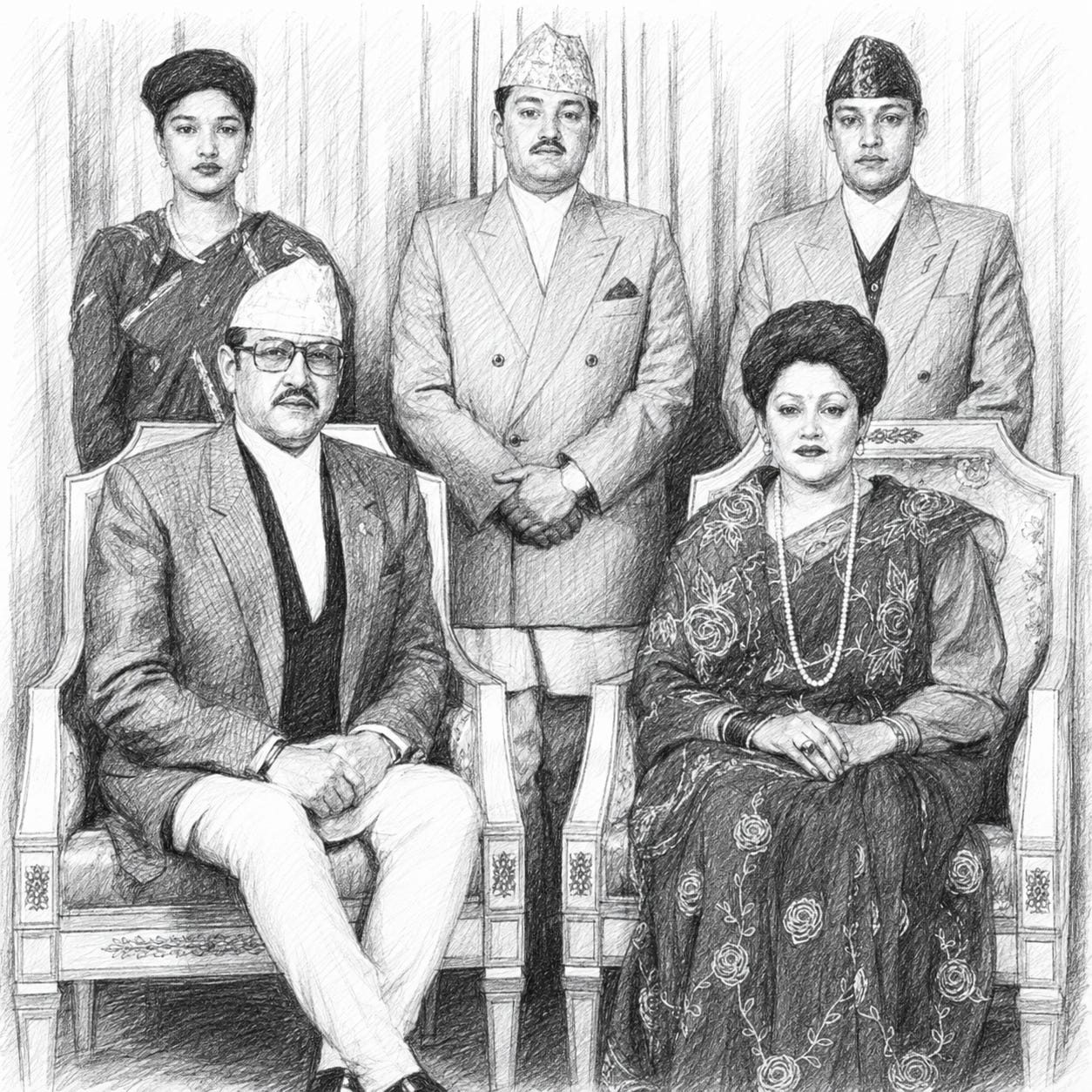
On the night of June 1, 2001, nine members of Nepal’s royal family were shot dead inside Narayanhiti Palace, among them King Birendra and Queen Aishwarya, in a few minutes that bent the course of the country’s history. Twenty-five years on, the anniversary was marked with quiet remembrance and candle-lighting, and the mystery that has never fully settled, an official inquiry named Crown Prince Dipendra as the gunman, still draws argument. What gives this anniversary its weight is the timing. The grief is being remembered under a republican government led by Balendra Shah, in a Nepal that has since abolished the monarchy the massacre helped doom. For older members of the diaspora, this is a date carved into memory, the night the news from home stopped making sense. For younger ones born into the republic, it is the origin story of the country they inherited (Ratopati).
So Close in Goa
Nepal’s women footballers gave the diaspora a night of nerves and then heartbreak. In the SAFF Women’s Championship semifinal in Margao, Goa, on June 3, the Gorkhali Chelis led Bangladesh through a 23rd-minute strike by Gita Rana and looked, for long stretches, like the better side. Bangladesh equalised on the stroke of half-time, the second half went blow for blow, and then Sagorika struck a last-gasp winner to end it 2-1 and send Bangladesh to the final. It is a brutal way to lose, but the performance said something hopeful: a Nepali women’s side that can lead a regional semifinal on the road is no longer a surprise package, it is a contender that fell a single moment short (Outlook India).
In Brief: A few more moments from the week.
Stories from the mountains. The Kathmandu International Mountain Film Festival wrapped its 23rd edition, screening 50 films from 29 countries and opening with the national premiere of ‘Shape of Momo’ (Nepal News).
Summit roll call. Kathmandu’s second Everest Summiteers Summit honoured 176 climbers from 26 countries, a reminder that the spring season still draws the world to Nepal’s doorstep (Nepal News).
Country number twenty. Folk-rock institution Nepathya played its first ever Malaysia concert, making the country the 20th and Kuala Lumpur the 58th city on a touring map built almost entirely on diaspora crowds (The Kathmandu Post).
Until next week, stay connected!
Let’s connect
Enjoying this issue? 📩 Share it with a friend & let’s keep Nepalis worldwide in the loop! Got thoughts? Hit reply—we’re all ears! Or let us know what you think via our Feedback form or follow us on Facebook | LinkedIn
P.S. Got a story or issue you’d like us to cover next week? Drop us a reply — we’re building this space together.
About Nepali Diaspora Digest:
The Nepali Diaspora Digest connects the global Nepali community with curated news, insights, and stories that matter most. Join us as we celebrate and explore the diverse voices and achievements of Nepalis worldwide.
Partner shout out
belayat.uk: helping Nepalis connect in the UK on jobs, housing, events and finding local Nepali owned businesses


