



Namaste, diaspora family! This was a week of things running short back home. Fuel got cheaper on paper and then vanished from the pumps overnight, an outbreak of bird flu emptied poultry sheds and shut the country’s only zoo, and the Supreme Court declined to free the opposition heavyweight the anti-corruption drive is holding. There was harder-edged news for the diaspora too, as the draft of a long-awaited NRN law quietly left a whole community out, even while the numbers show our footprint abroad growing faster than ever. And a clock is ticking on Nepali football. Let’s get into it.
🌍 Diaspora & Globalisation
The Promise With Fine Print
For months the government’s pitch to the diaspora has been a warm one, summed up in a slogan you have probably seen: “Once a Nepali, Always a Nepali.” The Shah administration has dangled property rights, voting rights, and a headline diaspora bond worth as much as Rs 100 billion a year to pull overseas capital home, even floating the idea of recognising NRNs as a special class of investor. This week the fine print drew scrutiny. A circulating draft of the amended Non-Resident Nepali Act turns away from the roughly 140,000 Nepali-Bhutanese of the diaspora, the community pushed out of Bhutan decades ago, leaving them outside the very promise the slogan makes. The Nepal Policy Institute, a think tank run largely by diaspora professionals, is urging the government to treat this rewrite as a rare chance to define its relationship with an estimated 3 million Nepalis abroad, not narrow it. For a readership that spans continents, the lesson lands cleanly: a law is only as generous as who it decides to count (The Kathmandu Post).
The Australia Chapter Gets Bigger
If you want to see where the diaspora is heading, look south. A study by the Institute for Integrated Development Studies, backed by Australia’s foreign ministry, found the Nepali-born population in Australia has jumped to about 213,580 by mid-2025, nearly doubling from 122,506 in 2021. This is not the old story of remittance and return. Some 61 percent arrived for higher education, close to half now earn between AUD 65,000 and 120,000 a year, and about a third have made formal investments. It is a young, credentialed, increasingly rooted community whose contribution is shifting from money sent home to businesses built, networks opened, and knowledge shared. Foreign Minister Shishir Khanal has called this diaspora “central” to the Nepal-Australia relationship, and the figures make the case for him. The challenge now sits with Kathmandu: whether its policies can keep pace with a community that is clearly not waiting around (The Annapurna Express).
In Brief: A few more notes from across the diaspora.
Balancing both neighbours. Foreign Minister Khanal followed a visit to New Delhi with four days in Beijing, meeting Wang Yi to talk connectivity, border management, trade and technology transfer. Wang called Nepal important to China’s neighbourhood diplomacy, and the back-to-back trips signal a deliberately even-handed foreign policy from the new government (Nepal News).
The lifeline holds. Even as fewer workers leave, remittances still run near a quarter of the entire economy, with inflows for the first nine months of the fiscal year around $11.55 billion, up roughly 39 percent year on year. It remains the number that keeps Nepal’s accounts standing (NepYork).
🏛️ Politics & Governance
The Court Keeps the Cell Door Shut
The biggest test yet of Nepal’s anti-corruption drive played out in the Supreme Court this week, and the drive held. A joint bench of Justices Binod Sharma and Nityanand Pandey dismissed the habeas corpus petition filed by Domaya Paudel on behalf of her husband, Bishnu Prasad Paudel, the CPN-UML vice-chair and eight-time former finance minister arrested on June 22 in Surkhet in a money-laundering probe. With the petition rejected, the Special Court’s order keeping him in judicial custody for further investigation stands. For a figure this senior in the main opposition, that is a heavy outcome, and the UML has not softened its line, calling the arrest politically motivated and its chair KP Sharma Oli branding it “illegal.” The government insists this is the law finally reaching the untouchable. The distinction between reform and revenge is now the argument running through Nepali politics, and this week the courts, at least, declined to hand the opposition an early exit (Nepal News).
Trying to Unjam Parliament
While the courts moved, Parliament sat stuck. Rabi Lamichhane, freshly re-elected as chair of the Rastriya Swatantra Party, spent the week playing fixer, holding consultations with Prime Minister Balendra Shah and convening an all-party meeting to break a legislative standoff that has slowed the government’s agenda. The timing is pointed. Only days earlier, at his party’s convention, Lamichhane floated a wholesale redesign of Nepal’s system, a directly elected executive and a fully proportional electoral model, ideas the old parties treated as an attack on the parliamentary order itself. So the man questioning whether the current system works is now the one trying to make it function week to week. For a diaspora long weary of coalition churn, it is a familiar bind: the reformers need the old machine to keep running even as they argue for replacing it (OnlineKhabar).
In Brief: The rest of the week in governance.
A body built for the money trail. The Council of Ministers discussed creating a separate, more powerful agency dedicated to financial crimes including money laundering, a sign the government wants permanent machinery, not just a moment, behind its graft crackdown (The Kathmandu Post).
An old idea returns. A campaign for a Hindu state and the restoration of the monarchy, fronted by former RPP figure Dhawal Shumsher Rana and activist Durga Prasai, is set to launch from Madhesh Province on July 6 (Nepal News).
The passport case grinds on. The CIAA’s Rs 10.13 billion graft case over rigged e-passport procurement continues against 18 people, even as booklet stocks run below 47,000 (The Kathmandu Post).
💸 Economy & Development
Cheaper Fuel Nobody Would Sell
Here is a Nepali paradox for the week: the price of petrol fell, and petrol disappeared. On July 1, the Nepal Oil Corporation cut petrol by Rs 20 a litre and diesel and kerosene by Rs 30, the kind of relief households rarely get. Within hours, private pumps across the Kathmandu Valley hung “No Petrol” and “No Diesel” boards and simply stopped selling, unwilling to move fuel they had bought at the older, higher price without eating the loss. Only stations run by the Army, Police and Armed Police Force stayed open, drawing long, frustrated queues. The NOC dispatched three monitoring teams, insisted there was “no shortage,” and by later reports declared the disruption resolved with fresh supplies pushed out from the Thankot depot. It is a small drama with a familiar shape, the gap between a policy announced in Kathmandu and what actually reaches the consumer, and this time it played out at the pump in a single day (New Spotlight).
Fixing the Plumbing
Away from the pumps, the government kept working on the unglamorous machinery of the economy. The Asian Development Bank approved a $50 million policy loan to modernise Nepal’s customs and logistics, funding digital systems, risk-based inspections and streamlined procedures meant to move goods faster and cut the friction that inflates prices. In the same stretch, the House of Representatives passed the Public Procurement (Second Amendment) Bill, another piece of the reform agenda the Shah government has staked its credibility on. Neither headline will thrill anyone, but for a diaspora that has watched projects stall for years in paperwork and leakage, better customs and cleaner procurement are exactly the sort of plumbing that decides whether the bigger promises, the diaspora bonds and investment pitches, ever hold water (The Kathmandu Post).
In Brief: A few more figures worth filing away.
The market drifts down. NEPSE slipped to around 2,608 on June 30, down nearly a percent, before clawing back a few points midweek on turnover above Rs 4 billion, with commercial banks leading the small rebound. The post-election glow has well and truly faded (Nepal News).
Tourists keep coming. Nepal welcomed 91,363 foreign visitors by air in June, up 19.5 percent on last year and above pre-pandemic levels. South Asia supplied more than half, with India alone sending 41,809 (ekantipur).
Money for the unfinished. The infrastructure ministry set aside Rs 2 billion for the coming fiscal year to complete stalled roads across 39 districts under the constituency road program, a nod to how many projects sit half-built (Nepal News).
⭐ Social & Cultural
The Flu That Emptied the Coop
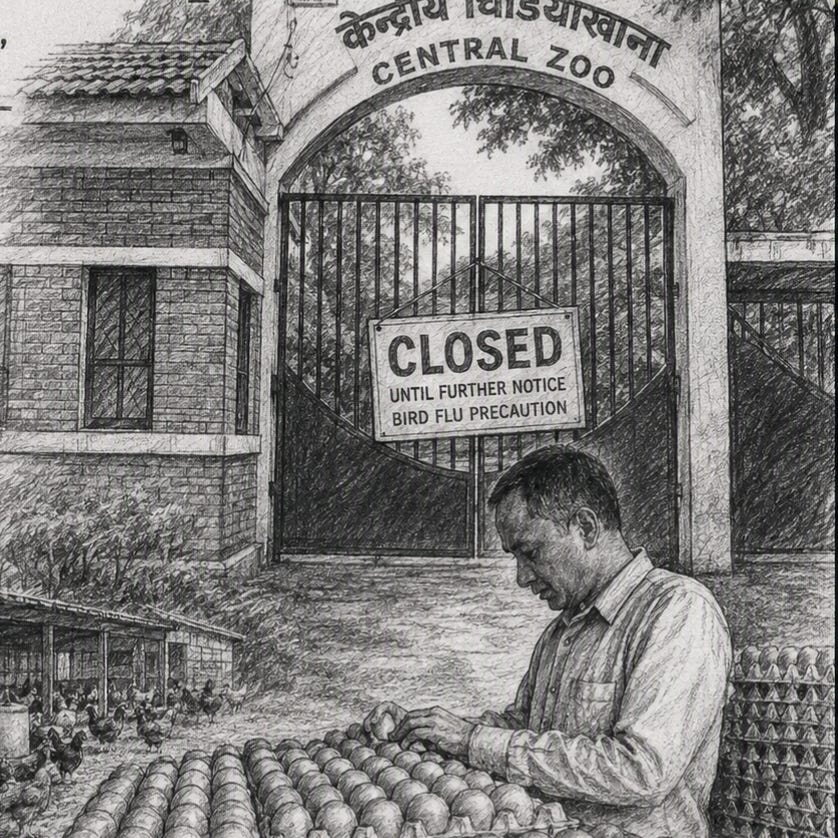
A quieter crisis has been building on Nepal’s farms, and this week the scale of it came into view. Since the first cases in mid-March, an outbreak of bird flu has forced the culling of more than 596,000 poultry and the destruction of over a million eggs, and it has now closed the country’s only zoo, the Central Zoo in Jawalakhel, as a precaution. For farmers this is a livelihood emptied out overnight, and for households it means pressure on the price and supply of eggs and chicken, staples of many Nepali kitchens. Bird flu has visited before, but the numbers this year are large enough to ripple through markets and dinner tables alike. Authorities are leaning on the blunt tool that works, widespread culling, while trying to keep the outbreak from crossing into people. It is the kind of slow-moving story that rarely leads the bulletins but reaches almost every plate (NAMPA).
Football’s Ticking Clock
Nepali football spent the week watching a calendar. After FIFA suspended the All Nepal Football Association on June 24 over what it called third-party interference, the fallout now comes with hard dates. Nepal can still contest the AFC U17 Women’s Asian Cup qualifiers if the suspension is lifted by July 13, just before the July 16 draw, and the U20 Asian Cup qualifiers if it is cleared by August 1. Miss those windows and the youth teams are simply struck from the competitions, on top of an AFC Women’s Champions League slot already lost. FIFA’s terms are specific: revoke the National Sports Council’s March order against the ANFA executive, reinstate that committee, and let the stalled elections finish. Sports Minister Sasmit Pokharel has acknowledged the federation long suffered political interference and corruption, which is part of how it landed here. The governance fight is real, but so is the cost, and right now it is measured in young players who may not get to take the field (The Kathmandu Post).
In Brief: A couple of last notes as the monsoon settles in.
The rains bite early. With forecasters warning of extremely heavy rain, authorities barred night travel between 5pm and 5am on the Hetauda-Kathmandu Kanti Highway at the turn of the month, citing the risk of landslides, flash floods and rising rivers. A reminder that monsoon season is as much about roads closed as skies opened (myRepublica).
A nation watching on its phones. Nepal’s sporting life is increasingly lived on the mobile screen, with 16.6 million internet users and 32.4 million mobile connections nationwide, and cricket the common thread, as local Nepali-language broadcasts bring the big tournaments to fans far from any stadium (The Kathmandu Post).
Let’s connect
Enjoying this issue? 📩 Share it with a friend & let’s keep Nepalis worldwide in the loop! Got thoughts? Hit reply—we’re all ears! Or let us know what you think via our Feedback form or follow us on Facebook | LinkedIn
P.S. Got a story or issue you’d like us to cover next week? Drop us a reply — we’re building this space together.
About Nepali Diaspora Digest:
The Nepali Diaspora Digest connects the global Nepali community with curated news, insights, and stories that matter most. Join us as we celebrate and explore the diverse voices and achievements of Nepalis worldwide.
Partner shout out
belayat.uk: helping Nepalis connect in the UK on jobs, housing, events and finding local Nepali owned businesses


