


Namaste, diaspora family! This week Nepal marked a milestone and watched a countdown at the same time. The Balen Shah government turned 100 days old and handed itself a glowing report card, even as the opposition and a jailed former finance minister told a very different story. Down at the football federation, the clock kept running toward a FIFA deadline that could shut a generation of young players out of the game. And in the quieter background, the numbers told their own tale: reserves at a record high, a stock market that refuses to celebrate, and a monsoon already counting its dead. Let’s get into it.
🌍 Diaspora & Globalisation
The Prime Minister Who Won’t Take the Meeting
Nepal’s foreign policy has a new personal style, and the diaspora should watch it closely. Prime Minister Balen Shah has been quietly rewriting the etiquette of how Kathmandu deals with the world, declining the usual one-on-one audiences with resident ambassadors in favour of group meetings, passing on several visiting US officials including Trump envoy Sergio Gor, and letting a planned visit by Indian Foreign Secretary Vikram Misri slip off the calendar. The stated logic is that “institutions, not individuals” should drive Nepal’s engagement abroad. Beneath the change of manner, the substance holds steady: the careful India-China balance continues, and Foreign Minister Shisir Khanal insists diplomacy “must ultimately contribute to Nepal’s economic transformation.” For a diaspora that lobbies, invests, and often acts as Nepal’s informal ambassadors, the message is worth reading twice. This is a government that wants to be courted through systems, not handshakes, and it is still short 17 ambassadors at its own missions abroad (The Kathmandu Post).
The Map of Where We Go Is Being Redrawn
The geography of Nepali migration is shifting under our feet. New labour permits fell nearly 19 percent as demand in the Gulf softened, rules tightened, and conflict across West Asia made old destinations look shaky, with the Department of Foreign Employment having frozen approvals to the region for seven weeks earlier this year. Where workers once streamed to Qatar and Saudi Arabia, the United Arab Emirates has now become the single largest destination, absorbing 137,892 permits in the first nine months of the fiscal year, while a reopened Malaysia saw its intake leap from barely a thousand to nearly 30,000, a twenty-seven-fold jump. And yet the money keeps flowing: remittances are running at a record pace even as fewer people leave. For families weighing where a son or daughter should build a life, the destinations that felt permanent a decade ago are quietly being replaced (The Kathmandu Post).
In Brief: A few more notes from across the diaspora.
Roots, replanted. The second Nepali Roots Summit wrapped up in Munich, drawing 96 entrepreneurs, researchers, students and professionals from across Germany to knit the diaspora closer and steer its skills and capital toward Nepal. It is a small gathering with a big idea: that the community abroad is now a source of ideas and investment, not just money sent home (Peoples’ Review).
The lifeline swells. Even with fewer workers heading out, remittances hit Rs 1,449 billion in the eight months to mid-March, up nearly 38 percent year on year and now equal to about a third of the entire economy, up from a quarter a year earlier. It remains the number holding Nepal’s accounts together (Nepal Rastra Bank data).
Both neighbours, no favourites. Foreign Minister Khanal reaffirmed that Nepal wants “balanced” ties with all its neighbours and partners, framing his recent trips to New Delhi and Beijing as confidence-building rather than tilting one way (The Shillong Times).
🏛️ Politics & Governance
One Hundred Days, Graded by the Teacher
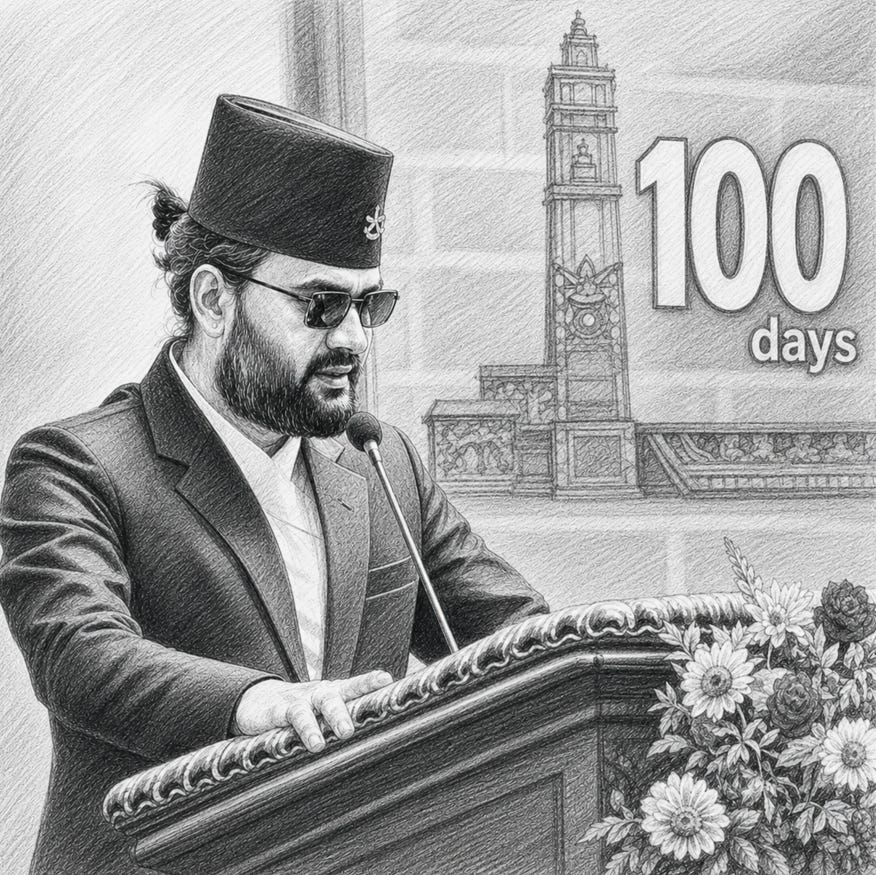
On July 4, the government led by Prime Minister Balen Shah completed its first 100 days, and it marked the occasion by grading its own homework generously. Sworn in on March 27 after the Rastriya Swatantra Party swept 182 of 275 seats in the March election, the administration announced it had delivered 87.2 percent of a 100-point reform agenda, with 70 points fully implemented. The showpieces are real enough: a Property Investigation Commission to chase hidden and illegally acquired wealth, a push to digitise public administration with e-signatures tied to the National ID and file-tracking meant to strangle petty corruption, and an ambitious Civil Service Bill. The opposition, unsurprisingly, calls the whole scorecard a work of fiction. Somewhere between the two lies the truth a diaspora has learned to look for: promises are cheap in Kathmandu, and 100 days is early. Still, after years of drift, a government moving fast enough to argue about is its own kind of news (New Spotlight).
The Cell Door Stays Shut, and the Questions Grow
The other half of the government’s story sits in a courtroom. This week the Special Court extended the custody of Bishnu Prasad Paudel, the CPN-UML vice-chair and former finance minister, by another five days, the latest in a string of extensions since his arrest in Surkhet on June 22 in a money-laundering probe tied to businessman Deepak Bhatta. The anti-corruption drive that holds him has already reached former Prime Minister KP Sharma Oli and former Home Minister Ramesh Lekhak, and Home Minister Sudhan Gurung frames it plainly: “No one is above the law.” But the crackdown is now drawing its own scrutiny. Opposition figures allege that officials of the anti-graft body itself were held and pressured at the Prime Minister’s Office, raising the uncomfortable question that shadows every reckoning of this kind. For the diaspora watching from afar, the line between cleaning house and settling scores has never mattered more, or been harder to draw (The Himalayan Times).
In Brief: The rest of the week in governance.
The crown campaign moves east. The drive to restore the monarchy and declare Nepal a Hindu state, led by Durga Prasai and former RPP figure Dhawal Shumsher Rana, is working its way through all eight districts of Madhesh Province, from Saptari to Parsa, as the pair try to weld the scattered pro-monarchy and nationalist forces into a single party (Peoples’ Review).
Due process on trial. As the graft cases pile up, watchdogs and legal observers warn that arrests and long custody extensions are outpacing the evidence made public, and that a crackdown which cuts corners risks discrediting the very reform it claims to deliver (OCCRP).
💸 Economy & Development
A Record in the Vault
Here is the good-news number of the week. Nepal’s gross foreign exchange reserves have climbed to a record of roughly Rs 3.5 trillion, around $24 billion, enough to cover about 18 months of imports, a cushion most economies would envy. The central bank, buoyed by the flood of remittances and steady tourism earnings, is projecting growth of around 7 percent for the coming fiscal year. For the diaspora, the reserves are more than an abstraction: they are what keeps the rupee stable, keeps imported goods on the shelves, and gives the government room to fund the projects it keeps promising. The paradox, of course, is that a country exporting so many of its young people is also awash in the cash they send back. The reserves are a monument to the diaspora’s labour, and a reminder that Nepal’s strongest export, for now, is still its people (The Himalayan Times).
The Market That Refuses to Cheer
Strong reserves, a growing economy, and yet the country’s investors are in no mood to celebrate. The NEPSE index drifted down again this week, closing around 2,602 on July 9, off nearly three-quarters of a percent on the day, with more than 220 stocks falling and every sector index in the red. The post-election optimism that briefly lifted the market has now fully evaporated, and the reason is not hard to find. The same anti-corruption drive winning headlines has left business circles uneasy, unsure who might be summoned next, and uncertainty is the one thing markets reliably punish. It is a telling gap: the macro numbers say Nepal is doing well, while the daily verdict of its own investors says wait and see. For NRNs weighing whether to move capital home, this is the tension to watch. Confidence, unlike reserves, cannot be built up in a vault (myRepublica).
In Brief: A couple more figures worth filing away.
Cheaper fuel, finally flowing. The price cut that emptied the pumps last week has settled. The Nepal Oil Corporation trimmed petrol by Rs 20 a litre, diesel and kerosene by Rs 30, and cooking gas by Rs 100 a cylinder, and after private dealers briefly hung “No Petrol” boards rather than sell older, costlier stock, fresh supplies from the Thankot depot brought the queues back to normal (Nepal News).
Half a year, six hundred thousand guests. Nepal welcomed 621,624 foreign tourists in the first half of 2026, with June alone up 19.5 percent on last year. India remains the largest source by far, sending nearly 46 percent of June’s arrivals (myRepublica).
⭐ Social & Cultural
Football’s Final Whistle Approaches
The clock that started ticking last month is nearly out of time. After FIFA suspended the All Nepal Football Association on June 24 over what it called third-party interference, Nepali football now faces a hard, close deadline: unless the suspension is lifted by July 13, three days before the July 16 draw, the country’s young women lose their place in the AFC U17 Women’s Asian Cup qualifiers, with a further cutoff on August 1 for the U20s. As of this week, the ban still stands. FIFA’s terms have not moved: fully and unconditionally revoke the National Sports Council’s March order against the ANFA executive, reinstate that committee, and let the stalled elections finish. The Kathmandu Post warns of a “lost generation” of players who may simply never get their tournament. It is a governance fight, yes, but the price is being paid in cleats and kit by teenagers who did nothing wrong (The Kathmandu Post).
The Flu Recedes, but Not Everywhere
There is cautious relief on Nepal’s poultry farms this week. The H5N1 bird flu outbreak that has haunted the country since March, spreading to 11 of 77 districts, is now reported contained across most of them, with districts including Jhapa, Morang, Sunsari, Bara and Chitwan declared clear. The cost of getting here has been staggering: more than 754,500 birds culled, over 1.09 million eggs destroyed, and the country’s only zoo in Jawalakhel shut since June 19. But the danger has not fully passed. Risk still lingers in the Kathmandu Valley and is worsening in Kavrepalanchok, and scientists tracking the virus warn that each new infection is a fresh chance for it to mutate toward something that could jump more easily to people. No human cases have been recorded in Nepal. The coop is quieter now, but the watch is not over (Radio Nepal).
In Brief: A couple of last notes as the monsoon deepens.
The rains keep their toll. The season’s cost is already grim. Between mid-April and July 3, disasters killed 127 people and injured 773 across more than 2,700 incidents, with landslides, lightning and even snakebite each claiming lives, and over 3,700 families affected. Peak monsoon is only now arriving (myRepublica).
Off to Utrecht. While football sits sidelined, cricket carries the flag. Nepal heads to the Netherlands for an ICC World Cup League 2 tri-series against the hosts and Namibia from July 21, another chance for the men in blue to keep chipping toward the bigger stage (ESPNcricinfo).
Let’s connect
Enjoying this issue? 📩 Share it with a friend & let’s keep Nepalis worldwide in the loop! Got thoughts? Hit reply—we’re all ears! Or let us know what you think via our Feedback form or follow us on Facebook | LinkedIn
P.S. Got a story or issue you’d like us to cover next week? Drop us a reply — we’re building this space together.
About Nepali Diaspora Digest:
The Nepali Diaspora Digest connects the global Nepali community with curated news, insights, and stories that matter most. Join us as we celebrate and explore the diverse voices and achievements of Nepalis worldwide.
Partner shout out
belayat.uk: helping Nepalis connect in the UK on jobs, housing, events and finding local Nepali owned businesses


