


Namaste, diaspora family! The government that promised to do things differently just passed seven laws without parliament and the opposition is having a field day. While Kathmandu’s political class was busy arguing about ordinances, Nepal’s brightest were making history at Harvard and MIT, where the first-ever Ivy League Nepal summit drew 400 people and 50 speakers across two days. Up on Everest, a 30-metre wall of ice kept a thousand climbers pinned at base camp for days. Down on the Bagmati riverbank, the bulldozers rolled through Thapathali and the Supreme Court asked the government to explain itself. And at Kirtipur, the Rhinos split their first two home matches beating UAE, then getting hammered by Oman. Let’s get into it.
🏛️ Politics & Governance
Seven Ordinances Parliament Bypassed Before It Even Sat
The optics are brutal. On April 21, the government recommended summoning parliament. On April 23, it recommended suspending the session before a single member took their seat. And on April 27, with both houses still shuttered, the cabinet asked President Paudel to issue seven ordinances covering the Constitutional Council Act, Cooperatives Amendment, Health Science Academies, Public Procurement, and university governance. The opposition erupted. Nepali Congress demanded the ordinances be withdrawn and parliament reconvened immediately. A Nepal News long-read titled “Nepal’s Ordinance Trend: Convenience or Constitutional Drift?” noted that the RSP government is now following the exact legislative shortcut it once denounced governing by presidential decree rather than parliamentary debate. Khabarhub reported that opposition parties are framing this as a test of the government’s democratic credentials: a movement that rode to power on accountability is now making law without a single vote in the House. PM Shah’s defenders argue the ordinances address urgent governance gaps cooperatives reform, procurement transparency, university autonomy that can’t wait for a parliamentary calendar derailed by political obstruction. But the precedent is set, and the opposition now has a talking point that cuts to the heart of the RSP’s brand (Kathmandu Post, Nepal News, Khabarhub).
Nepali Congress Finally Picks a Leader Angdembe Elected Unanimously
After weeks of delays, factional deadlock, and growing embarrassment, the main opposition finally has a voice in parliament. Bhishma Raj Angdembe was unanimously elected leader of the Nepali Congress parliamentary party on April 27, breaking a stalemate that had paralysed the party since the March election. The breakthrough came when both the Sher Bahadur Deuba and Shekhar Koirala factions backed Angdembe a veteran from Jhapa who commands cross-factional respect. Abhishek Pratap Shah was named deputy leader, Basana Thapa chief whip, and Nishkal Rai whip. In the National Assembly, Kamala Panta replaced Krishna Prasad Sitaula as party leader. The timing matters: with seven ordinances on the table and parliament suspended, NC now has a recognised floor leader to challenge the government when or if the House reconvenes. Whether Angdembe can transform a fractured 38-seat caucus into an effective opposition is the next test (Kathmandu Post, Radio Nepal).
In Brief: The political churn doesn’t stop.
The money laundering probe keeps widening. Shekhar Golccha, chair of the powerful Golccha Group, was arrested in a related securities case. A Peoples’ Review investigation titled “Bhatta, Agrawal, Golccha: Probe Exposes Deep NEPSE Rot” alleges systematic share price manipulation through interconnected corporate networks raising questions about the structural integrity of Nepal’s stock market itself (Peoples’ Review, Himalayan Times).
UML’s grand rally fizzled. The planned April 25 Kathmandu mega-demonstration was quietly postponed. The party held cultural events for its establishment day instead, though rhetoric against the government continued to escalate. On April 27, police detained 10 individuals including UML leader Mahesh Basnet’s wife following an assault at Maitighar Mandala (Ujyaalo Nepal, Nepal News).
Prachanda is building a coalition. The NCP chairman announced plans to form a seven-party opposition front to hold the government accountable through parliament and the streets signalling that the old guard isn’t done yet (Nepal News).
🌍 Diaspora & Globalisation
Nepal Takes Harvard Inaugural Summit Draws 400 to Cambridge
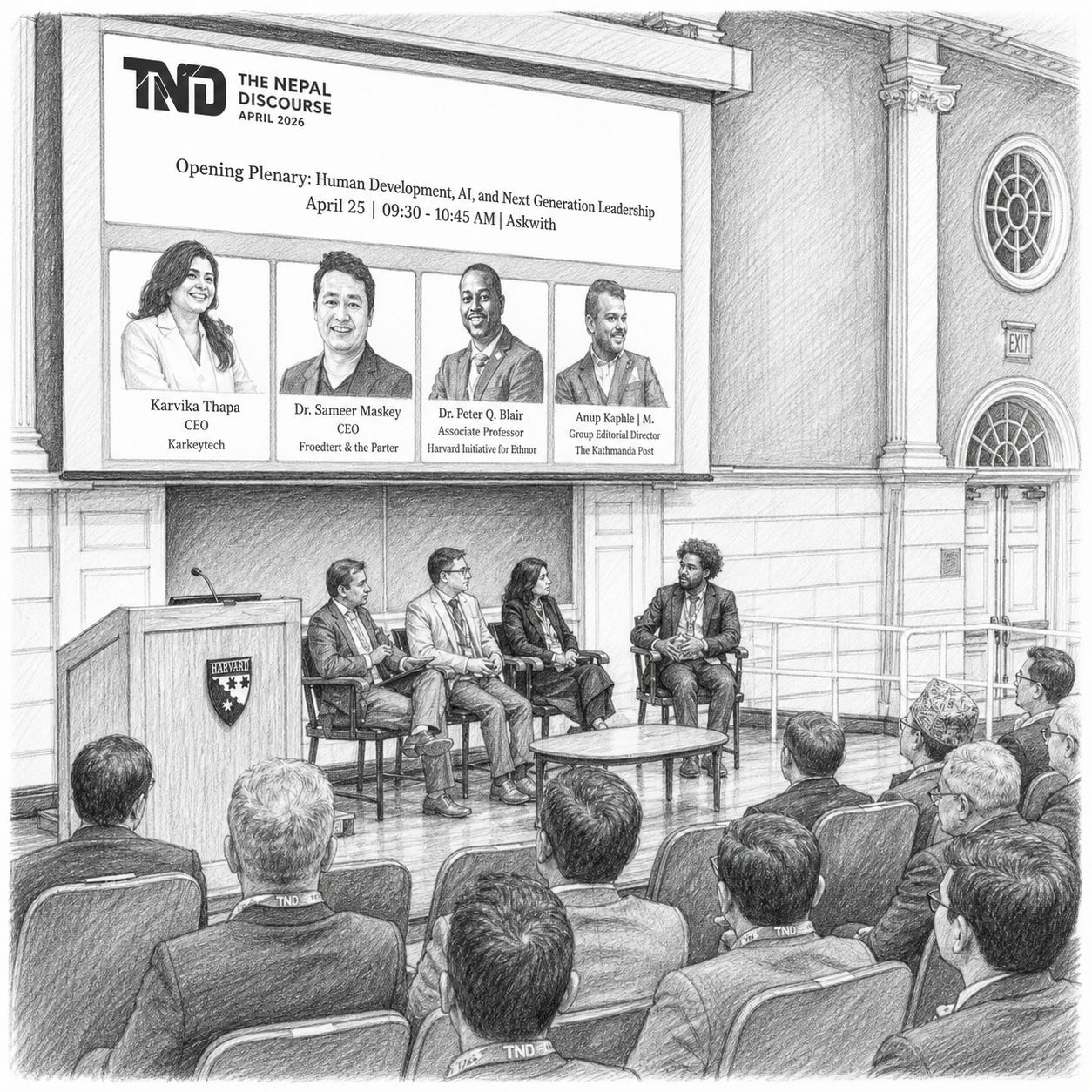
It happened. The Nepal Discourse 2026 the first-ever Nepal summit at an Ivy League institution wrapped up on April 27 after two days at Harvard University and MIT, and by every measure it exceeded expectations. More than 50 speakers and nearly 400 participants including 35 delegates who flew in from Nepal filled 16 panels structured around four pillars: artificial intelligence and the future of work, next-generation leadership, resilient institutions, and diaspora engagement. Finance Minister Swarnim Wagle opened the event virtually from Kathmandu. The speaker roster read like a who’s who of the Nepali innovation ecosystem: Sameer Maskey (Fusemachines), Pukar C Hamal (SecurityPal), Ncell CEO Michael Foley, and World Bank Country Director David Sislen. AI researcher Karvika Thapa spoke at both venues on Nepal’s economic transformation. For a diaspora that has long felt disconnected from the decision-making table, having Nepal’s challenges and opportunities debated at Harvard is more than symbolic it’s a statement that the global Nepali community has the intellectual firepower to shape the conversation. Now the question is whether the conversations translate into action (Kathmandu Post, Nepalism, Nepal on the Web).
Nepal’s “Cash Cow” Left Underprotected Gulf Workers’ Social Security Gap Exposed
Here’s a number that should alarm every Nepali family with someone in the Gulf: of the 2.2 million migrant workers registered with Nepal’s Social Security Fund, only about 2% continue contributing after their initial enrollment. That’s the finding in a devastating Kathmandu Post investigation published April 30, which reveals that the system designed to protect Nepal’s biggest economic asset is barely functioning. The International Labour Organization warns that gaps persist across every stage of the migration cycle from pre-departure to return. Workers face job losses, wage theft, limited healthcare access, and near-impossible paths to compensation when things go wrong. Women migrants, low-wage earners, and undocumented workers are the most vulnerable. The West Asia conflict has made everything worse: with contracts being cut short and salaries delayed, the lack of a functioning safety net means workers are absorbing losses alone and their families back home are absorbing the consequences. Nepal earned $10.15 billion in remittances in the first eight months of this fiscal year. The question is what it’s spending to protect the people who earn it (Kathmandu Post).
In Brief: More diaspora developments this week.
Nepali fashion is going global. Designer Kriti Mainali debuted a 10-piece “Heritage of Nepal” couture collection at New York Fashion Week, while London-based Umanga Raut (age 23) presented “Setubandh” a jacket embroidered with Gen Z revolution imagery at the British Fashion Awards. The Kathmandu Post notes that for Nepalis abroad, fashion is becoming “a language of culture” (Kathmandu Post).
Fresh violence in India’s Manipur has left roughly 60,000 Nepali-speaking people living in fear. More than 10,000 have been displaced over the past decade. Settlements in Kalapahar, Irang, and Purao Valley are emptying out, with community members reporting harassment, extortion, and dozens of Nepali-owned shops burned (Kathmandu Post).
US deportations of Nepalis have now passed 800 since President Trump’s second term began. A NepYork investigation — “Tricked, Trafficked, and Tossed Out” — documents the dangerous pipeline of trafficking, exploitation, and eventual deportation that many face (NepYork).
💸 Economy & Development
The Growth Numbers Don’t Add Up 3.85% or 2.3%?
How fast is Nepal’s economy actually growing? Depends who you ask and the gap has never been this wide. On April 28, the Kathmandu Post reported that Nepal’s National Statistics Office estimates GDP growth at 3.85% for FY 2025/26. The World Bank says 2.3%. The ADB says 2.7%. The IMF says 3.0%. That’s not a rounding error it’s a 1.55 percentage point gap between the government’s own projection and the World Bank’s, which translates to real differences in how much money the economy is actually generating and how many jobs are being created. The government’s figure looks optimistic given the evidence: a fuel crisis that has pushed diesel up 68% in five weeks, capital spending stuck at 23.58% of the annual target after nine months, the September 2025 unrest that disrupted economic activity for weeks, and tourism arrivals from key markets still down double digits. The World Bank’s April Development Update projects poverty rising to 6.6% in FY26, with an additional 17,267 people pushed below the poverty line by the Gulf conflict alone. The numbers matter because they drive budget planning for FY 2026/27 and if the government is budgeting on 3.85% growth that doesn’t materialise, the revenue gap could be painful (Kathmandu Post, World Bank).
Two Infrastructure Milestones in One Week Tunnel Trial & Ring Road Grant
In a week dominated by political drama, two concrete infrastructure developments landed. First: the Nagdhunga-Naubise Tunnel one of Nepal’s most anticipated road projects is preparing for its first vehicle trial run by May 3. A service provider has been selected for Rs 1.1 billion over five years to manage and maintain the tunnel, which will dramatically cut travel time on the country’s busiest highway corridor between Kathmandu and the Tarai. Second: the Chinese government committed Rs 11 billion in grants for the Ring Road Expansion (Second Phase), extending from Kalanki to Basundhara through Kathmandu Valley’s most congested stretch. For anyone who has sat in traffic at Kalanki which is everyone who has ever been to Kathmandu this is the project that’s been promised and delayed for years. Neither project is finished, and Nepal’s infrastructure track record demands healthy scepticism. But trial runs and signed grants are more than most weeks deliver (Nepal News, Radio Nepal).
In Brief: A few more economic signals this week.
NOC cut diesel by Rs 12/litre — the first reduction after weeks of relentless hikes — and petrol by Rs 2/litre. But it simultaneously hiked LPG by Rs 150 per cylinder, meaning cooking gas just got more expensive even as transport fuel got marginally cheaper. Current prices: petrol Rs 217, diesel Rs 225.50 in Kathmandu (Khabarhub).
NEPSE slid below 2,750, closing the week at 2,738.72 — down from 2,838 the week before. Only 42 of 349 traded companies gained on April 28. The fuel crisis and economic slowdown are weighing heavily on market sentiment (ShareHub).
Provincial budgets are shrinking as federal grants decline. Sudurpashchim Province set its FY 2026/27 ceiling at Rs 22.63 billion — down Rs 2.24 billion from this year. Lumbini is preparing a budget of ~Rs 33 billion, down from Rs 38.91 billion. The squeeze reflects the broader fiscal challenge facing Nepal’s federal structure (Nepal News).
⭐ Social & Cultural
Bulldozers, Protests & a Show-Cause — The Thapathali Eviction Escalates
Last week we reported that Amnesty International had told the government to put the bulldozers away. This week, the bulldozers came anyway. At 6 AM on April 25, demolition crews backed by metropolitan police, Nepal Police, and Armed Police Force moved through Thapathali, Shantinagar, and Gairigaun, flattening riverbank squatter settlements along the Bagmati. 144 families were processed at a stadium, temporarily moved to hotels, and promised relocation to government apartments in Nagarjun Municipality within two weeks. By April 26, the eviction drive had expanded to Manohara and Sinamangal. The response was swift from multiple directions. Amnesty International released a formal research briefing — “Nowhere to Go: Forced Evictions in Nepal” — condemning what it called a “blatant disregard” for human rights and noting the affected families are disproportionately Dalit and Indigenous communities. The All Nepal Squatters Association announced phased protests. And critically, the Supreme Court issued a show-cause order to the government, raising constitutional questions about the right to housing. The tension is real and legitimate on both sides: riverbank encroachment is an environmental and flood-risk problem that every government has talked about and none has solved. But mass evictions of vulnerable communities without completed resettlement infrastructure puts the reform government in uncomfortable territory (Kathmandu Post, Kathmandu Post, Amnesty International).
Everest 2026 — A 30-Metre Wall of Ice and 1,000 Waiting Climbers
The mountain had its own plans this week. A 30-metre unstable serac — a tower of glacial ice — lodged itself in the Khumbu Icefall, the treacherous passage between Everest Base Camp and Camp 1, effectively blocking the route and stalling the entire spring 2026 climbing season for days. Over 1,000 people — climbers, Sherpa guides, porters, and support staff — waited at base camp while the Icefall Doctors assessed whether to route around or wait for the serac to collapse. By April 29, the route was finally opened to Camp 2, and rope fixers began pushing toward Camp 3 — but the serac hasn’t fully collapsed, and it hangs over the route like an unresolved question. This season, Nepal issued permits to 425 climbers (including 98 women) from 42 expedition teams. The north side via Tibet is closed to international teams this year, funnelling all traffic through Nepal’s route. A new waste regulation requires each climber to carry 2 kg of rubbish down from Camp 2 and above. The main summit window is expected in mid-to-late May — if the icefall cooperates (CNN, Alan Arnette, Global Rescue).
In Brief: A few more stories to round out the week.
Cricket at Kirtipur delivered drama. Nepal beat UAE by 37 runs on April 25 — Dipendra Singh Airee anchoring with 75 and Karan KC devastating with 4/19. But on April 29, Oman crushed Nepal by 102 runs (DLS) after captain Jatinder Singh smashed 130. The Rhinos sit 7th in the CWC League 2 standings with qualification looking increasingly difficult. The tri-series runs through May 5 (Kathmandu Post, Nepal News).
Nepal faces a FIFA ban. FIFA and the AFC have set a May 4 deadline for the National Sports Council to lift its suspension of ANFA or Nepal will be banned from international football. The government also banned 24 ANFA officials from travelling abroad. Nepal will lose its AFC Challenge League spot — again (Kathmandu Post, Kathmandu Post).
May Day brought three announcements: Labour Minister Ramji Yadav launched a five-year National Occupational Safety and Health Programme and a 6% interest rate housing loan for workers enrolled in the contribution-based social security fund (Radio Nepal).
Until next week, stay connected!
Let’s connect
Enjoying this issue? 📩 Share it with a friend & let’s keep Nepalis worldwide in the loop! Got thoughts? Hit reply—we’re all ears! Or let us know what you think via our Feedback form or follow us on Facebook | LinkedIn
P.S. Got a story or issue you’d like us to cover next week? Drop us a reply — we’re building this space together.
About Nepali Diaspora Digest:
The Nepali Diaspora Digest connects the global Nepali community with curated news, insights, and stories that matter most. Join us as we celebrate and explore the diverse voices and achievements of Nepalis worldwide.
Partner shout out
belayat.uk: helping Nepalis connect in the UK on jobs, housing, events and finding local Nepali owned businesses


