



Namaste, diaspora family! It happened. On the auspicious morning of Ram Navami, Balendra “Balen” Shah placed his hand on the constitution and became Nepal’s 40th and youngest-ever Prime Minister. Hours earlier, the former rapper dropped “Jay Mahakaali,” a unity anthem that racked up three million views before the ink on his oath was dry. His 15-member cabinet broke records too: ten ministers under 40, five women, and a PhD economist from the World Bank running Finance. Meanwhile, the Gulf crisis grinds on with permits frozen and fuel prices hitting Rs 187, and Nepal was just named the happiest country in South Asia — because the universe has a sense of timing. Let’s get into it.
🏛️ Politics & Governance
Nepal’s Youngest PM Sworn In — Balen Shah Takes the Oath on Ram Navami
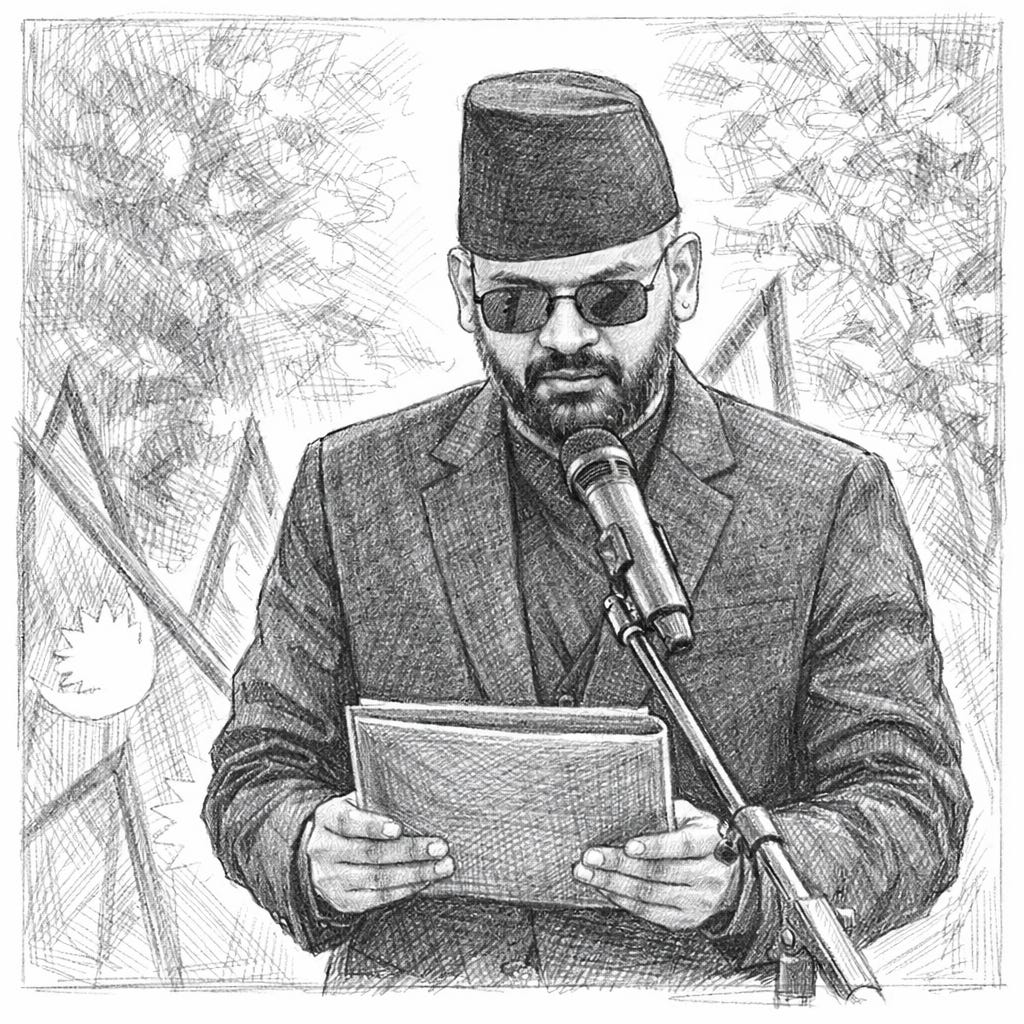
At 10:36 a.m. on Friday, March 27 a time chosen for its astrological auspiciousness on Ram Navami — President Ramchandra Paudel administered the oath of office and secrecy to Balendra Shah at the President’s Office in Shital Niwas. The 35-year-old walked in wearing black trousers, a matching jacket, his signature black Nepali cloth cap, and sunglasses — the same look that made him an icon during his tenure as Kathmandu’s mayor. Shah is Nepal’s first Madhesi Prime Minister, representing the southern plains bordering India, and the youngest to hold the office in decades. His Rastriya Swatantra Party’s 182-seat landslide on March 5 gives him the first single-party majority government since 1999 no coalitions, no horse-trading. But it was the hours before the ceremony that captured the mood: Shah released “Jay Mahakaali (Victory to Goddess Mahakali),” a rap song with the lyrics “Undivided Nepali, this time history is being made” and “The strength of unity is my national power.” The music video, featuring campaign rally footage, hit nearly three million views before he took the oath. For a diaspora that has watched Nepal’s political class trade power for decades, this felt different. The world noticed too — Al Jazeera, Washington Post, NBC, and Euronews all led with the story (Al Jazeera, Himalayan Times).
Meet the Cabinet — Nepal’s Youngest-Ever Government
Sworn in alongside Shah, the 15-member Council of Ministers is the youngest cabinet in Nepal’s history — 10 of 15 members are under 40, and five are women (one-third of the cabinet). Deputy Prime Minister and Finance Minister Dr. Swarnim Wagle, 51, is the oldest member a PhD economist from the Australian National University who served as chief economic adviser for the Asia-Pacific region at UNDP and held roles at the World Bank. On assuming office, he announced an immediate economic reform drive. The full roster signals RSP’s promise of technocratic governance over patronage politics. Here’s who’s running Nepal (Himalayan Times, Kathmandu Post, OnlineKhabar):
The Full Cabinet:
Balendra Shah, 35 — Prime Minister, Defence & Industry — structural engineer, rapper, former Kathmandu mayor
Dr. Swarnim Wagle, 51 — DPM & Finance — PhD economist, ex-UNDP Asia-Pacific chief economic adviser, ex-World Bank
Sudhan Gurung, 38 — Home Affairs — RSP leader tasked with law enforcement and internal security
Shishir Khanal, 47 — Foreign Affairs — faces immediate diplomatic tests including Gulf crisis and India-China balance
Sobita Gautam, 30 — Law, Justice & Parliamentary Affairs — one of five women in cabinet
Sasmita Pokharel, 29 — Education, Science & Technology — youngest minister, overseeing Nepal’s education reform agenda
Sunil Lamsal, 35 — Physical Infrastructure & Transport — inherits the National Pride Projects backlog
Pratibha Rawal, 32 — General Administration/Federal Affairs — managing the bureaucratic machinery
Sita Badi, 30 — Women, Children & Senior Citizens — advancing gender and social protection
Amaresh Kumar Singh, 55 — Industry, Commerce & Supplies — managing supply chains during Gulf crisis
Biraj Bhakta Shrestha, 44 — Energy, Water Resources & Irrigation — overseeing Nepal’s hydropower ambitions and fuel crisis response
Nisha Mehta — Health & Population — faces measles outbreak and health system challenges
Khadak Raj (Ganesh) Poudel — Culture, Tourism & Civil Aviation — boosting Nepal’s tourism recovery
Dr. Bikram Timilsina, 43 — Communication & Information Technology — elected from Nuwakot-1
Deepak Kumar Sah, 49 — Labour, Employment & Social Security — from Mahottari, managing the Gulf migrant worker crisis
Geeta Chaudhary — Agriculture & Livestock/Forest & Environment — fifth woman in cabinet
In Brief: The political transition isn’t without its complications.
Rabi Lamichhane, RSP’s party president, delivered a pointed message at an orientation for new MPs on March 18-19, reminding them that the party’s “right to recall” provision will be enforced. But Lamichhane himself faces suspension from parliamentary duties due to ongoing legal battles, creating an unusual split between party leadership and parliamentary power (Kathmandu Post).
The opposition is in crisis. After their electoral rout — Nepali Congress down to 38 seats (its worst ever), CPN-UML to 25 — leaders of both parties face internal calls to step down. The Diplomat’s analysis piece asks whether Nepal’s traditional parties can survive the “Balen Wave” at all (Kathmandu Post, The Diplomat).
Finance Minister Dr. Swarnim Wagle assumed office on Friday and announced an economic reform drive, signalling the new government’s priority on fiscal discipline and investment climate improvement (Himalayan Times).
🌍 Diaspora & Globalisation
Gulf Crisis Month Two — Workers in Limbo as Permits Stay Frozen
The Gulf conflict’s stranglehold on Nepali migrant workers is tightening. One month after the US-Israel strikes on Iran triggered retaliatory attacks across the Gulf, 1.7 million Nepali workers in the region face deepening uncertainty. Labour permits remain frozen for 12 countries — including the UAE, Saudi Arabia, Qatar, and Kuwait — and more than 2,000 workers are being denied permits every day. Only 52,944 permits were issued in March, down sharply from an average of 73,000 in previous months. The 22 bodies of deceased workers remain stranded — 8 in the UAE, 7 each in Kuwait and Saudi Arabia — with families enduring waits of over a month despite embassies completing paperwork. The economic stakes are staggering: Gulf countries contribute 41% of Nepal’s remittances — about Rs 422 billion in the first six months of this fiscal year alone. A separate Kathmandu Post investigation found that lack of digital awareness is putting migrants at additional legal risk, as many cannot navigate the online employment systems that host countries now require. This is the first crisis landing on PM Shah’s desk, and Labour Minister Deepak Kumar Sah — himself from the Terai — inherits a portfolio that affects more families than any other (Kathmandu Post, Kathmandu Post).
US Nepali Diaspora Sends Its Wishlist to the New Government
As Balen Shah took office, the US Nepali community was already drafting its expectations. A widely circulated NepYork editorial outlined the diaspora’s demands: meaningful voting rights for non-resident Nepalis, dual citizenship pathways, simplified investment and banking channels, and enforceable labour protections for the 1.8 million workers in the Middle East. The timing aligns with the NRNA’s new leadership push — president Dr. Hem Raj Sharma met with the Foreign Minister this week to advance the 12-point Kathmandu Declaration adopted at the Global Conference two weeks ago. The declaration calls for amendments to citizenship, foreign investment, income tax, and property transaction laws. Whether the RSP government — which owes much of its grassroots energy to young Nepalis abroad who championed it on social media — will deliver on these asks will define its relationship with the diaspora (NepYork, Radio Nepal).
In Brief: More diaspora developments this week.
US deportations of Nepalis continue to climb — 585 Nepalis have been deported since Trump’s second term began, with January 2026 recording the highest monthly total. The ongoing immigrant visa suspension for 75 countries, including Nepal, remains in effect (Kathmandu Post).
The Gulf war’s economic ripple effects are threatening Nepal’s debt sustainability, as remittances account for 28.6% of GDP and the government may need to reconsider its external borrowing strategy amid persistent fiscal deficits (Fiscal Nepal).
💸 Economy & Development
Fuel Prices Surge Again — Petrol Hits Rs 187 as Gulf War Bites
Nepal Oil Corporation raised fuel prices for the second time this month on March 26 — petrol and diesel up Rs 15 per litre each, bringing petrol to Rs 187 and diesel to Rs 167 in Kathmandu. Between March 1 and 24, the purchase cost of petrol has risen by approximately Rs 76 per litre and diesel by Rs 143 per litre as crude oil remains above $105 per barrel following Iran’s Strait of Hormuz disruptions. The LPG shortage continues, with NOC distributing half-filled cylinders and ruling out a return to full cylinders while global supply chains remain unstable. Construction materials are spiking (steel rods up from Rs 95 to Rs 105/kg), freight charges jumped Rs 5,000 per ton, and economy-class flights to the US now cost Rs 300,000. Economist Puskar Bajracharya warned that prices could rise further if crude hits $125/barrel. For the new government, this is a day-one inheritance with no easy fix — though Nepal’s electric cooking push (induction stove imports hit 132,000 units last year) offers a rare silver lining (Kathmandu Post, Kathmandu Post).
Markets Rally on Political Stability, But FDI Tells a Different Story
The Nepal Stock Exchange has been on a tear. NEPSE crossed 2,900 points on March 22 and reached 2,950 by March 26, with turnover exceeding Rs 13 billion in a single session — a clear market vote of confidence in the political stability a single-party RSP government promises. But the foreign investment picture is far less rosy: FDI commitments have plummeted to just Rs 386 million by mid-March, with the Department of Industry linking the collapse to the September 2025 Gen Z protests that caused an estimated Rs 86 billion in damages and shattered investor confidence. The contrast is stark — domestic investors are betting on the new government, but international capital is sitting on the sidelines. Nepal’s trade deficit has meanwhile hit Rs 1.1 trillion in the first two quarters of FY 2025/26, and the ILO’s warning from last week — that LDC graduation in November could cost 132,000 jobs and nearly $1 billion — hangs over the new Finance Minister’s inbox (ShareHub, Nepal News).
In Brief: A few more economic signals worth watching.
The trade deficit hit Rs 1.1 trillion in the first two quarters of FY 2025/26, underscoring Nepal’s structural import dependency as fuel costs continue to climb (Nepal News).
LDC graduation in November 2026 could cost 132,000 jobs and nearly $1 billion over five years as trade preferences in textiles are withdrawn — roughly half the affected jobs are held by women (Kathmandu Post).
The World Bank’s $50 million Digital Transformation Project, approved in February, aims to digitize public services — a priority for an RSP government that ran on anti-corruption and transparency (World Bank).
⭐ Social & Cultural
Nepal Tops South Asia in World Happiness Report 2026
In a week of political upheaval, here’s an unexpected data point: Nepal ranked 99th globally in the 2026 World Happiness Report, released March 21 — a slight slip from 92nd last year, but still #1 in South Asia, ahead of Pakistan (104th), India (116th), Bangladesh (127th), and Sri Lanka (134th). The report, based on a three-year rolling average of surveys covering 100,000 people across 140 nations, evaluates social support, income, life expectancy, freedom, generosity, and corruption perceptions. It also includes a pointed warning about a “social media trap” eroding youth well-being globally — a finding that resonates in Nepal, where digital entertainment interactions around cricket content alone grew 442% this year. Whether happiness scores survive a Rs 187 petrol bill is another question, but for now, Nepal can claim bragging rights in the neighbourhood (Review Nepal, Press Adda).
Nepali Cricketers Go European — Eight Players Sign for Inaugural T20 League
Nepali cricket continues its quiet march onto the global stage. Eight players secured contracts in the inaugural European T20 League, to be held in Brussels from June 4-14 — the most star-studded T20 competition to debut in continental Europe. Captain Rohit Paudel will play for the Ghent Gladiators, spin sensation Sandeep Lamichhane signed with the Liege Red Lions, and five players joined JB Bruges. The signings come on the back of Nepal’s T20 World Cup 2026 campaign earlier this year, which raised the team’s international profile significantly. For a country where cricket was barely played a generation ago, having eight players in a European franchise league is a quiet revolution — and a reminder that Nepal’s soft power exports aren’t limited to Gurkha soldiers and Sherpa mountaineers (CricNepal).
In Brief: A few more stories to close out a historic week.
Nepal’s football frustration continues. ANFA postponed the international friendly between Nepal and Hong Kong, scheduled for March 26 at Dasharath Stadium, after failing to secure permission from the National Sports Council to use the venue. The administrative dysfunction is becoming a pattern (Nepal News).
The measles outbreak in Baglung is still spreading — 126+ suspected cases since February, with schools closed and the infection spreading to neighbouring Nisikhola and Badigad municipalities. Nepal’s target of eliminating measles by 2026 is now in serious jeopardy (Kathmandu Post).
“Jaun Hai Pokhara” — a new tourism campaign by Hotel Association Nepal and the Nepal Tourism Board — launched in eastern Nepal to build a partnership with Koshi Province, linking religious and natural attractions across both regions (Nepal News).
Until next week, stay connected! — The Nepali Diaspora Digest Team
Let’s connect
Enjoying this issue? 📩 Share it with a friend & let’s keep Nepalis worldwide in the loop! Got thoughts? Hit reply—we’re all ears! Or let us know what you think via our Feedback form or follow us on Facebook | LinkedIn
P.S. Got a story or issue you’d like us to cover next week? Drop us a reply — we’re building this space together.
About Nepali Diaspora Digest:
The Nepali Diaspora Digest connects the global Nepali community with curated news, insights, and stories that matter most. Join us as we celebrate and explore the diverse voices and achievements of Nepalis worldwide.
Partner shout out
belayat.uk: helping Nepalis connect in the UK on jobs, housing, events and finding local Nepali owned businesses


