



Namaste, diaspora family! Balen Shah’s government is barely a week old and it’s already moving at a pace Nepal hasn’t seen in decades. Former PM KP Sharma Oli was arrested within 24 hours of the new administration taking power — charged over the Gen Z crackdown that killed 76 people — and four more high-profile figures followed him into custody in the same week. The Cabinet dropped a 100-point reform roadmap that reads like a manifesto on steroids: slash ministries, digitise everything, investigate every ill-gotten rupee since 1990. Meanwhile, Nepal Airlines is flying rescue missions to the Gulf as bodies come home and the migrant crisis deepens. And in Cambridge, Massachusetts, Nepali students at Harvard are building a summit that could reshape how the diaspora engages with home. It’s been seven days. Let’s get into it.
🏛️ Politics & Governance
Former PM Oli Arrested; Five Detentions in Five Days Shake Nepal’s Political Order
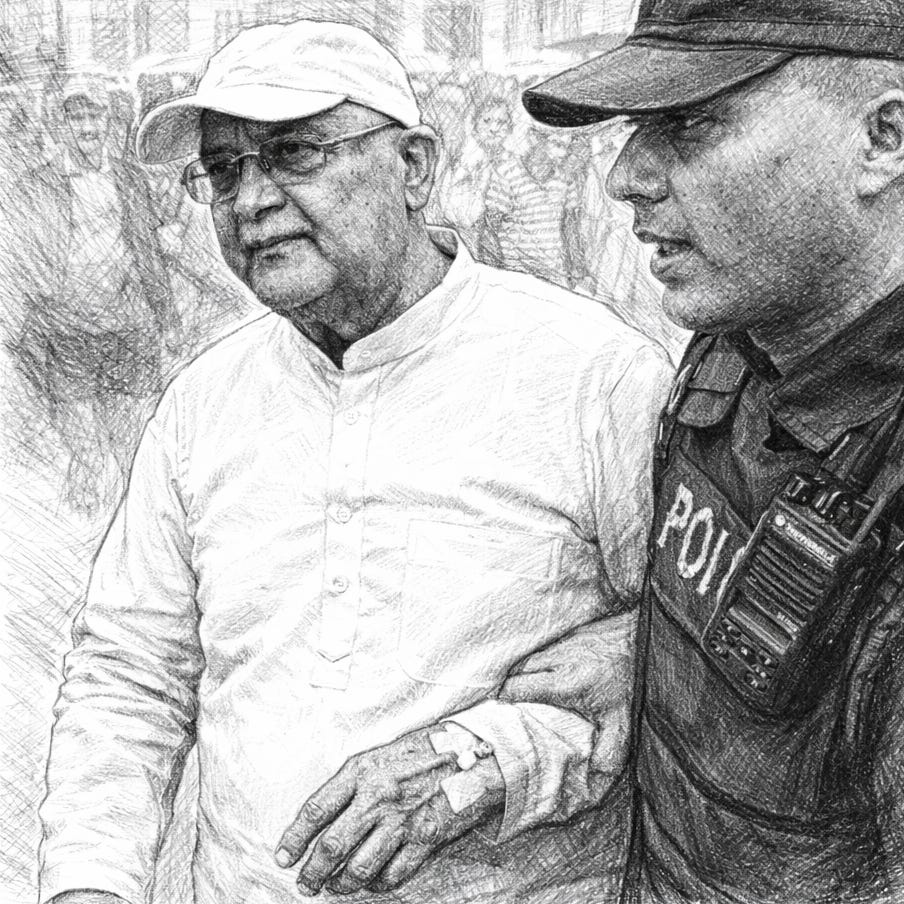
Just 24 hours after Balen Shah was sworn in, police detained former Prime Minister KP Sharma Oli and ex-Home Minister Ramesh Lekhak on charges of criminal negligence amounting to reckless homicide — tied directly to the September 8–9, 2025 Gen Z protest crackdown that left 76 people dead, including minors. The arrests followed the new government’s decision to implement the Gauri Bahadur Karki Commission report, which had identified political leaders who authorised force against protesters. Oli, a post-renal transplant patient, was hospitalised at Tribhuvan University Teaching Hospital and appeared before Kathmandu District Court via video link; the court initially granted a 2-day remand, later extended to 5 days. Within the government’s first five days, five high-profile figures were in custody: Oli, Lekhak, former minister Deepak Khadka, Lumbini Province lawmaker Rekha Sharma, and former Chief District Officer Chhabilal Rijal. Foreign Policy ran the arrests under the headline “Nepal’s New Leaders Go on the Offensive.” CPN-UML has announced a two-week nationwide protest campaign beginning April 11, calling the detentions “illegitimate, unconstitutional, and political revenge,” while Nepali Congress accused the government of “selective” justice — targeting politicians while forming a separate study committee for the security forces who pulled the triggers. The opposition’s argument has a point: accountability that stops at the politicians who gave orders but doesn’t reach the officers who carried them out will feel incomplete to the families of the 76 (Al Jazeera, Kathmandu Post, Foreign Policy).
100-Point Reform Agenda — The Most Ambitious Blueprint Nepal Has Seen
The Balen Shah Cabinet didn’t wait for the honeymoon period. At its very first meeting, the government released a 100-point governance reform roadmap that is either a masterclass in ambition or a setup for spectacular disappointment — possibly both. The headline items: federal ministries to be cut from ~22 to 17 within 30 days; an Asset Investigation Committee formed within 15 days to probe illicit wealth of political leaders and officials from 1990 onward; a ban on student politics in educational institutions, with non-partisan Student Councils replacing political unions within 90 days; and a pledge to fully digitise government services — including doorstep delivery of passports, citizenship certificates, and driving licences via a new “Government Courier Service” within 100 days. In parallel, Finance Minister Dr. Swarnim Wagle launched his own reform blitz: he abolished the Revenue Investigation Department in his first executive action, initiated the repeal or amendment of 15 outdated laws (some dating to 1956), and set growth targets of 7% annual GDP over five years with per capita income above $3,000. The Confederation of Nepalese Industries welcomed the signals. Fitch Ratings noted that RSP’s majority “reduces near-term political uncertainty” but cautioned that “weak implementation capacity may constrain results.” The plan is on paper. Now comes the hard part (Kathmandu Post, Nepal News, Kathmandu Post).
In Brief: The political machinery is cranking into gear.
The first session of the new Federal Parliament opened on April 2 at Singha Durbar. Speaker nominations are set for April 3, with the election on April 5. RSP President Rabi Lamichhane — who separately appeared before Parsa District Court on April 1 for his Rs 115.69 million cooperative fraud case — addressed the first House session, declaring “the prosperity of the country is the only aim of the government” (Radio Nepal, Khoj Samachar).
A constitutional amendment task force has been formed under PM’s political advisor — and filmmaker — Asim Shah. The all-party body will draft a discussion paper on reforming electoral systems and federal structures, with a directly elected executive PM among the options on the table. The appointment of a filmmaker to chair a constitutional process has drawn predictable backlash (Spotlight Nepal, The Statesman).
The Lipulekh sovereignty dispute is heating up again. India and China are preparing to resume border trade through the disputed pass in June 2026, after a six-year hiatus. Nepal claims Lipulekh as sovereign territory — enshrined in a 2020 constitutional amendment — and public pressure is mounting on the new government to take a clear stand. It’s the first foreign policy test for FM Shishir Khanal (Kathmandu Post, PressAdda).
🌍 Diaspora & Globalisation
Gulf Crisis Escalates — Rescue Flights Launch as Bodies Finally Come Home
The Gulf migrant crisis entered a critical new phase this week. A chartered Kuwait Airways flight landed at Gautam Buddha International Airport on April 1 carrying the bodies of 9 deceased Nepali workers and over 300 stranded citizens — the first major repatriation since the conflict disrupted the region in late February. Foreign Minister Shishir Khanal then convened an emergency meeting and ordered Nepal Airlines special rescue flights to Dubai (April 3–4) and Dammam, Saudi Arabia (April 5) — the first such flights since regular service was suspended on February 28. One Nepali has been confirmed killed — Dibas Shrestha, a 29-year-old security guard from Gorkha, hit by shrapnel from an intercepted missile at Abu Dhabi’s Zayed International Airport. His family had been planning his wedding. A Human Rights Watch report released April 1 documented the toll on South Asian workers across six Gulf states: salary cuts (some employers slashing pay by half), mass layoffs, and workers trapped without exit options. A Nepali chef in Abu Dhabi told HRW: “To lose a job after taking recruitment loans is sad. People pay 300,000–400,000 Nepali Rupees for these jobs.” Labour permits remain frozen for 12 countries, with over 2,000 workers denied permits daily. Khanal has formed an eight-member panel to recommend a long-term national strategy for protecting citizens abroad — a policy framework Nepal has never had (Kathmandu Post, ANI, Human Rights Watch).
Nepal Summit at Harvard — The Diaspora Builds Its Own Table
In a signal that the Nepali diaspora is maturing beyond remittance cheques and cultural associations, students at Harvard and MIT have announced “Nepal Discourse 2026” — the first-ever Nepal summit at an Ivy League institution, scheduled for April 25–26 in Cambridge, Massachusetts. The invitation-only event expects ~400 participants and ~30 speakers drawn from tech, policy, and academia — including Biswas Dhakal (F1Soft), Prasanna Dhungel (GrowByData), Sameer Maskey (Fusemachines/Columbia University), David Sislen (World Bank), and Peter Blair (Harvard Kennedy School). The summit is organised around four pillars: AI and the future of work, next-gen leadership, resilient institutions, and diaspora engagement. It’s backed by Leadership Academy Nepal and Kantipur Media Group. The timing couldn’t be better: with an RSP government that owes much of its momentum to young Nepalis at home and abroad, and a diaspora that has been demanding a seat at the policy table, this is a chance to move from asking for change to designing it (Kathmandu Post).
In Brief: More diaspora developments this week.
Remittances surged 37.7% to Rs 1.449 trillion ($10.15 billion) in the first eight months of FY 2025/26, with forex reserves hitting $23.08 billion (18.5 months of imports). But economists warn the numbers mask a “sluggish” economy — production, investment, and job creation aren’t keeping pace with money flows (Radio Nepal, Spotlight Nepal).
Australia has moved Nepal to Assessment Level 3 (high-risk) for student visas, requiring mandatory upfront proof of financial capacity (AUD 29,710 for living costs plus tuition) after a spike in fraudulent documents. Processing times have stretched to 4–12 weeks, affecting thousands of Nepali applicants (Access Edu).
US TPS for ~12,700 Nepalis remains effectively terminated after the 9th Circuit Court stayed a lower court’s reversal in February. Meanwhile, 585 Nepalis have been deported under the current administration, with January 2026 recording the highest monthly total at 101 (Kathmandu Post).
💸 Economy & Development
Wagle’s First Week — Abolishing Laws, Setting Targets, Earning Cautious Praise
Finance Minister Dr. Swarnim Wagle isn’t wasting time. The PhD economist — who spent 25+ years at UNDP and the World Bank — made the abolition of the Revenue Investigation Department his first executive decision, calling it a relic of a “harassment-based” enforcement culture. He followed up by initiating the repeal or amendment of 15 outdated laws, including the Export-Import (Control) Act of 1956 and the Foreign Investment Prohibition Act of 1964 — legislation older than most of his cabinet colleagues. The government has set growth targets of 7% average annual GDP over five years, with per capita income above $3,000 and the economy approaching Rs 10 trillion. Wagle ordered a comprehensive Economic Status Report within five days and pledged 100-day, semi-annual, and annual action plans for every ministry. The Confederation of Nepalese Industries welcomed the agenda. Fitch Ratings assessed that RSP’s majority “reduces near-term political uncertainty” and maintained Nepal’s BB- stable outlook, but cautioned that “weak implementation capacity may constrain results” — diplomatic language for: Nepal’s problem has never been a lack of plans (Kathmandu Post, Clickmandu, Ratopati).
NRB’s 8-Month Report — Record Reserves Hide a Fragile Reality
Nepal Rastra Bank’s latest macroeconomic snapshot looks impressive on paper: forex reserves at $23.08 billion (up 27.5%, covering 18.5 months of imports), remittances at Rs 1.449 trillion (up 37.7%), a balance of payments surplus of Rs 658 billion, and CPI inflation holding at 3.62%. But look beneath the headline numbers and the picture is less reassuring. The economy remains structurally dependent on remittances — money earned abroad that sustains consumption at home but doesn’t build productive capacity. NEPSE dropped sharply from 2,950 to 2,782 in a single week as the post-inauguration euphoria faded and global uncertainty weighed on sentiment. And at the household level, the fuel-driven cost-of-living squeeze is real: with petrol at Rs 187 and diesel at Rs 167, freight costs have pushed food prices up Rs 30–50 across the board. The informal “Momo Index” — the price of Nepal’s beloved dumplings — has hit an all-time high, which may sound trivial but is a near-perfect proxy for how ordinary families are feeling the pinch (Nepal News, myRepublica, Trending Net Nepal).
In Brief: A few more economic signals worth watching.
The $2.32 billion Dudhkoshi Storage Hydroelectric Project (670MW) has secured unprecedented multilateral backing — ADB ($580M), EIB ($500M), World Bank ($200M), AIIB ($200M), OFID ($100M), and SFD ($100M). The 220-metre dam in eastern Nepal would be a game-changer for energy security. Financial approval is expected by September 2026 (Kathmandu Post, AIIB).
Tourism keeps climbing. March recorded 120,516 international arrivals, and Nepal Tourism Board announced Nepal-ASEAN Tourism Year 2026. The country is on track to surpass its pre-pandemic 2019 peak if momentum holds (Ratopati).
Nepal is racing to exit the FATF grey list by year’s end, but remains compliant with only 21 of 40 anti-money laundering recommendations. The 100-point reform agenda includes AML measures, but weak investigation and prosecution capacity remain the bottleneck (Clickmandu).
⭐ Social & Cultural
Measles Crisis Deepens — “We Don’t Have Vaccines in Stock”
Nepal’s measles crisis is escalating into a public health emergency. The country has experienced its fourth outbreak since January 2026, with the disease spreading from Malangawa (Sarlahi) to Dhorpatan (Baglung) and now into neighbouring Nisikhola and Badigad rural municipalities. Dozens of children have been hospitalised. The most alarming revelation came from Dr Abhiyan Gautam, chief of the Immunisation Section, who told the Kathmandu Post: “We don’t have measles vaccines in stock for outbreak response.” There is no dedicated budget for outbreak-response vaccines, and aid agencies have yet to provide requested doses. Nepal had set an ambitious target to eliminate measles by 2026 — a goal now in serious jeopardy as the new Health Minister Nisha Mehta inherits a crisis that requires immediate funding and vaccine procurement. The WHO helped contain an earlier outbreak in Sarlahi through rapid response, but the vaccine supply gap means each new outbreak is a race against time with dwindling ammunition (Kathmandu Post, WHO Nepal).
Nepal Cricket Gears Up — World Cup Squad Named, New Jersey Unveiled
Nepal’s cricket journey continues to build momentum. The Cricket Association of Nepal has named a 24-member camp squad for the ICC Men’s T20 World Cup 2026 build-up, headlined by captain Rohit Paudel, spin sensation Sandeep Lamichhane, and all-rounder Dipendra Singh Airee. Emerging talents from the Nepal Premier League — including Sher Malla, Abinash Bohara, and Pratish GC — earned their places alongside the established core. CAN also unveiled a new national jersey: deep navy blue with crimson red accents, “NEPAL” in bold white across the chest, the crescent moon and sun from the national flag on opposite shoulders, and a Mount Everest graphic at the base. Fan jerseys are priced at Rs 799 and the player version at Rs 3,499. Nepal will travel to the Netherlands in July for a tri-series with Namibia as part of World Cup League 2 qualification, and the Women’s T20 World Cup Qualifiers will be hosted at home later this year. For a country that barely played cricket a generation ago, the trajectory is remarkable (CricNepal, CricNepal, ICC).
In Brief: A few more stories to round out the week.
SEE 2026 exams kicked off on April 2, with 512,421 students sitting across 1,966 centres nationwide. For the first time, female candidates (257,613) outnumber males (254,801). The exams were delayed 12 days due to the March 5 elections — a small disruption in the grand scheme, but a stressful one for half a million teenagers (Spotlight Nepal).
The 9th Nepal International Film Festival (April 2–6) is screening 88 films from 40 countries at QFX Civil Mall under the theme “Future Forward,” featuring workshops on AI filmmaking. Separately, “Purna Bahadurko Sarangi” became the first Nepali film to earn approximately Rs 500 million domestically and Rs 250 million abroad — a box office milestone (Kathmandu Post, Lens Nepal).
Nepali New Year and Bisket Jatra are just around the corner (April 14–15). Bhaktapur’s dramatic chariot processions carrying idols of Kal Bhairav and Bhadra Kali, and Thimi’s vibrant Sindoor Jatra, are highlights of the cultural calendar for anyone planning a visit or feeling nostalgic from abroad.
Until next week, stay connected! — The Nepali Diaspora Digest Team
Let’s connect
Enjoying this issue? 📩 Share it with a friend & let’s keep Nepalis worldwide in the loop! Got thoughts? Hit reply—we’re all ears! Or let us know what you think via our Feedback form or follow us on Facebook | LinkedIn
P.S. Got a story or issue you’d like us to cover next week? Drop us a reply — we’re building this space together.
About Nepali Diaspora Digest:
The Nepali Diaspora Digest connects the global Nepali community with curated news, insights, and stories that matter most. Join us as we celebrate and explore the diverse voices and achievements of Nepalis worldwide.
Partner shout out
belayat.uk: helping Nepalis connect in the UK on jobs, housing, events and finding local Nepali owned businesses


