



Namaste, diaspora family! If last week was about ordinances, this week is about what happens when a government uses them at scale. PM Shah’s Constitutional Council bypassed three senior justices including the woman who would have been Nepal’s first female Chief Justice to pick its own candidate. Meanwhile, 1,594 political appointees were terminated overnight, 12 trade unions were scrapped, and a botched import labelling rule stranded 2,000 trucks at the border before the government quietly backed down. On the diplomatic front, the Lipulekh dispute with India is back after six years. And if you’re one of the 3,933 Nepalis holding a DV lottery selection and waiting for a visa that isn’t coming, the clock is ticking. Let’s get into it.
🏛️ Politics & Governance
Chief Justice Controversy — Sharma Picked Over Nepal’s First Woman CJ
The Constitutional Council made history on May 7 just not the kind most people were hoping for. In a meeting convened by PM Shah, the council recommended Dr. Manoj Kumar Sharma as Nepal’s next Chief Justice — bypassing the three most senior justices, including Acting CJ Sapana Pradhan Malla, who would have been Nepal’s first woman to lead the judiciary. Sharma is ranked fourth in the seniority order, making this the first time in Nepal’s history that a judge so far down the hierarchy has been elevated to the top. The move was enabled by the Constitutional Council First Amendment Ordinance, signed by President Paudel on May 5 to break an eight-month institutional deadlock. National Assembly Chair Narayan Prasad Dahal and opposition leader Bhishma Raj Angdembe registered written dissent. The Nepal Bar Association called an emergency meeting. Sharma must still clear a parliamentary hearing — but the signal is clear: this government is willing to reshape the judiciary on its own terms (Khabarhub, Himalaya Times, Nepal Press).
The Great Purge — 1,594 Appointees Terminated, 12 Trade Unions Scrapped
The most sweeping administrative overhaul in recent memory landed this week — and it’s still reverberating. On May 2, President Paudel endorsed an ordinance that automatically terminated 1,594 office-bearers appointed prior to March 26 across more than 110 laws and dozens of institutions: Tribhuvan University, Kathmandu University, eight other universities, Nepal Telecommunications Authority, Civil Aviation Authority, Nepal Airlines, Nepal Electricity Authority, the Employees Provident Fund, and Gorkhapatra Sansthan, among others. Vice-chancellors, registrars, board members all gone. Four days later, the government annulled 12 civil service and health trade unions for alleged political affiliations and ordered them to return government property. Former University Grants Commission chairperson Bhim Prasad Subedi warned: “Such massive vacancies at once can create confusion.” The government frames it as depoliticisation. Peoples’ Review asks the harder question: “Mass Dismissals: Fixing Politics or Fueling Instability?” No timeline for replacements has been announced (Kathmandu Post, Spotlight Nepal, Peoples’ Review).
In Brief: More governance developments this week.
Parliament finally has a date. President Paudel summoned both houses for May 11 the budget session where the government must present its annual budget by May 29. It may be the first session held in the new parliament building at Singha Durbar (Kathmandu Post).
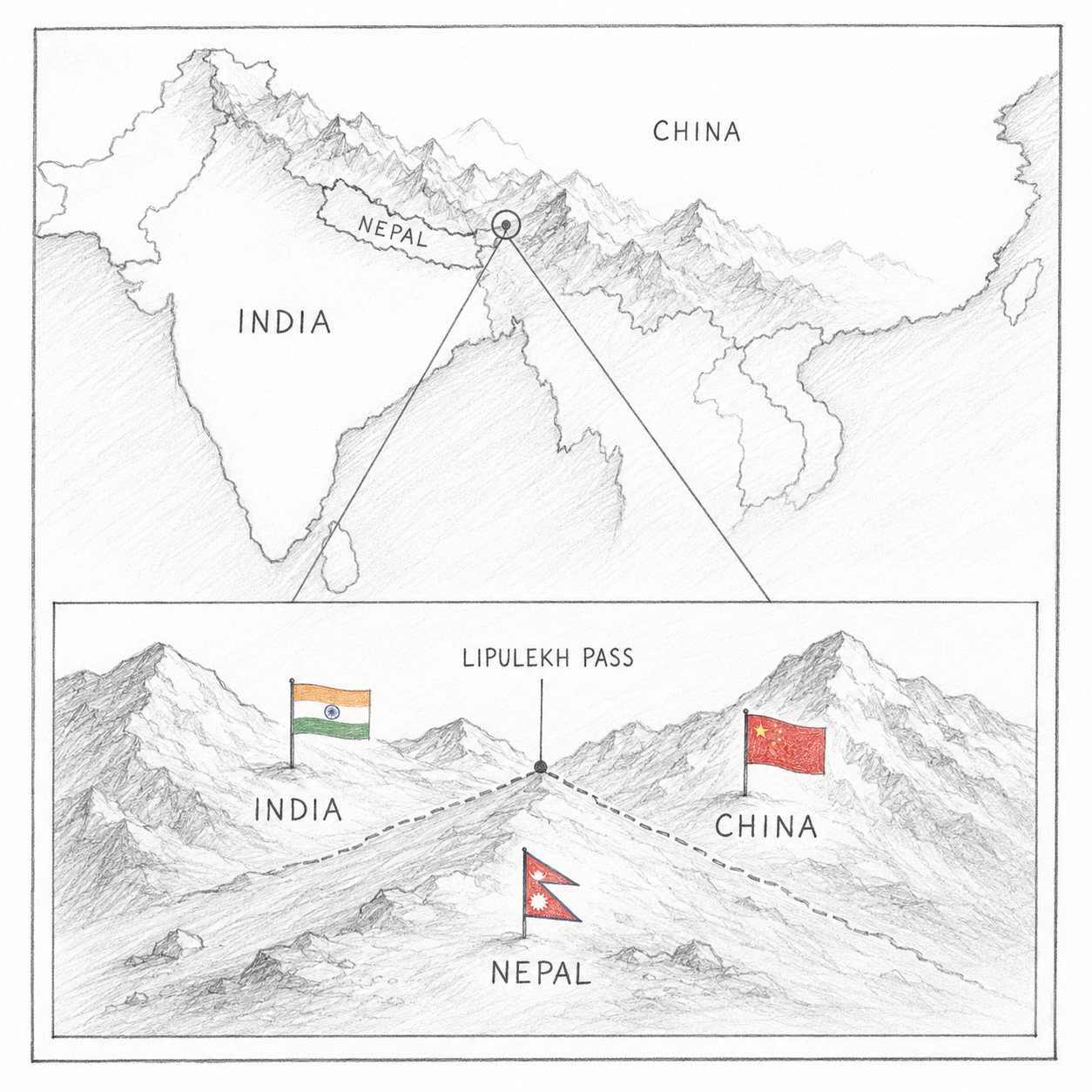
The Lipulekh dispute is back. Nepal’s Foreign Ministry lodged a formal diplomatic protest against India’s plan to route the 2026 Kailash Mansarovar Yatra through Lipulekh Pass territory Nepal claims under the 1816 Treaty of Sugauli. India’s MEA called the claim “untenable.” The Cabinet sent notes to both India and China (Al Jazeera).
Bank chairs are out too. The chairs of Rastriya Banijya Bank and the Agricultural Development Bank resigned amid the government’s wider institutional shake-up (Khabarhub).
🌍 Diaspora & Globalisation
Lipulekh Stand-Off Returns — Nepal Fires Diplomatic Protest Over Pilgrimage Route
If you were in Kathmandu in 2020 when India built a road through Lipulekh and the streets erupted, you remember what this issue means. It’s back. On May 3, Nepal’s Ministry of Foreign Affairs lodged a formal diplomatic protest after India and China announced plans to resume the Kailash Mansarovar Yatra sending approximately 500 Hindu pilgrims through the Lipulekh Pass in Uttarakhand between June and August. Nepal’s position is unambiguous: Limpiyadhura, Lipulekh, and Kalapani are Nepali territory, defined by the 1816 Treaty of Sugauli that drew the Kali River as the western boundary. India’s Ministry of External Affairs rejected the claim, stating it is “neither justified nor based on historical facts.” China, for its part, treated the yatra as a bilateral India-China arrangement — effectively ignoring Nepal’s protest. The Cabinet sent diplomatic notes to both governments. For the diaspora, this is a sovereignty question that cuts across party lines and generations — and PM Shah’s willingness to push back will be closely watched (Al Jazeera, Nepal News).
America’s Doors Keep Closing — DV Freeze, $15K Bonds & 800+ Deported
The US visa crisis facing Nepalis is now hitting from every direction simultaneously. The diversity visa lottery for decades the single biggest pathway for Nepalis to reach America — has been frozen since December 23, 2025. No DV visas are being stamped, even as interviews proceed at the Kathmandu embassy. For Nepal’s 3,933 DV-2026 selectees, the September 30 deadline is approaching fast if the freeze isn’t lifted, their numbers expire and the dream dies. It gets worse: the F-1 student visa refusal rate hit 81% in 2025. B1/B2 tourist and business visa applicants now face bonds of up to $15,000. And deportations have passed 800 since Trump’s second term began with 231 removed in January and February alone. The termination of Temporary Protected Status means an additional 7,000+ Nepalis face potential removal. NepYork’s investigation “Tricked, Trafficked, and Tossed Out” documents the dangerous pipeline many face. For families who’ve invested everything in an American future, the walls are closing in (Nepal News, NepYork).
In Brief: More diaspora developments this week.
NRN legislation is moving. The government is preparing a draft NRN Act for the upcoming parliamentary session the first concrete legislative effort to codify the rights, responsibilities, and contributions of Nepalis abroad in years. Foreign Minister Shishir Khanal is leading the push (Peoples’ Review).
The South Asia Trade Fair 2026 opened at Bhrikutimandap Exhibition Hall (May 7–11) with participants from all SAARC nations a rare regional trade event in Kathmandu, organised in collaboration with Bangladesh’s Ministry of Industries (Nepal News).
💸 Economy & Development
The MRP Fiasco — 2,000 Trucks Stranded, Then the Government Blinked
Good policy, terrible execution. On April 28, the government made it compulsory for all imported finished goods to carry Maximum Retail Price (MRP) labels before clearing customs. The idea was consumer protection. The reality was chaos. Traders halted clearance across every major border point Birgunj, Bhairahawa, Biratnagar, Nepalgunj, Rasuwagadhi, Kakarbhitta arguing it was logistically impossible to label thousands of individual items at the border. In Birgunj alone, 2,000 trucks sat idle. Customs revenue dropped over 50%. The standoff exposed an embarrassing rift between the PM’s Office and the Finance Ministry over who authorised the rule and who should fix it. The crisis escalated through the Department of Customs, the Ministry of Industry, the PMO, and finally the Finance Minister before a resolution emerged. On May 7–8, the government backed down: importers can now self-declare MRP at customs and affix labels at their warehouses. The temporary fix runs for three months while permanent rules are drafted for the 2026/27 budget (Peoples’ Review, Kathmandu Post).
Simara SEZ Comes Alive — Six Industries, 700 Jobs & a Lesson in Incentives
Nepal’s special economic zones have been promised, delayed, and mocked for years. This week, one of them actually worked. Six industries in the Simara Special Economic Zone have begun production Pashupati Ceramics, Brilliant Shoes, Balaji Manufacturing, Nepal Agro Tools, ACM Vehicles, and Biokalpa Nepal — creating approximately 700 jobs. The catalyst? A simple policy change: the government slashed land rent from Rs 20 to Rs 5 per square metre, and investment surged. A total of 21 industries are now registered in the zone, with new projects backed by Indian, Chinese, and South Korean investors including a ceramics joint venture with India’s AGL Group and a South Korean cosmetics facility. It’s still one zone out of several that remain largely empty — but Simara is now proof that when the incentive structure works, the investment follows (Kathmandu Post, Ujyaalo Nepal).
In Brief: A few more economic signals this week.
The Nagdhunga tunnel is almost here. The Japan-built Nagdhunga-Sisnekhola tunnel is set for its trial run in mid-May, with free vehicle passage during testing. A Chinese-Nepali joint venture (Yusin-ART JV) will operate it with 150 staff. Commercial operation is targeted for July, promising a 7-minute Dhading–Kathmandu journey (Khabarhub).
NEPSE keeps sliding. The index closed at 2,708.58 — down from 2,738 last week and 2,838 the week before. The sustained decline reflects persistent economic uncertainty and weak market sentiment (ShareHub).
E-billing goes mandatory. The Inland Revenue Department now requires electronic billing for businesses with Rs 10 crore+ annual turnover (Rs 5 crore for hospitality). One-month compliance deadline. Part of the broader digital governance push (Nepal News).
⭐ Social & Cultural
Save Kamalpokhari — Heritage Protesters Take On Thamel’s Controversial Complex
A Licchavi-era pond, a commercial complex built on top of it, and a fight that has been simmering for over a decade came to a head this week. Protesters gathered at Maitighar Mandala demanding the demolition of the Chhaya Devi Complex in Thamel — a commercial building constructed on land that includes the historic Kamalpokhari pond, a sacred Newar heritage site believed to date back to the Licchavi kingdom (450–750 AD). The case has reached the Supreme Court, which is examining whether guthi (communal trust) land can be retained in private hands through a settlement agreement. Lead activist Bhagabat Narsingh Pradhan, who has campaigned for the pond’s restoration for years, has faced threats, intimidation, and a contempt of court case — prompting UN human rights experts to flag the case internationally. For a government that bulldozed riverbank settlements in the name of urban reform, the Kamalpokhari question is a test: does heritage protection get the same energy as encroachment clearance? (Ratopati, ShareHub).
Four Golds in Hainan — Nepal’s Taekwondo Stars Shine in China
Nepal doesn’t win four gold medals at an international tournament every week — so when it happens, it deserves a moment. At the Hainan Open International Taekwondo Championship in Sanya, China, Nepali athletes brought home four golds. Vision Tamang led the charge with two gold medals, while Ayush Bohra and Sandeep Basnet (in the breaking event) each added one. The results are a reminder that Nepal’s combat sports athletes — often underfunded and underrecognised — continue to punch above their weight on the international stage. Coach Indraraj Khadka led the squad. For a country where cricket and football dominate headlines, these are the quiet achievers who keep showing up (Radio Nepal, Nepal News).
In Brief: A few more stories to round out the week.
Cricket ended on a high. Nepal hammered Oman by 81 runs on May 5 to close the home tri-series. Now the real test: Scotland and the USA arrive from May 12 for the next CWC League 2 round. Nepal sit 7th with 12 points — 16 still available from remaining home matches. World Cup qualification is difficult but mathematically alive (Wisden).
Football remains in limbo. The NSC-ANFA dispute blew past the May 4 FIFA deadline with no resolution. Nepal’s women’s team has already pulled out of the FIFA Women’s Series, the National League is suspended, and youth competitions are cancelled. A FIFA ban now looks increasingly likely (Kathmandu Post).
Women’s cricket heads to Malaysia. The national squad, captained by Indu Barma, has been named for the ACC Women’s Premier Cup (May 23–31) and Asian Games Qualifiers (June 1–13) (Nepal News).
Until next week, stay connected!
Let’s connect
Enjoying this issue? 📩 Share it with a friend & let’s keep Nepalis worldwide in the loop! Got thoughts? Hit reply—we’re all ears! Or let us know what you think via our Feedback form or follow us on Facebook | LinkedIn
P.S. Got a story or issue you’d like us to cover next week? Drop us a reply — we’re building this space together.
About Nepali Diaspora Digest:
The Nepali Diaspora Digest connects the global Nepali community with curated news, insights, and stories that matter most. Join us as we celebrate and explore the diverse voices and achievements of Nepalis worldwide.
Partner shout out
belayat.uk: helping Nepalis connect in the UK on jobs, housing, events and finding local Nepali owned businesses


