



Namaste, diaspora family! Two weeks into the Balen era and the plot is already thickening. The Supreme Court ordered former PM KP Sharma Oli released after 13 days in custody and his CPN-UML has announced a nationwide protest campaign starting tomorrow. Meanwhile, petrol has been hiked four times in a single month and now costs more than a plate of dal bhat in some neighbourhoods, the World Bank just halved Nepal’s growth forecast to 2.3%, and 38 bodies of Nepali workers remain stranded across the Gulf because the flights can’t get through. But it’s not all grim: Bisket Jatra is rolling through Bhaktapur, half a million students are finishing their SEE exams, and NEPSE just had its best week in months. Naya Barsha 2083 is days away. Let’s get into it.
🏛️ Politics & Governance
Supreme Court Checks the Executive; Oli and Lekhak Walk Free After 13 Days
The judiciary drew a line. On April 7, the Supreme Court ruled that former Prime Minister KP Sharma Oli and ex-Home Minister Ramesh Lekhak did not need to remain in custody for the ongoing investigation into the September 2025 Gen Z protest crackdown that killed 76 people. The court ordered authorities to either complete the investigation or release both men by Thursday, April 9. On Thursday morning, they walked out — released on bail after 13 days in judicial custody, with the condition that they appear before authorities when required. The case itself is far from over: the charges of criminal negligence amounting to reckless homicide still stand, and the investigation continues under the Gauri Bahadur Karki Commission framework. But the Supreme Court’s intervention sent a clear signal — even in a moment of political reckoning, due process matters. CPN-UML has announced a two-week nationwide protest campaign beginning April 11: demonstrations in all municipalities, expanding to ward-level on April 16, provincial capitals on April 20, and a grand rally in Kathmandu on April 25. The party calls the arrests “illegitimate, unconstitutional, and political revenge.” Whether the protests gain traction or fizzle will be the first real test of whether the old parties can still mobilise on the streets in the RSP era (Kathmandu Post, Kathmandu Post, Spotlight Nepal).
Nepal’s Legacy Parties Face an Existential Crisis
While all eyes were on Oli’s custody drama, a quieter crisis is unfolding inside Nepal’s two establishment parties — and it may be more consequential. Spotlight Nepal this week published a damning analysis titled “NC and UML: On the Brink of Collapse,” while the Kathmandu Post editorial board ran “Reform or Collapse: The UML is Running Out of Time to Save Itself.” The numbers tell the story: Nepali Congress was reduced to 38 seats (its worst ever), with party president Gagan Thapa losing his own seat. CPN-UML collapsed to 25 seats, losing more than two-thirds of its previous strength. Inside UML, the cracks are visible. Ram Bahadur Thapa was elected parliamentary leader after young lawmaker Suhang Nembang was pressured not to run — a move that has alienated younger cadres. Thapa then blamed the Nepal Army, Nepal Police, and civil servants for the party’s defeat in his House address, a claim that drew ridicule. Nepali Congress has taken a strikingly different approach to the Oli arrest — remaining largely silent and respecting the legal process — but this restraint masks the same internal paralysis. Both parties face a fundamental question: can organisations built on patronage politics reinvent themselves in a country that just gave a rapper a supermajority? The answer will shape whether Nepal develops a functioning opposition or drifts toward de facto one-party dominance (Spotlight Nepal, Kathmandu Post).
In Brief: The political machinery keeps grinding.
President Ram Chandra Paudel addresses a joint session of both houses of parliament today (April 10) at 3:00 PM — the first presidential address since the March 5 elections. Under Article 95, the speech outlines the government’s policy direction and legislative agenda. The current session will be prorogued from midnight tonight (Nepal News, Ratopati).
A government advertising directive issued April 1 — requiring all ministries to publish notices exclusively through state-owned media — has triggered a full-blown press freedom row. The Federation of Nepali Journalists launched a pressure campaign on April 8, calling it “an attack on private media.” Rural radio stations that depend on local government ads face an existential threat. IFEX flagged the move internationally (IFEX, Himalaya Times).
Education Minister Sasmita Pokharel’s ban on bridge courses and entrance prep classes lasted approximately two hours before a contradictory clarification narrowed it to classes up to Grade 12 only. The original press statement was quietly removed from the ministry website, fuelling accusations of policy-by-impulse (The Statesman, Khabarhub).
PM Shah expanded his Cabinet on Friday, inducting two new Madhesi lawmakers: Ramji Yadav (Saptari-2) takes Labour, Employment & Social Security — replacing dismissed minister Dipak Kumar Sah — and Gauri Kumari Yadav (Mahottari-4) takes Industry, Commerce & Supplies, a portfolio the PM had been holding himself. The cabinet is now 17 members (Kathmandu Post).
🌍 Diaspora & Globalisation
Gulf Crisis: 38 Bodies Stranded as War Disrupts Flight Routes
The human cost of the Gulf conflict keeps mounting. As of April 4, the bodies of 38 deceased Nepali workers remain stranded across the region — 17 in Riyadh, 15 in Dubai, 5 in Jeddah, 4 in Abu Dhabi, 3 in Tel Aviv, 2 in Qatar, and one each in Oman and Bahrain. Foreign Ministry spokesperson Lok Bahadur Chettri told reporters that flight disruptions caused by the ongoing US-Israel-Iran conflict are making repatriation “extremely difficult.” The government has dispatched non-scheduled flights to Dubai and continues Nepal Airlines rescue operations, but irregular commercial routes — particularly from Riyadh and Tel Aviv — mean families are enduring waits of over a month to bring their loved ones home. The broader picture is equally sobering: 86,420 Nepalis have registered on the government’s online evacuation platform. A Spotlight Nepal analysis this week — “Beyond Remittance: A Crisis of Dignity and Protection” — argued that Nepal has never built the institutional infrastructure to protect its citizens abroad, despite sending 1.7 million workers to the Gulf. Labour permits remain frozen for 12 countries, with over 2,000 workers denied permits daily. The eight-member panel formed by FM Khanal to recommend a long-term protection strategy is the right idea — but the 38 coffins waiting for flights are a reminder of how late it comes (Kathmandu Post, Spotlight Nepal).
World Bank Warns: Gulf War Threatens Nepal’s Remittance Lifeline
The World Bank’s Nepal Development Update, released April 8 under the title “Growth Under Pressure: Navigating Domestic and Global Shocks,” paints a stark picture of what a prolonged Gulf conflict means for Nepal’s most important income stream. The report projects GDP growth of just 2.3% in FY26 — halved from 4.6% in FY25 — and explicitly names the Middle East conflict as the primary driver. Here’s why the diaspora should pay attention: Gulf countries contribute 41% of Nepal’s remittances, which in turn account for 28.6% of GDP. A prolonged conflict doesn’t just mean stranded workers — it means reduced earnings, delayed transfers, and weaker consumption back home. The services sector, which includes tourism, is expected to be “most affected,” with higher transport costs and supply chain disruptions compounding the damage. The World Bank does offer a silver lining: growth could recover to an average of 4.4% over FY27–28, driven by reconstruction, hydropower expansion, and spending ahead of 2027 subnational elections. But that recovery assumes the Gulf stabilises — and right now, with crude above $105 and the Strait of Hormuz still contested, that’s an assumption, not a certainty (World Bank, Himalayan Times).
In Brief: More diaspora developments this week.
The US Supreme Court is hearing arguments on TPS lawsuits (Haiti and Syria) this month, with a decision expected by early July. The ruling could shift the legal landscape for 7,000+ Nepalis whose TPS was effectively terminated after the 9th Circuit stay in February. Meanwhile, 585 Nepalis have been deported since Trump’s second term began (Kathmandu Post).
Australia’s Assessment Level 3 designation for Nepali student visas continues to bite — mandatory upfront proof of AUD 29,710 in living costs plus tuition, with processing times stretched to 4–12 weeks. Thousands of applicants are affected as the new academic cycle begins (Access Edu).
💸 Economy & Development
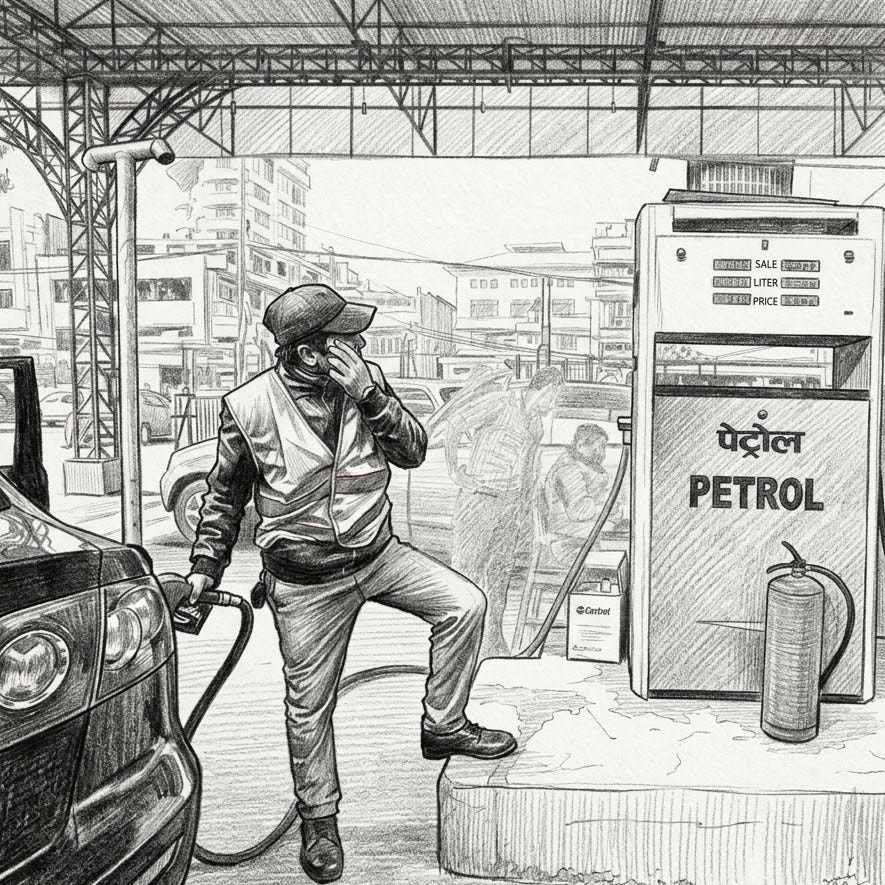
Petrol Hits Record Rs 219 — Four Hikes in One Month as Gulf War Bites
It’s not a typo. Nepal Oil Corporation has raised fuel prices four times in a single month, and the numbers are staggering. As of April 10, petrol costs Rs 216.50–219 per litre depending on the region, and diesel sits at Rs 204.50–207. To put that in perspective: diesel was Rs 139 in February — a 47% jump in roughly five weeks. The cascading effects are hitting every household. On April 8, the Department of Transport Management approved a 16.71% increase in public transport fares, with cargo rates up 15.75–21.68% depending on route terrain. Economists estimate the cargo fare hikes alone could push inflation up by 2 percentage points. The government tried to intervene: on April 7, the Cabinet cut customs duty and infrastructure tax on petroleum imports by 50% — reducing the duty on petrol from Rs 25 to Rs 12.5 per litre. But here’s the catch: NOC is sitting on accumulated losses so large that it won’t pass the savings to consumers. The tax cut helps NOC’s balance sheet, not your fuel bill. The one genuine bright spot is the government’s parallel push on electrification — a new Cabinet decision this week approved a legal framework for converting petrol and diesel vehicles to electric, and Nepal’s EV charging network has grown to roughly 270 stations nationwide (Kathmandu Post, Spotlight Nepal, Kathmandu Post, Spotlight Nepal).
World Bank Halves Growth Forecast: Nepal’s Toughest Year Since COVID
The World Bank’s April 2026 Nepal Development Update doesn’t mince words. Growth is projected at 2.3% for FY26 — down from 4.6% in FY25 and the weakest performance since the pandemic year. The report, titled “Growth Under Pressure,” identifies a double blow: the Middle East conflict disrupting remittances, tourism, and supply chains, and the lingering economic damage from the September 2025 Gen Z protests, which caused an estimated Rs 86 billion in destruction and shattered investor confidence. The services sector — Nepal’s largest — is expected to bear the brunt, with tourism arrivals slowing, transport costs spiking, and consumption weakening as remittance flows face uncertainty. On the fiscal side, the fuel crisis is squeezing government revenue even as spending pressures mount. The one sector bucking the trend is electricity: power generation grew 22.74% in Q2, driven by continued hydropower expansion — a reminder that Nepal’s long-term energy story remains strong even as the short-term macro picture darkens. The World Bank expects recovery to 4.4% average over FY27–28, contingent on reconstruction spending, hydropower commissioning, and the economic stimulus that typically accompanies subnational elections. Finance Minister Dr. Swarnim Wagle’s response has been to accelerate the reform agenda — but even the best-designed reforms take time to show results, and Nepal’s economy is feeling the pain now (World Bank, World Bank PDF).
In Brief: A few more economic signals worth watching.
The ADB piled on the same day, projecting 2.7% growth in its April 2026 Asian Development Outlook — slightly more generous than the World Bank’s 2.3% but still a dramatic cut from 4.6% last year. The Kathmandu Post headlined it bluntly: “Nepal growth outlook dims as global lenders cut projections below 3 percent.” Two multilateral downgrades in the same week is hard to ignore (Himalayan Times, Kathmandu Post).
NEPSE had its best week in months, gaining 175 points across the week to close at 2,851.24 on Thursday. All 13 sub-indices rose, market capitalisation hit Rs 4.764 trillion, and single-day turnover reached Rs 8.31 billion. Analysts caution that trading volume hasn’t fully supported the rally (Kathmandu Post).
The Kathmandu-Terai Fast Track reached 43.6% physical progress this week, with the government approving land acquisition for the Nagdhunga Tunnel and Pasang Lhamu Highway sections. Completion remains targeted for March 2027 at the original Rs 201.3 billion budget (myRepublica).
Gold prices hit Rs 299,000 per tola before pulling back, reflecting global safe-haven demand amid Middle East uncertainty. The bullion market saw its most volatile week of the year (Kathmandu Post).
⭐ Social & Cultural
Naya Barsha 2083 — Nepal Rings in the New Year with Bisket Jatra
As the political world churns, Bhaktapur is doing what it has done for centuries. Bisket Jatra — the nine-day Newar festival marking the transition from Chaitra to Baisakh — kicked off on April 10 and will run through April 18, with Nepali New Year (Baisakh 1, 2083 BS) falling on April 14. The central ritual hasn’t changed in generations: massive wooden chariots carrying the idols of Kal Bhairav and Bhadra Kali are pulled through Bhaktapur’s narrow streets by residents in a dramatic tug-of-war, while the lingo (a 25-metre ceremonial pole) is erected and toppled in Pottery Square. Across the valley in Thimi, Sindoor Jatra — where participants drench each other in vermillion powder — will mark the new year’s dawn. For the diaspora, Naya Barsha is the annual reminder of what makes Nepal irreplaceable: a country where a 35-year-old rapper can run the government and a 500-year-old festival can still stop the city. If you’re in Bhaktapur, you’re lucky. If you’re not, call someone who is (Jagadamba Holidays, Termatree).
Half a Million Students Finish SEE — Results Coming in Record Time
The Secondary Education Examination (SEE) 2082 wraps up on April 12 after a 10-day run across 1,966 centres nationwide. Over 517,000 students sat for what remains Nepal’s most consequential academic milestone — and for the second consecutive year, female candidates outnumbered males. The big change this year is speed: the National Examination Board has approved a new procedure to check answer sheets directly at exam centres, promising results within one month — a dramatic improvement over the previous average of 79 days. For families anxiously waiting to plan the next step — whether that’s Grade 11 in Nepal, a bridge course (if the Education Minister’s policy survives the week), or an application abroad — faster results are a genuine quality-of-life improvement. The new academic session begins April 28, with formal teaching starting May 4 (RedVoiceNepal, Nepal News).
In Brief: A few more stories to round out the week.
Nepal will host ICC World Cup League 2 action at TU International Cricket Ground, Kirtipur, from April 25 to May 5 — a rescheduled tri-series with Oman and UAE that is crucial for 2027 Cricket World Cup qualification. Captain Rohit Paudel and the Rhinos need a strong home performance (ICC, Kathmandu Post).
The government launched a 10-point digital governance plan this week, headlined by the commitment to clear the 2.9 million driver’s licence backlog by mid-July. Domestic printing capacity of 40,000 cards per day — after shifting from foreign contractors — makes the target plausible, if ambitious (Clickmandu, Kathmandu Post).
Nepal Police arrested 226 people in four days of search operations targeting illegal activities including hooliganism and brokering — 51 from Kathmandu Valley alone. The crackdown signals the new Home Ministry’s approach to urban law and order.
Naya Barsha 2083 ko hardik shubhakamana! Happy Nepali New Year to you and yours.
Until next week, stay connected!
Let’s connect
Enjoying this issue? 📩 Share it with a friend & let’s keep Nepalis worldwide in the loop! Got thoughts? Hit reply—we’re all ears! Or let us know what you think via our Feedback form or follow us on Facebook | LinkedIn
P.S. Got a story or issue you’d like us to cover next week? Drop us a reply — we’re building this space together.
About Nepali Diaspora Digest:
The Nepali Diaspora Digest connects the global Nepali community with curated news, insights, and stories that matter most. Join us as we celebrate and explore the diverse voices and achievements of Nepalis worldwide.
Partner shout out
belayat.uk: helping Nepalis connect in the UK on jobs, housing, events and finding local Nepali owned businesses


