



Namaste, diaspora family! It’s a week of opposites back home: Sherpas fixed the Everest ropes for a record-breaking spring season just as the chief of one of Nepal’s biggest banks was hauled in by the CIB, and trucks of Ilam tea sat idle at the Indian border thanks to a new lab-testing rule out of Kolkata. We’ve also got a constitutional standoff at Sheetal Niwas, a fresh draft immigration law open for your comments, and the British Gurkha Cricket League back in full swing in the UK. Settle in.
🏛️ Politics & Governance
Cabinet resends Constitutional Council ordinance to the President
A quiet constitutional standoff broke into the open this week. The Cabinet decided to resend the Constitutional Council (First Amendment) Ordinance 2026 to President Ram Chandra Paudel without any changes after he returned it for reconsideration earlier in the month. The ordinance — which tweaks how key constitutional appointments (CIAA, Election Commission, Supreme Court justices) get pushed through the Council — has been a flashpoint since the Balen Shah government took office, with critics arguing it concentrates appointment power in the executive. By sending the same text back, the Cabinet is essentially daring the President to either issue it or trigger a more visible confrontation. For diaspora readers watching Nepal’s institutional balance, this is the first real test of how the Sheetal Niwas–Singha Durbar relationship will work under a non-traditional PM (Nepal News).
National Assembly digs into Wagle’s FY 2026/27 policy & programme
The National Assembly began formal deliberations on the government’s policies and programme for fiscal year 2026/27 following the President’s joint-sitting address on May 11. Eight amendment proposals have already been registered against Finance Minister Swarnim Wagle’s policy document — a relatively low number that hints at a smoother passage than many expected, but also previews the lines of fight: capital-budget execution targets, the diaspora financing instrument, and federal–province transfer math. The full budget itself lands later in May, but this is the philosophical scaffolding — and so far, the Wagle pitch of “execute, don’t announce” appears to be holding the centre of the conversation (Nepal News).
In Brief: Three smaller political stories worth flagging.
“Cleanliness Week 2026” kicked off May 11 from the PMO, branded “A New Commitment to Clean Governance” and covering all federal, provincial and local offices plus public schools — equal parts symbolism and signal (Nepal News).
The Supreme Court issued an interim order stopping authorities from dissolving student organisations, after a writ challenged a recent government decision — a small but meaningful win for campus politics (Nepal News).
Vice President Ram Sahay Prasad Yadav met EU Ambassador Veronique Lorenzo, marking 52 years of Nepal–EU ties and floating expanded cooperation in health, education, energy and rural development (Nepal News).
💸 Economy & Development
NIMB chief executive Jyoti Prakash Pandey detained by CIB
The week’s biggest economic story is also its most uncomfortable. Jyoti Prakash Pandey, chief executive of Nepal Investment Mega Bank (NIMB) — one of the country’s largest commercial lenders — was taken into custody by the Central Investigation Bureau on May 14 for investigation. NIMB sits at the heart of Nepal’s banking system, and a detention of a sitting CEO is genuinely rare; it lands on a sector already under pressure, with deposits ballooning to Rs 7.9 trillion while credit flow stagnates around Rs 5.87 trillion. The Nepal Rastra Bank has been quietly mopping up that excess liquidity (a fresh Rs 40 billion drained this week alone via a 21-day deposit-collection instrument), but a high-profile CEO probe will rattle confidence in ways macro tools can’t fix. Expect both regulatory ripples and political theatre in the days ahead (Nepal News).
Nepali tea trucks stuck at the Indian border
For a fourth straight week, the India–Nepal trade plumbing keeps clogging — this time at the tea border. The Tea Board of India’s new Standard Operating Procedure, enforced from May 13, requires every truck of Nepali tea to be sent to Kolkata for individual laboratory testing, a process taking 10 to 15 days per consignment. The result has been an immediate, complete standstill in tea exports just as the spring flush from Ilam and Jhapa comes off the gardens. Tea is a flagship Nepali export with deep diaspora resonance, and the new SOP follows a series of friction-heavy Indian moves (the recent customs-side trucks crisis, and now an outright sugar export ban through September 30). The economic damage is real; the diplomatic message is louder (Nepal News).
In Brief: A packed economy week beyond the headlines.
World Bank country head David Sislen told Kathmandu Post the private sector must be at the centre of Nepal’s infrastructure and jobs push, noting the government spent only 59% of its capital budget last year (Kathmandu Post).
India’s sugar export ban through September 30, 2026 is set to tighten supply across Nepali wholesalers and sweet shops in the run-up to festival season (Nepal News).
Construction has begun on the 132 kV Myagdi Corridor transmission line — a 16.48 km link tying three hydropower plants into the national grid for Rs 426.2 million (Nepal News).
The new Customs Regulation 2026 is now in force, replacing a 17-year-old framework; the border market town of Bhadrapur is already reporting a 30–40% jump in sales as informal cross-border flows get squeezed (Nepal News).
🌍 Diaspora & Globalisation
British Gurkha Cricket League returns for its 6th edition
The British Gurkha Cricket League (BGCL) — the homegrown summer institution of the UK’s Nepali community — bowled off its sixth edition on May 10, with matches running all the way through August. The 40-over format remains a serious professional platform for players of Nepali origin in Britain, with several BGCL alumni having gone on to feature for the national side or in the NPL back home. Beyond the cricket, the league has quietly become one of the most important social anchors for the UK diaspora — a weekend ritual where ex-Gurkha families, students, NHS workers and Belayat-based business owners all show up at the boundary rope. With the ICC T20 World Cup looming and Nepal’s Associate-nation profile at an all-time high, this year’s BGCL feels less like a local league and more like a feeder system the national team can no longer ignore (Nepal Sportz).
NRNA Australia signs on to FY 2026/27 — but with conditions
The Non-Resident Nepali Association (NRNA) Australia chapter formally welcomed the Government of Nepal’s policy and programme for FY 2026/27, becoming one of the first major NRN bodies to back the Balen Shah government’s first full-year agenda. The statement specifically applauded the diaspora-facing items — property rights movement, voting-rights signalling, and the new diaspora-targeted financing instrument — but pointedly urged Kathmandu to ensure “timely execution, transparent legal frameworks, and strong institutional mechanisms.” Translation: we’ve heard the speeches before. With the controversial NRN draft bill still circulating and being widely criticised in diaspora circles as regressive, NRNA Australia’s qualified endorsement reads as a careful first move from a chapter that wants to keep the pressure on (Nepal News).
In Brief: A short, busy week for diaspora policy.
The Home Ministry has published a draft of a new immigration law consolidating Nepal’s current patchwork rules, and is taking public comment for seven days — NRNs with views on visa categories, work permits and border facilitation should weigh in (Nepal News).
President Paudel’s new infrastructure financing model formally names diaspora capital as a pillar alongside private and alternative finance — the clearest sign yet that NRN money is being designed into Nepal’s growth math (Clickmandu).
Remittances reached Rs 1.65 trillion (~$11.55B) in the first nine months of FY 2025/26 — up 39.1% YoY — the diaspora is, by several measures, now the single largest contributor to the Nepali economy (Nepalism).
⭐ Social & Cultural
Everest route opens — 14 Nepalis summit on a record-breaking season
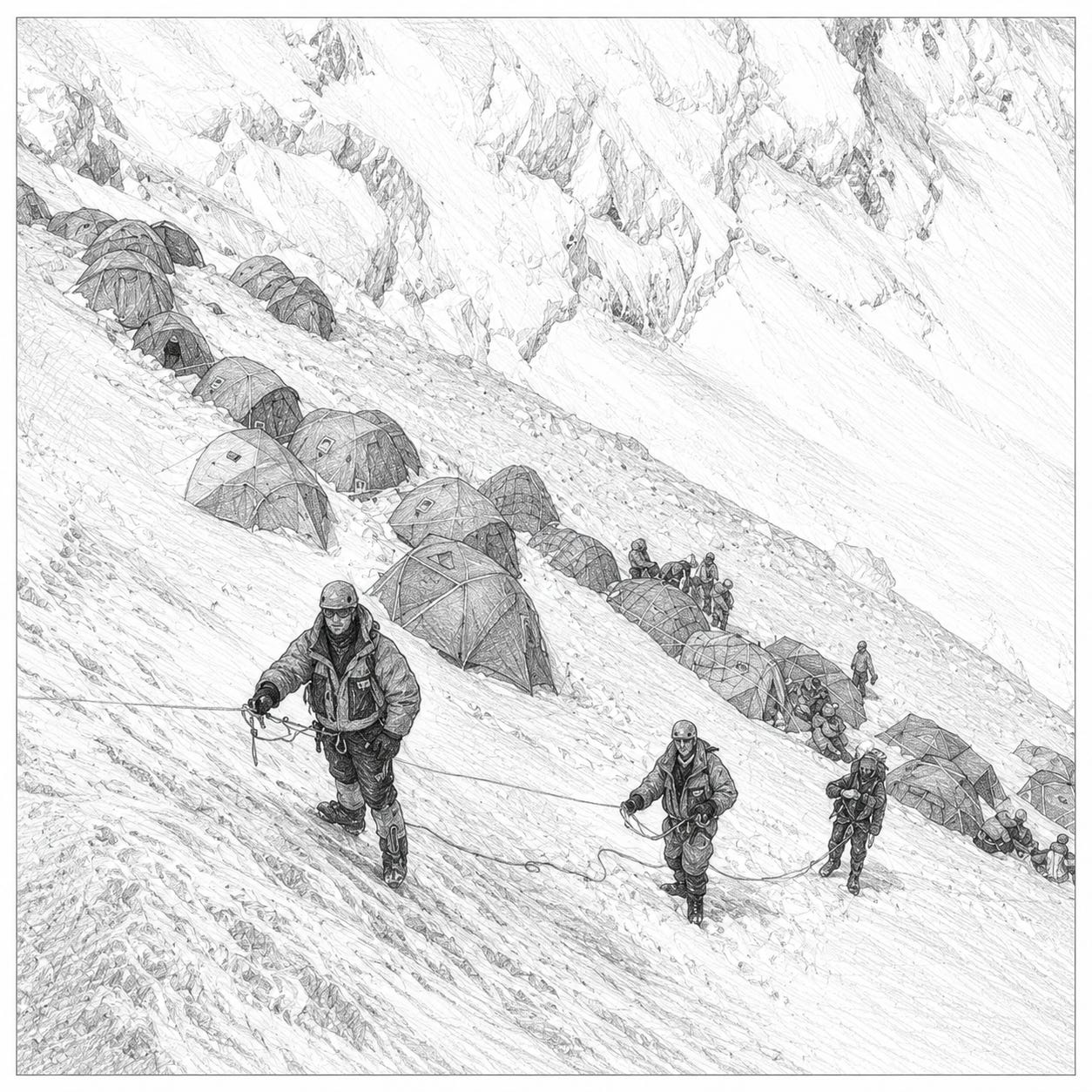
A 14-member Nepali rope-fixing team summited Everest on May 13, officially opening the route for hundreds of foreign climbers stacking up at South Base Camp. Nepal has issued a record 492 climbing permits this spring and earned an unprecedented Rs 1.07 billion in royalty revenue from Everest alone — the most commercially lucrative season the mountain has ever produced. For a tourism economy still rebuilding post-pandemic, the numbers are a genuine bright spot; but the same record permits are reigniting old questions about crowding, waste, and whether Nepal’s biggest brand is being well managed by its biggest beneficiary — the state. The Sherpa community’s quiet, lethal expertise is once again the only reason any of this works (Kathmandu Post).
Nepal hosts USA & Scotland in Kirtipur tri-series
The Rhinos are back in Kirtipur for a marquee Associate-nation tri-series against the United States and Scotland, kicking off May 12 at TU International Cricket Ground after the recent leg with Oman and the UAE. The matches matter: every result feeds into ICC rankings and World Cup qualification routes, and Nepal’s home form has been a major reason Kathmandu’s cricket scene continues to draw 15,000-plus crowds on a Wednesday. With Aasif Sheikh and Dipendra Singh Airee newly inside the ICC ODI Top 100 batting rankings (more on that in the briefs) and a generation of NPL talent pushing through, this series feels like a checkpoint for whether Nepal can hold its place at the top of the Associate ladder (Nepal News).
In Brief: A few more things worth your weekend.
Aasif Sheikh (93rd) and Dipendra Singh Airee (99th) are both now inside the ICC ODI Top 100 batting rankings — the first time two Nepali batters have sat there together (Nepal News).
The Second South Asian Trade Fair 2026 closed at Bhrikutimandap on May 11 with all eight SAARC nations exhibiting handicrafts, food, garments and EVs — a quiet but symbolically important regional moment (Nepal News).
The Kathmandu Post reports Nepal’s only dedicated mental hospital is stretched beyond capacity — a sobering reminder of how thin the country’s mental-health infrastructure remains (Kathmandu Post).
Until next week, stay connected!
Let’s connect
Enjoying this issue? 📩 Share it with a friend & let’s keep Nepalis worldwide in the loop! Got thoughts? Hit reply—we’re all ears! Or let us know what you think via our Feedback form or follow us on Facebook | LinkedIn
P.S. Got a story or issue you’d like us to cover next week? Drop us a reply — we’re building this space together.
About Nepali Diaspora Digest:
The Nepali Diaspora Digest connects the global Nepali community with curated news, insights, and stories that matter most. Join us as we celebrate and explore the diverse voices and achievements of Nepalis worldwide.
Partner shout out
belayat.uk: helping Nepalis connect in the UK on jobs, housing, events and finding local Nepali owned businesses


