



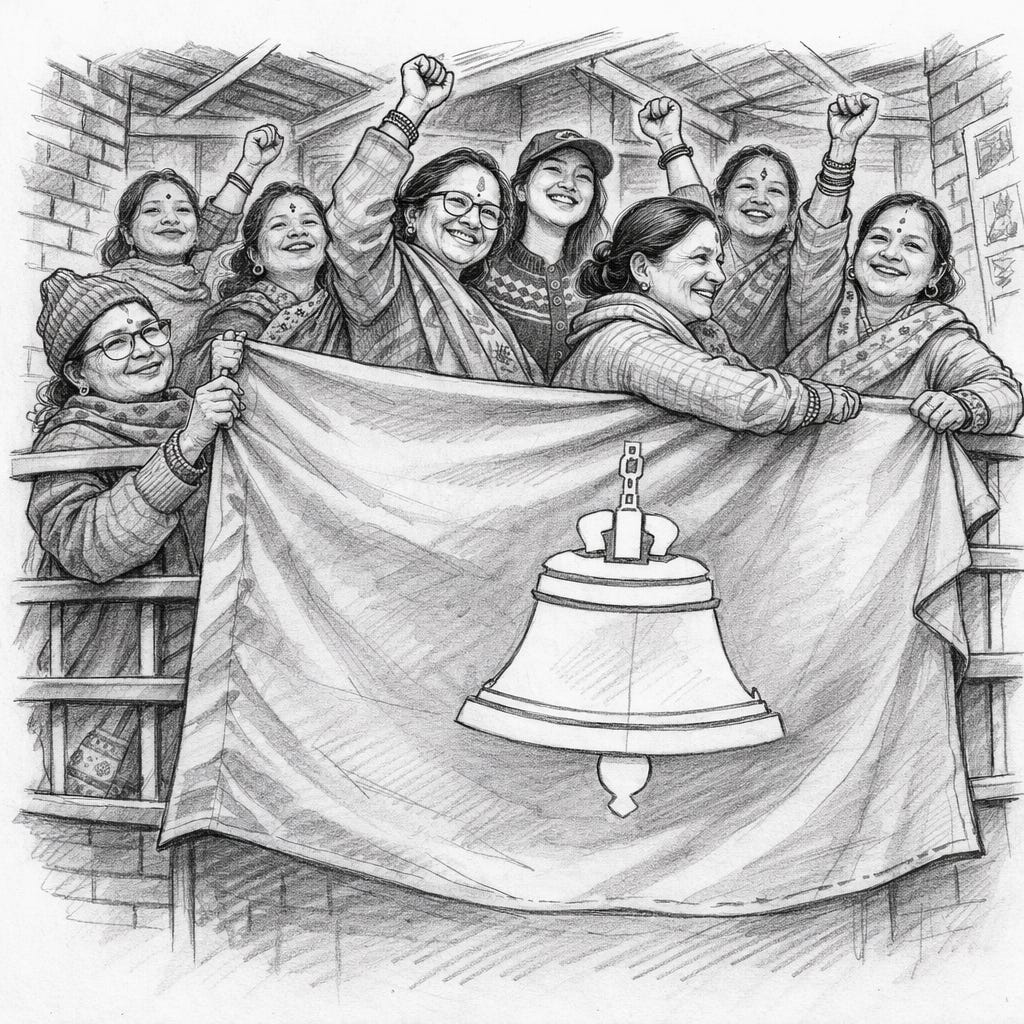
Namaste, diaspora family! What a week to be Nepali. The final election count is in and it’s official: Balendra “Balen” Shah’s Rastriya Swatantra Party has won 182 seats, an unprecedented single-party majority that obliterated Nepal’s political establishment. At 35, Balen is set to become the youngest prime minister in modern Nepali history. But while Kathmandu celebrates, the Gulf crisis grinds into its second week with 1.7 million Nepali workers caught in the crossfire, flights only just resuming, and cooking gas now being rationed back home. And in Surkhet, the brutal killing of a 16-year-old girl has ignited nationwide protests demanding justice. Let’s get into all of it.
🏛️ Politics & Governance
RSP’s 182-Seat Landslide — The Final Count
The numbers are now official, and they are staggering. The Rastriya Swatantra Party has won 182 of 275 seats in Nepal’s House of Representatives, 125 through first-past-the-post and 57 through proportional representation. It is the most dominant electoral performance since 1959, just two seats short of the two-thirds supermajority threshold of 184. The Nepali Congress was reduced to 38 seats, its worst result in history, with party president Gagan Thapa losing his own Kathmandu-4 constituency. CPN-UML fared even worse: 25 seats, with KP Sharma Oli defeated 68,348 to 18,734 in Jhapa-5, a seat he had held for most of his career. The Nepali Communist Party under Pushpa Kamal Dahal managed just 17 seats. RSP’s 47.8% proportional vote share is the highest recorded since the mixed-member system was introduced in 2008. Nepal’s three-decade-old political establishment didn’t just lose — it collapsed (Al Jazeera, Wikipedia).
Balen Shah: Nepal’s PM-Designate at 35
Balendra Shah, rapper, civil engineer, former Kathmandu mayor, is now Nepal’s prime minister-designate and, at 35, will be the country’s youngest leader in modern history and the first PM to rise directly from the Madheshi youth movement. His journey from hip-hop artist (”Sadak Balak,” “Balidan”) to Time magazine’s Top 100 Emerging Leaders to the steps of Singha Durbar is the kind of story that doesn’t happen in Nepali politics — until it did. Shah won his engineering degrees, cleaned up Kathmandu as an independent mayor from 2022, and then channelled the fury of the September 2025 Gen Z protests into a party that barely existed four years ago. Under Nepal’s constitutional process, parties must now submit proportional representation nominees before parliament is formally summoned by the president. With 182 seats, RSP can govern comfortably alone and would need just two allies or crossbenchers for constitutional amendments. No coalitions, no horse-trading. The question facing Balen and his largely inexperienced caucus is whether they can deliver on the ten-point agreement that started all of this (Time, CFR).
In Brief: A few more developments from a historic political week.
The old guard is in crisis. The Nepali Congress has called a central committee meeting to review its worst-ever result, while CPN-UML has yet to formally assess its own collapse. Three decades of establishment dominance ended in a single night (NPR).
Election expense reports are trickling in. Rabi Lamichhane declared total spending of just Rs 989,987, while the Election Commission has given all candidates and parties 35 days to submit their accounts or face legal action.
149,000 temporary election police recruited for March 5 are being discharged by March 12, as the country transitions from election mode to government formation.
🌍 Diaspora & Globalisation
Two Weeks of War — 1.7 Million Nepalis in the Gulf
The US-Iran-Israel conflict has now entered its second week, and while bombs may not be falling on Nepali workers, the disruption to their lives, and Nepal’s lifeline, is immense. Foreign Minister Balananda Sharma told parliament this week that the situation “does not warrant immediate mass evacuation” of the 1.7 million Nepalis officially registered across Gulf states (MoFA estimates the real number, including informal workers, could be as high as 3 million), but the government has launched an emergency registration portal that 100,000 workers have already used. Nepal Airlines evacuated 272 citizens from Dubai on special flights, and MoFA is exploring Saudi Arabia as an alternate route home for those stranded in the UAE, Qatar, and Kuwait. Flights to the Gulf, suspended for 12 days after the February 28 strikes, have partially resumed, with Air Arabia, Fly Dubai, and Himalaya Airlines running limited services. But Dubai International Airport will close entirely from March 16 to 28 for repair of strike damage. The aviation crisis is the worst since COVID-19: Kathmandu’s international flights dropped 65% overnight, with 129 cancellations costing more than Rs 21 million daily (Kathmandu Post, Nepal News).
21 Nepalis Rescued from Cambodia’s Scam Factories
In a very different kind of diaspora crisis, 21 Nepali citizens trafficked to Cambodia were repatriated on Friday after being lured by organised criminal gangs promising lucrative jobs. Instead, they were forced to work in illegally operated online scam centres and casinos in Bavet city, near the Vietnamese border, without valid visas. The rescue was coordinated by the Nepal Embassy in Bangkok and the NRNA chapter in Cambodia, following a Cambodian police raid on January 28 that detained over 2,000 foreign nationals, including 30 Nepalis. The embassy has urged any remaining stranded Nepalis in Cambodia to contact the mission for free travel permits. The case is a stark reminder that while the Gulf crisis dominates headlines, trafficking networks continue to exploit Nepali workers across Southeast Asia (Kathmandu Post, Himalayan Times).
In Brief: More diaspora updates from a turbulent week.
The 12th NRNA World Conference is still on for March 14–16 in Kathmandu, themed “Our Unity, the Foundation for Prosperity,” though delegates from the Gulf may face travel complications with Dubai Airport shutting down and limited flight options (OnlineKhabar).
Nepalis in the Gulf may be able to return via Saudi Arabia, according to MoFA, which is exploring the kingdom as an alternative transit route for workers stranded by airspace closures (Kathmandu Post).
Qatar Airways has scheduled 143 relief flights to help move stranded passengers, while Nepal Airlines continues special evacuation services from Dubai.
💸 Economy & Development
Oil Crisis Hits Home — Nepal Starts Rationing Cooking Gas
The Gulf conflict has arrived in Nepali kitchens. Nepal Oil Corporation announced this week that it will sell half-filled 7.1 kg LPG cylinders at Rs 955 to manage surging demand driven by consumer hoarding. While NOC insists imports remain regular, the underlying supply picture is grim: the Strait of Hormuz, through which 20% of the world’s oil passes, has seen tanker traffic drop to a trickle. Brent crude spiked to $115 per barrel before falling to $93 after President Trump warned Iran against blocking the strait. Nepal is 100% dependent on India for fuel, and India imports over 80% of its crude from the Middle East. The dual shock that economists warned about last week is materialising: a potential remittance freeze if Gulf operations stay disrupted, and an energy price surge cascading through Nepal’s import-dependent economy. The IEA’s March report described the Hormuz shutdown as having “wiped out more oil supply than any crisis in history” (Spotlight Nepal, ANI).
Next Year’s Budget Already Shrinking Before RSP Takes Power
Before Balen Shah’s government even takes office, the fiscal straitjacket is tightening. The National Planning Commission set the FY2026/27 budget ceiling at Rs 1.89 trillion — a 4% decrease from the current year. Vice Chairman Dr. Prakash Shrestha attributed the cut to weak revenue growth and insufficient foreign aid mobilisation. Capital expenditure will come in under Rs 400 billion. The NPC has also proposed reducing recurrent expenditure from 39% to 36% of the total budget and excluding projects under Rs 30 million from the federal budget, a move that could curb the pork-barrel spending that has long defined Nepali budgets. For RSP, the message is clear: transformative change will have to be delivered within a shrinking fiscal envelope, at a time when oil prices are spiking and the Gulf conflict threatens the remittance flows that fund nearly 29% of GDP (Nepal News).
In Brief: A few more numbers worth watching this week.
Remittances hit Rs 1.261 trillion in the first seven months of FY2025/26, a 39.8% year-on-year increase, but with 1.8 million Nepali workers in the conflict zone, economists warn that the growth streak may be about to break sharply (Nepal News).
Nepal’s electricity import tariff rises 1.5% from April. The Nepal-India Power Exchange Committee approved a rate of Rs 8.22 per unit for up to 350 megawatts of supply.
Sopan Pharmaceuticals launched a targeted IPO for migrant workers, believed to be the first offering specifically designed for the diaspora, signalling a growing recognition of NRN investment potential.
⭐ Social & Cultural
Justice for Inisa — A Nation Demands Answers
On March 7, 16-year-old Inisa BK left her home in Birendranagar, Surkhet, at 6 a.m., telling her mother she was going to tuition classes. She was found unconscious and bleeding in Janajagaran Community Forest and died shortly after reaching hospital. The postmortem confirmed what her family feared: death from excessive bleeding caused by violent sexual assault. Four minors have been detained, including a 16-year-old suspect. Her father told reporters: “My world has been incinerated. It appears she was lured into the dense forest with false promises.” Inisa was a grade 11 science student who dreamed of becoming a doctor or an Army officer. In the days since, protests have erupted across Nepal, with students in Karnali Province and Kathmandu demanding justice, stricter rape laws, and systemic protection for women and girls. Her family has refused to receive the body, which remained at Karnali Provincial Hospital for five days, until justice is delivered. The case has become a lightning rod for anger over gender-based violence in a country where 33% of women aged 20–24 were married before 18 (Kathmandu Post, Khabarhub).
Footballers Force ANFA’s Hand — A-Division League Returns
Nepal’s footballers took matters into their own hands this week — literally. On March 8, members of the Nepal Football Players Association padlocked the ANFA headquarters in Satdobato, Lalitpur, over three demands: restart the A-Division League (suspended for over 1,000 days), fund the player welfare account, and release outstanding prize money. ANFA condemned the action as “undisciplined and anarchic” and warned it could jeopardise international fixtures. But the players held firm — and it worked. By March 10, ANFA agreed to all three demands: the Sahid Smarak A-Division League will kick off on April 13, B and C Division leagues will be completed by mid-November, welfare fund deposits will begin, and prize money will be released in instalments. It was the second protest in four months. In November, players had hung their national medals on ANFA’s gates. The pattern is now familiar in Nepali institutions: those in charge only move when forced to (Kathmandu Post, Nepal News).
In Brief: A few lighter, brighter notes to close the week.
Nepal will participate in the Cannes Film Festival for the first time. The Film Development Board and Nepal Tourism Board will share a dedicated stall at the 79th edition (May 12–23) to promote Nepali cinema and facilitate international collaborations (Ratopati).
17,000 students in Humla received textbooks on the first day of school, a historic first for Nepal’s most remote district, where 141 community schools opened with materials ready for the first time ever (Nepal News).
Temperatures are climbing across Nepal, with Kathmandu hitting 25.4°C and Siraha reaching 31.1°C. Spring is here, and so is the heat.
Until next week, stay connected! — The Nepali Diaspora Digest Team
Let’s connect
Enjoying this issue? 📩 Share it with a friend & let’s keep Nepalis worldwide in the loop! Got thoughts? Hit reply—we’re all ears! Or let us know what you think via our Feedback form or follow us on Facebook | LinkedIn
P.S. Got a story or issue you’d like us to cover next week? Drop us a reply — we’re building this space together.
About Nepali Diaspora Digest:
The Nepali Diaspora Digest connects the global Nepali community with curated news, insights, and stories that matter most. Join us as we celebrate and explore the diverse voices and achievements of Nepalis worldwide.
Partner shout out
belayat.uk: helping Nepalis connect in the UK on jobs, housing, events and finding local Nepali owned businesses


