


Namaste, diaspora family. There is no gentle way to ease into this week. On March 5, Nepal voted — and the people delivered a verdict so decisive it will be studied for decades. The Rastriya Swatantra Party, barely four years old, is heading for a two-thirds supermajority, sweeping Kathmandu and humbling every political giant in sight. Balen Shah is leading KP Sharma Oli by a 4-to-1 margin in Oli’s own stronghold. Meanwhile, a war has erupted in the Gulf: US-Israeli strikes on Iran triggered retaliatory attacks on airports across the UAE, Qatar, and Kuwait — killing a 29-year-old Nepali security guard at Abu Dhabi airport and putting 1.9 million Nepali workers in immediate danger. The Strait of Hormuz has effectively shut down, oil prices have surged 35% in a single week, and Nepal’s entire remittance lifeline is at risk. This is a week that will define Nepal’s trajectory for years to come. Let’s get into it.
🏛️ Politics & Governance
RSP’s Historic Landslide — The Numbers So Far
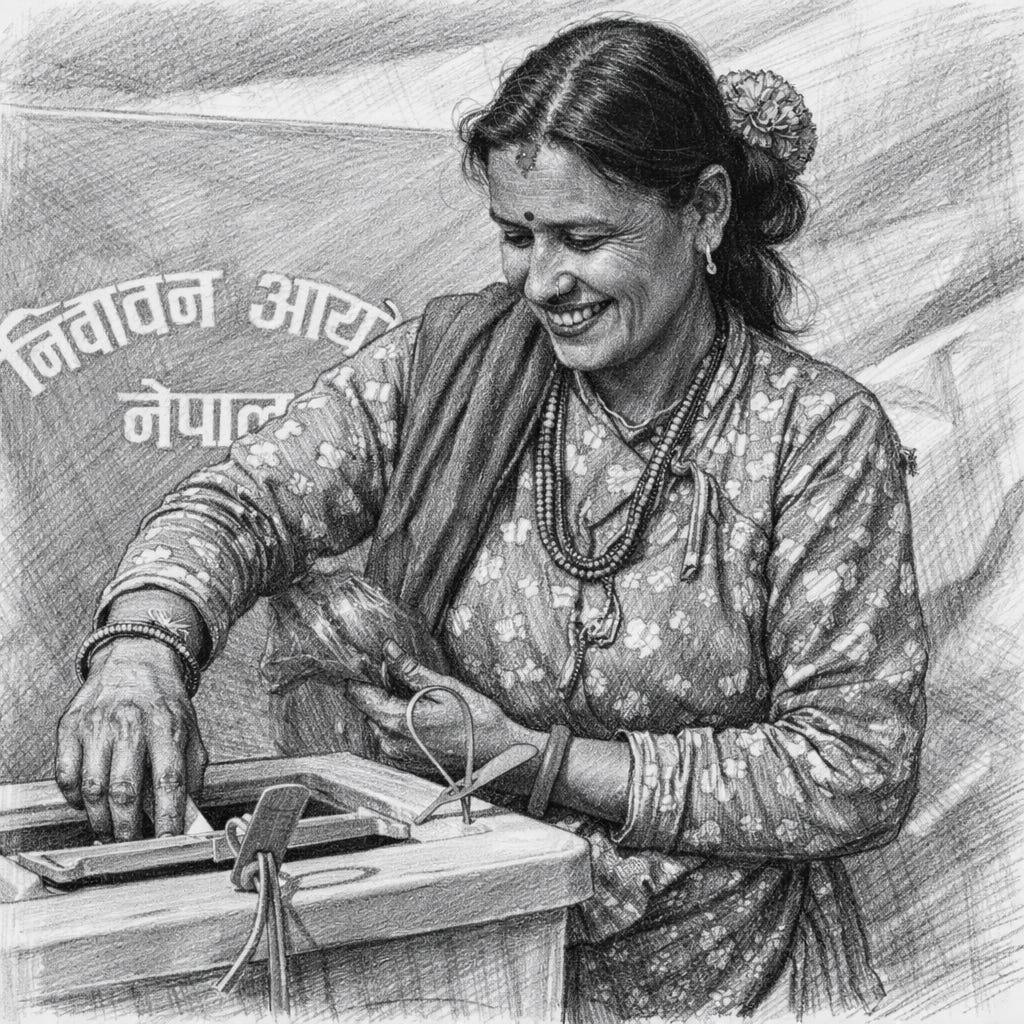
As vote counting continues across Nepal, the scale of the Rastriya Swatantra Party’s victory is becoming clear and it is historic. RSP has won at least four FPTP seats and leads in over 105 of 165 constituencies, sweeping all 10 Kathmandu seats and 14 of 15 across the Valley. The Nepali Congress holds just two confirmed wins (Manang and Mustang) and leads in roughly 12 seats; CPN-UML leads in about 11 with no confirmed victories. RSP Vice President Dol Prasad Aryal told ANI the party expects 186 seats —surpassing the two-thirds threshold of 184 in the 275-member House. Independent analysts put the combined FPTP and PR total closer to 200. RSP is also dominating the proportional representation count, holding 59% of early PR tallies. Turnout was 58.07% — the lowest since 1991, but the message from those who did vote could not be louder (Kathmandu Post).
Balen vs Oli — The Jhapa-5 Verdict
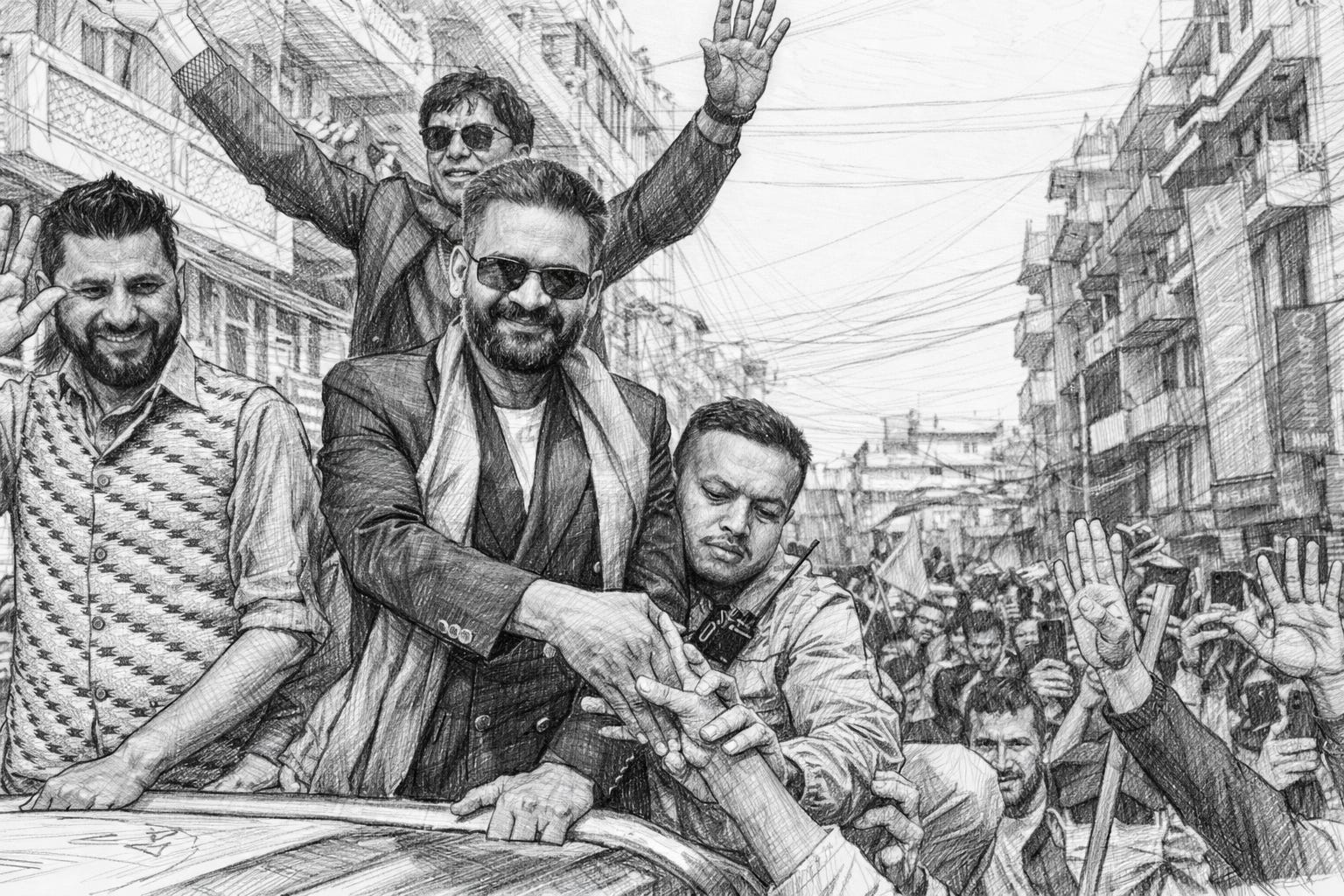
The most watched race in Nepal delivered perhaps its most symbolic result. In Jhapa-5 — the constituency KP Sharma Oli had won in every election except 2008 — Balendra “Balen” Shah leads the former prime minister 15,161 to 3,344, a staggering 4.5-to-1 margin. In 2022, Oli secured 54,319 votes here. The reversal is total. Across Kathmandu, Ranju Darshana won Kathmandu-1 with nearly double the votes of her nearest rival, becoming one of RSP’s first confirmed victors. Nepali Congress president Gagan Thapa, who positioned himself as the establishment’s generational answer to Balen, is trailing in Kathmandu-4 to RSP’s Pukar Bam. At 35, Balen Shah — rapper, civil engineer, former Kathmandu mayor is now almost certainly Nepal’s next Prime Minister, and he would be the youngest in the country’s history (Kathmandu Post, OnlineKhabar).
What This Means — Government Formation, Foreign Policy & the Gen Z Mandate
If RSP secures two-thirds of parliament, it would be only the second time in Nepal’s history that a single party commands such power and the first under the 2015 constitution. The implications are profound. RSP could govern alone without coalition partners, ending the era of 14 governments and 9 prime ministers since 2008. It could amend the constitution unilaterally a power that carries both promise and risk. On foreign policy, RSP has advocated “strategic autonomy,” positioning Nepal as a bridge rather than a buffer between India and China. Analysts at Chatham House note that left-wing representation in parliament will drop from roughly 60% to 35%, potentially reducing China’s strategic influence. India, which provided election aid and backed the democratic transition, may gain leverage. But the deeper story is generational: over 800,000 new voters registered for this election, two-thirds of them Gen Z. The September 2025 protests that killed 77 people and toppled Oli’s government have been validated at the ballot box. As the Atlantic Council observed, Nepal now joins Bangladesh in demonstrating that Gen Z protest energy can translate into decisive electoral power. The question now is whether a politically inexperienced party can deliver on the ten-point agreement that started it all (ORF).
In Brief: A few more things from the election trail this week.
Election Day was largely peaceful — 339,000 security personnel were deployed across 23,112 polling centres and international observers from ANFREL commended the exercise as “conducted in a peaceful and orderly environment,” though only 39% of polling stations had accessibility ramps.
Code of conduct violations were rampant in the campaign period — observers found social media misinformation surging to unprecedented levels, but the Election Commission fined only two candidates despite examining roughly 100 cases.
Holi fell just three days before polling — celebrations at Basantapur and across the country proceeded under strict election code restrictions, with mass musical events banned and 68 additional checkpoints deployed in Kathmandu Valley to prevent violations.
🌍 Diaspora & Globalisation
1.9 Million Nepalis in the Crossfire — Iran War Hits Nepal’s Gulf Lifeline
On February 28, the United States and Israel launched coordinated strikes on Iran — Operation Epic Fury — deploying over 50,000 troops and striking more than 1,700 targets. Supreme Leader Khamenei was killed in an Israeli airstrike on his Tehran compound. Iran retaliated with drones and ballistic missiles across the Gulf: Abu Dhabi’s Zayed International Airport was struck, Dubai airport damaged, 65 missiles and 12 drones launched at Qatar, and Kuwait intercepted 97 ballistic missiles and 283 drones. Among the casualties was Diwas Shrestha, 29, from Gorkha — a security guard at Abu Dhabi airport killed when an Iranian drone struck the facility. He had been preparing to marry on his next visit home. Nepal’s government suspended labour permits for 12 countries, launched an emergency registration portal, and began evacuating stranded workers — 150 from Iraq’s Erbil airport, 90 in transit in Kuwait, 36 Hajj pilgrims stuck in Jeddah, and 80 more in Dubai. Interim PM Sushila Karki spoke with Qatar’s PM, who assured equal protection for Nepal’s 357,913 workers in the country. But with 1.9 million Nepalis across the Gulf and airspace closures spreading, the full scale of the crisis is only beginning to emerge (Kathmandu Post).
Nepal’s Remittance Lifeline Under Threat
The economic ripple effects of the Gulf conflict are already hitting Nepal. Approximately 41% of Nepal’s remittances — Rs 422 billion in the first half of this fiscal year alone — flow from the Middle East, and remittances account for 28.6% of GDP. The Strait of Hormuz, through which 20% of the world’s oil passes, has effectively shut down: tanker traffic dropped 70% before ceasing entirely, and major shipping lines Maersk, CMA CGM, and Hapag-Lloyd have all suspended transits. Brent crude surged to $92.69 per barrel, and US crude posted its biggest weekly gain in futures history — up 35.63%. Nepal Oil Corporation has assured the public of 13 days of petroleum stocks and says Indian Oil Corporation will maintain supply, but Nepal depends entirely on India for fuel, and India imports over 80% of its crude from the Middle East. Economists warn of a dual shock: a remittance freeze if Gulf operations remain disrupted, and a fuel price surge that could cascade through every sector of Nepal’s import-dependent economy (Kathmandu Post, Nepal News).
In Brief: Some important diaspora updates beyond the Gulf crisis.
Record 95 Nepalis were deported from the US on February 27 in the largest single deportation flight in history — 92 men and 3 women who had entered via the Mexico border after paying smugglers $60,000–$75,000 each (NepYork).
TPS termination reinstated — the US Ninth Circuit Court of Appeals on February 9 allowed the Trump administration’s TPS termination to proceed, putting over 7,000 Nepalis who have lived lawfully in the US for over a decade at immediate risk of deportation.
The NRNA World Conference is still on for March 14–16 in Kathmandu, themed “Our Unity, the Foundation for Prosperity” — though Gulf airspace closures may complicate travel for delegates from the Middle East (OnlineKhabar).
💸 Economy & Development
Gulf Conflict Threatens Nepal’s Fragile Economic Recovery
Beyond the immediate human toll, the West Asia conflict is threatening several pillars of Nepal’s economy simultaneously. The CWC League 2 tri-series — Nepal vs UAE vs Oman — scheduled for March 10 in Kathmandu has been postponed indefinitely after UAE and Oman teams couldn’t travel due to airspace closures, hitting Nepal’s cricket tourism aspirations. At ITB Berlin, the world’s largest tourism fair, Nepal Tourism Board CEO Deepak Raj Joshi and his team were stranded in Doha after their Qatar Airways flight landed just before Hamad International Airport shut down — a colleague read his statement at the Nepal pavilion instead. The pattern is clear: from remittances to fuel to tourism to cricket, the Gulf crisis is touching every corner of Nepal’s economic life, and there’s no indication it will resolve quickly.
IMF’s Final $43.2 Million Tranche — Board Approval Still Pending
The IMF reached a staff-level agreement on the seventh and final review of Nepal’s Extended Credit Facility on February 20, clearing the way for approximately $43.2 million — bringing the programme total to $384.4 million. But the fine print remains sobering: growth is pegged at 3–3.5%, non-performing loans have risen to 5.4%, and the IMF has flagged that Nepal Rastra Bank Act amendments must be submitted to parliament for programme completion. In a notable first, the IMF also launched a governance and corruption diagnostic — a signal of the fund’s concern about institutional weaknesses. Board approval is pending, and the incoming RSP government will inherit both the funds and the conditions attached to them (myRepublica).
In Brief: A few more economic developments worth watching.
World Bank approved $50 million for Nepal’s Digital Transformation Project — covering a citizen service portal, social registry, digital wallets, and land administration digitization, co-financed with ADB for an additional $40 million.
NRB directed banks to stay open during the Holi holidays and election day to ensure uninterrupted financial services during an unprecedented overlap of festivals, public holidays, and polling.
Forex reserves sit at a record $22.47 billion — covering 21.4 months of merchandise imports — but the paradox persists: banking deposits grew Rs 417 billion while private credit increased only Rs 197 billion. The money is coming in; it’s still not going anywhere productive.
⭐ Social & Cultural
Samba Update — Fundraiser Smashed, But Aspetar Access Now Uncertain
Last week, Nepal rallied behind women’s football captain Sabitra Bhandari “Samba” after ANFA stepped back from supporting her surgery. The response was extraordinary: Rs 14 million raised domestically and NZ$52,000 internationally within 24 hours, smashing her NZ$135,000 target for revision ACL surgery at Qatar’s Aspetar Orthopaedic Hospital. But this week brought a cruel complication: with Qatari airspace closed following Iranian retaliatory strikes, and EASA advising airlines not to operate in the airspace of Qatar, UAE, and a dozen other countries, access to Aspetar is currently impossible by air. No reporting has directly linked the Gulf conflict to Samba’s surgical timeline, but the logistics are self-evidently challenging. For a player who has already battled ANFA’s indifference, the waiting continues (Kathmandu Post, Friends of Football NZ).
Nepal’s Children Demand Change Ahead of Polls
Days before Nepal voted, 125 children from six provinces presented their own manifesto to political parties — a quiet but powerful intervention organised by Save the Children. Their demands cut to the heart of Nepal’s unfinished social agenda: end child marriage (33% of women aged 20–24 were married before 18), guarantee free and inclusive education, provide accessible mental health services for children traumatised by the Gen Z protests that killed at least 50 people including three children, and act on air pollution. With over 900,000 first-time voters registering for this election, many of them just aged out of childhood themselves, the children’s manifesto is a reminder that the generation behind Gen Z is watching too — and they have their own demands for the government RSP is about to form.
In Brief: A few lighter notes to close out an extraordinary week.
CWC League 2 tri-series postponed — Nepal’s cricket showdown against UAE and Oman, set for March 10, was shelved indefinitely after Gulf airspace closures prevented the visiting teams from travelling.
Holi at Basantapur brought its usual explosion of colour to Kathmandu, but this year’s celebrations were hemmed in by election code restrictions — no mass music events, no party-branded T-shirts, and 68 extra checkpoints to make sure.
Nepal at ITB Berlin — the country’s tourism pavilion went ahead at the world’s biggest tourism fair despite the NTB CEO being stranded in Doha, a metaphor for the resilience and improvisation that defined this entire week.
Until next week, stay connected! — The Nepali Diaspora Digest Team
Let’s connect
Enjoying this issue? 📩 Share it with a friend & let’s keep Nepalis worldwide in the loop! Got thoughts? Hit reply—we’re all ears! Or let us know what you think via our Feedback form or follow us on Facebook | LinkedIn
P.S. Got a story or issue you’d like us to cover next week? Drop us a reply — we’re building this space together.
About Nepali Diaspora Digest:
The Nepali Diaspora Digest connects the global Nepali community with curated news, insights, and stories that matter most. Join us as we celebrate and explore the diverse voices and achievements of Nepalis worldwide.
Partner shout out
belayat.uk: helping Nepalis connect in the UK on jobs, housing, events and finding local Nepali owned businesses


