


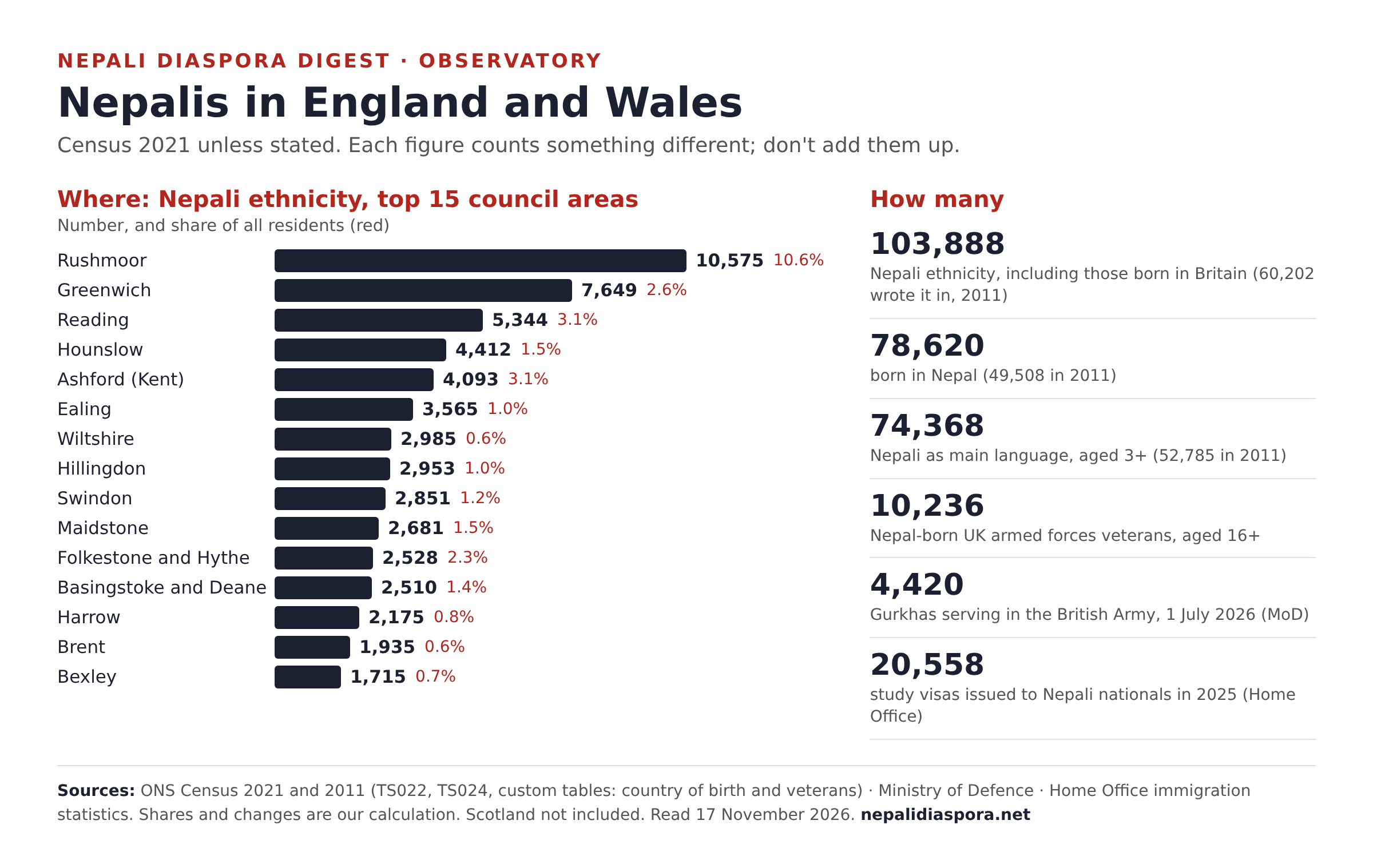
England and Wales had 103,888 people of Nepali ethnicity on census day in March 2021, up from about 60,000 in 2011. One in ten of them lives in a single council area, Rushmoor in Hampshire, home of Aldershot, where Nepalis are one resident in ten.
This page sets out what the census and the government’s own figures say about Nepalis in Britain, and what each figure counts. It is a companion to our page on the Nepalese diaspora in numbers.
How many Nepalis live in the UK?
The 2021 census for England and Wales gives three counts, as of 21 March 2021, and they measure different things, so they should not be added together:
103,888 described their ethnic group as Nepali (including Gurkha), in table TS022. This includes children born in Britain to Nepali parents.
78,620 were born in Nepal, whatever their passport, from the Office for National Statistics’ custom census tables (country of birth, 190 categories).
74,368 aged three and over gave Nepali as their main language (TS024).
Northern Ireland’s census counted 270 people born in Nepal. We could not find a figure for Scotland, whose census was held a year later.
Ten years earlier, the 2011 census counted 49,508 people born in Nepal, 52,785 Nepali speakers and 60,202 people who wrote in Nepalese as their ethnic group. That makes a rise of about 59% in the Nepal-born and 41% in Nepali speakers. The ethnicity count rose about 73%. In both censuses Nepali was a written-in answer that the ONS coded afterwards (there was no Nepali tick box), and the ONS says the two are only broadly comparable, so treat that rise as approximate.
Where do they live?
Mostly in the south of England and in London. The South East (44,532) and London (29,923) together hold 72% of everyone of Nepali ethnicity in England and Wales. The top ten council areas, by Nepali ethnicity, are:
Council area Nepali ethnicity Share of residents Born in Nepal Rushmoor (Aldershot, Farnborough) 10,575 10.6% 8,329 Greenwich 7,649 2.6% 5,963 Reading 5,344 3.1% 4,198 Hounslow 4,412 1.5% 3,429 Ashford (Kent) 4,093 3.1% 3,270 Ealing 3,565 1.0% 2,643 Wiltshire 2,985 0.6% 2,092 Hillingdon 2,953 1.0% 2,152 Swindon 2,851 1.2% 2,103 Maidstone 2,681 1.5% 1,991
Next come Folkestone and Hythe, Basingstoke and Deane, Harrow, Brent and Bexley. All the figures are from table TS022 and the ONS country of birth data; the shares are our calculation.
Rushmoor stands out. No other council area is more than 3.1% Nepali. Since 2011 it has also grown in newer places: Bexley’s count went from 261 (written-in answers, 2011) to 1,715 and Wiltshire’s from 908 to 2,985. Brent was the only area in the top 15 where it fell.
Who are they?
The ONS publishes the detail below only for people born in Nepal, not for everyone of Nepali ethnicity, so it leaves out the British-born second generation. For the 78,620 Nepal-born in England and Wales in 2021, by our calculation from the ONS’s custom census tables:
Arrival: 46% came between 2001 and 2010, and another 46% in 2011 or later. Fewer than 8% arrived before 2001.
Age: 35% were 30 to 44, a quarter 45 to 64, and 11% 65 or older. Only 4% were under 18. Children born in Britain to Nepali parents are not in these figures, and the ONS does not publish how many there are.
Religion: 52% Hindu, 26% Buddhist, 8% another religion, 5% no religion and 4% Christian. The census had no Kirat tick box and the ONS publishes no Kirat figure, so we cannot say how Kirat followers answered: some may be in “another religion”, some under Hindu or Buddhist.
Passports: 40% held a British passport.
English: 18% said they spoke English not well or not at all.
The Gurkha link
The places where most Nepalis live are also the places where most Nepal-born veterans of the British armed forces live. Most of them, we assume, served with the Gurkhas; the census does not say.
The census asked everyone aged 16 and over whether they had served in the UK armed forces. Among the Nepal-born, 10,236 said yes: 13% of those aged 16 and over. The ONS has published them by area: 1,610 in Rushmoor, 715 in Greenwich, 695 in Ashford, 630 in Reading and 625 in Hounslow (rounded to the nearest 5).
On 21 May 2009 the government announced that Gurkhas who “retired prior to 1 July 1997” and “served in the British Army for at least four years” could apply to settle in the UK with their spouses and dependent children, according to the Home Office’s press release. Those who retired after 1 July 1997 had been able to apply since 2004; by May 2009, the release said, over 6,000 Gurkhas and their families had been given the right to live in the UK. Both changes fall in the decade 2001 to 2010, when 46% of the Nepal-born arrived, but the census groups those years together and does not record why people came.
On 1 July 2026 the British Army had 4,420 Gurkhas serving, according to the Ministry of Defence’s figures for 1 July 2026. Separately, 870 trade-trained personnel, almost all of them regulars in the Army, reported Nepalese nationality in April 2026, a number the MoD’s diversity statistics say “has been increasing” since 2022.
Who is coming now?
Students. The UK issued 38,526 visas to Nepali nationals in 2025, of which 20,558 were for study, up from 5,953 study visas in 2022, according to the Home Office’s visa statistics. In the year to June 2026 it issued 32,859, of which 17,151 were for study.
Work visas have gone the other way. Health and care worker visas to Nepali main applicants peaked at 1,321 in 2023 and fell to 84 in the year to June 2026.
These are entry visas issued to people applying from outside the UK, not people arriving or staying: a student may leave after the course, and someone who switches visa inside the UK is not in these figures. About 11,000 a year are visitor visas.
What these numbers miss
Scotland. We could not retrieve a figure for Nepalis in Scotland’s 2022 census from an official source.
The second generation’s profile. The census counts British-born Nepalis in the ethnicity figure, but the ONS does not publish their age, religion or other details separately.
Change since 2021. The census is the only full count; the next is due in 2031. The visa figures show who is coming, not how many stay.
Gurkha settlement. We did not find an official count since 2009; the 2009 release gave over 6,000 Gurkhas and family members for 2004 to 2009.
If you know a better figure, or you live in Scotland and know where the number is, reply with the source. We will update this page.
Sources
Read on 17 November 2026.
Office for National Statistics, Census 2021, England and Wales: ethnic group (TS022), main language (TS024), custom census tables (country of birth, extended, with area, age, religion, year of arrival, passports held, English proficiency and armed forces veterans); veterans born in Nepal by local authority (December 2024)
ONS, Census 2011: country of birth (QS213EW), ethnic group write-ins (CT0010) and main language (QS204EW)
Ministry of Defence: quarterly service personnel statistics, 1 July 2026 and biannual diversity statistics, April 2026
Home Office: immigration system statistics, year ending June 2026 (entry clearance visa outcomes); news release, 21 May 2009 (as republished by Wired-Gov)
More from the Digest: Kulbir Thapa VC, the first Gurkha to win the Victoria Cross · NRN citizenship: who qualifies and how to apply
The Nepali Diaspora Digest is the week in Nepal for Nepalis abroad, free every Friday: nepalidiaspora.net
— Binit, for the Nepali Diaspora Digest