


On the night of 25 September 1915, a wounded rifleman from the hills of western Nepal lay behind a German trench in northern France with a badly wounded British soldier. The soldier told him to save himself. He stayed. By daylight the next day he had brought that man and two wounded Gurkhas back to safety, the last stretch under enemy fire, and two months later Kulbir Thapa became the first Gurkha soldier to be awarded the Victoria Cross, Britain’s highest award for bravery.
His story is worth knowing for what he did, and for what it tells us about why so many Nepalis were fighting in Europe at all.
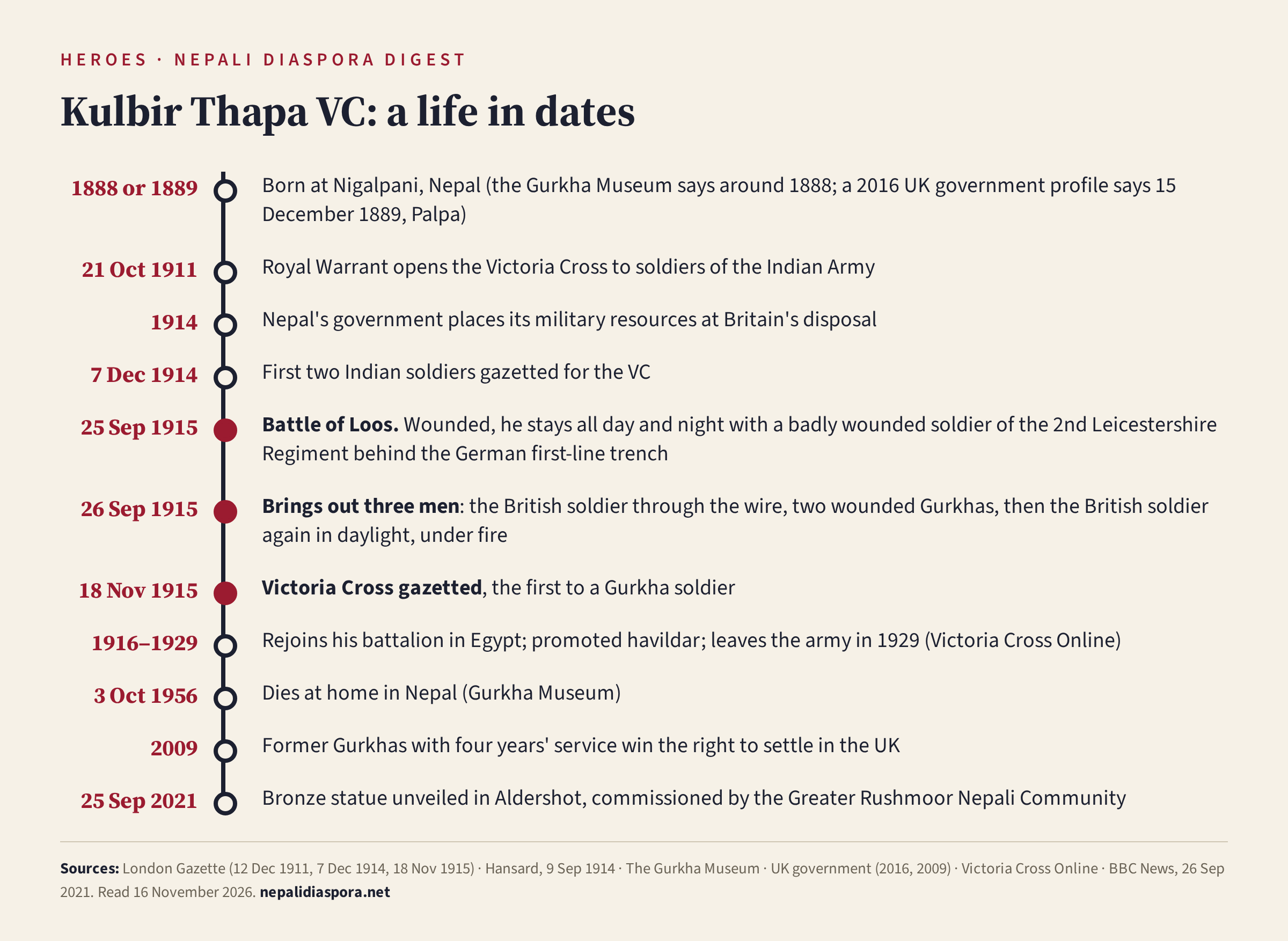
Who was Kulbir Thapa?
The sources agree on less than you might expect. The Gurkha Museum in Winchester says he was born at Nigalpani in Nepal “around 1888”. A UK government profile published in 2016 gives 15 December 1889, in Palpa. Victoria Cross Online, which keeps records of every VC, puts Nigalpani in Palpa district and says he was a Magar (the BBC calls him Kulbir Thapa Magar), married, with at least one son.
He enlisted in 1907, according to Victoria Cross Online, in the 1st Battalion of the 3rd Gurkha Rifles, a regiment of the British Indian Army, and moved to the 2nd Battalion when it was sent to France after war broke out in 1914, according to the museum.
Why were Nepalis fighting in France?
Gurkhas had served Britain for a century by then. The National Army Museum traces it to the war of 1814–16 between the East India Company and Gorkha, after which large numbers of Gurkhas were allowed to volunteer for the Company’s army.
In 1914 Nepal’s rulers went further. A telegram from the Viceroy of India, read out in the House of Commons on 9 September 1914, reported that “the military resources of the State have been placed at the disposal of the British Government”, and that Prime Minister Chandra Shumsher had offered Rs 3 lakh for machine guns or field equipment for Gurkha regiments going overseas.
How many Nepalis served is still argued over. The Gurkha Museum says over 90,000 Gurkhas had served by the end of the war, with over 20,000 casualties; the National Army Museum says around 100,000 fought. Others give 200,000: a 2023 Kathmandu Post column by Deepak Thapa quotes R. L. Turner, a former Gurkha officer, telling London’s Royal Geographical Society in 1923 that 200,000 men were recruited from Nepal, of whom 55,000 enlisted in the Gurkha battalions. Nepal also sent thousands of its own army to garrison India and release Indian Army units for service overseas: Sam Cowan, a retired British general writing in The Record, counts 7,500 men in March 1915, 4,000 more in December 1915 and another 4,000 a year later.
This is the hard part of the story. Deepak Thapa, in his Kathmandu Post column, calls the Nepal government’s wartime recruitment drives “akin to conscription”. After the war the British Government of India paid Nepal’s government a million rupees a year, Cowan writes; Thapa says the money is believed to have been siphoned off into the prime minister’s personal coffers. And in 1923 Britain signed a treaty recognising Nepal’s independence, which the Gurkha Museum says was partly in gratitude for its support in the war. Kulbir Thapa had enlisted years before the war. His bravery was his own; the bargain that sent Gurkhas to France was struck by others.
A rule that had changed four years earlier
Until 1911 Indian soldiers could not win the Victoria Cross. A Royal Warrant dated 21 October 1911, published on the day of the Delhi Durbar, extended it to “the Native Officers, Non-commissioned Officers and Men of the Indian Army”. It also set a special pension: 525 rupees a year for a native officer and, for a non-commissioned officer or soldier like Kulbir, 150 rupees. The first two Indian soldiers to receive it, Darwan Sing Negi of the Garhwal Rifles and Khudadad of the Baluchis, were gazetted on 7 December 1914.
25 September 1915
The Battle of Loos was the largest British offensive of the war up to that point, in the Gurkha Museum’s words, and the first British use of poison gas, according to The Long, Long Trail, a reference site on the British Army in the First World War. Kulbir’s battalion was not in the main attack.
In his despatch, the British commander Sir John French wrote that the Indian Corps attacked the Moulin du Pietre, one of several attacks meant to hold German troops away from the main assault. Those attacks “were at first successful all along the line”, he wrote, but by nightfall the troops “reoccupied their original trenches”.
The cost is clearer in a battalion that attacked alongside Kulbir’s. The Gurkha Museum says the 2nd Battalion of the 8th Gurkha Rifles went in about 500 strong and had 469 casualties, killed, wounded and missing, in less than a day. On its right, the museum says, the 2nd Leicestershire Regiment had failed to take its objective.
What he did
His citation, published in the London Gazette on 18 November 1915, tells it in a single paragraph:
“When, himself wounded, on the 25th September, 1915, he found a badly wounded soldier of the 2nd Leicestershire Regiment behind the first line German trench, and, though urged by the British soldier to save himself, he remained with him all day and night. In the early morning of the 26th September, in misty weather, he brought him out through the German wire; and, leaving him in a place of comparative safety, returned and brought in two wounded Gurkhas one after the other. He then went back in broad daylight for the British soldier and brought him in also, carrying him most of the way and being at most points under the enemy’s fire.”
(The Gazette prints “Gúrkhas” with an accent; we have used today’s spelling.)
So: three men, carried out one at a time by a man who was wounded himself, the last of them in daylight. The Gazette names him as 2129 Rifleman Kulbir Thapa, 2nd Battalion, 3rd Queen Alexandra’s Own Gurkha Rifles, and places the action “south of Mauquissart”; the UK government’s profile says south of Fauquissart, a nearby village. It does not name the Leicestershire soldier, and we have not found a reliable record that does.
After the war
He recovered and was promoted havildar, a sergeant’s rank, the Gurkha Museum says. Victoria Cross Online says he rejoined his battalion in Egypt on 4 January 1916 and left the army in 1929; the museum says he returned to India at the end of the war. He died at home in Nepal on 3 October 1956, aged 68, according to the museum (66, if the 1889 birth date is right). Victoria Cross Online says he is buried at Nigalpani, but that the exact spot is not known.
Was he really the first?
He was the first Gurkha soldier awarded the VC, as the Gurkha Museum puts it; British officers of Gurkha regiments had won it before. He was not the first Indian soldier to win it; those two came eleven months earlier. Another rifleman of his own battalion, Karanbahadur Rana, was gazetted on 21 June 1918. In Nepal it is Karanbahadur who has the statue: Kantipur reported in January 2026 that an ex-servicemen’s association had put one up at Bharse in Gulmi, where he died. We found no memorial to Kulbir Thapa in Nepal.
The long tail
The terms Gurkhas served on stayed tied to India for decades. After Indian independence the 1947 Tripartite Agreement between Britain, Nepal and India became the basis for Gurkha service in the British Army. The UK government said in its 2015 response to MPs that this agreement gave Gurkha pay and pensions an “underlying parity” with the Indian Army’s, and it called the Gurkha pension scheme “a generous and fair scheme” designed to give veterans a good standard of living in Nepal. Gurkhas who joined from April 2007 are on the same terms as other soldiers. For those who served before, the same response notes that some in the community see the historic differences as unjust, and veterans campaigned for years over both pensions and the right to live in Britain. In April 2009 MPs defeated the government 267 to 246 on a Liberal Democrat motion for equal residence rights, RNZ reported, and in May the Home Office announced that former Gurkhas with at least four years’ service could settle in the UK.
The statue in Aldershot
On 25 September 2021, 106 years to the day after his action, a bronze of Kulbir Thapa carrying a wounded soldier from the Leicestershire Regiment was unveiled in Princes Gardens, Aldershot. The BBC reported that the Greater Rushmoor Nepali Community commissioned it and that it was made by the Hampshire-based sculptor Amy Goodman. Miaya Dangol KC, of the community’s committee, told the BBC it was funded entirely by private donations, and the project manager, Gary Ghale, said most donors were Gurkha veterans and their families. It is the diaspora remembering one of its own.
What we could not confirm
Whether he was born in 1888 or 1889, and exactly where he is buried.
The name of the Leicestershire soldier he saved.
Whether he received the medal from the King: the UK government’s profile says George V gave it to him at Buckingham Palace; Victoria Cross Online says there does not appear to have been a formal investiture.
Where his Victoria Cross is now. Victoria Cross Online says his medals are held by the Gurkha Museum; the museum’s own pages we read do not say.
Anything about him in Nepali-language sources, or from his family.
If you are from Palpa, or from his family, and know more, reply and tell us. We will add it here.
Sources
Read on 16 November 2026.
The London Gazette: his citation, 18 November 1915; the Royal Warrant of 21 October 1911 and its pension clause; the first Indian Army VCs, 7 December 1914; Sir John French’s despatch on Loos, dated 15 October and published 1 November 1915; Karanbahadur Rana’s citation, 21 June 1918
The Gurkha Museum: Kulbir Thapa, the 8th Gurkha Rifles at Loos, the 1923 treaty
UK government: Kulbir Thapa case study (2016) and response to the APPG on Gurkha Welfare (2015)
Home Office announcement on Gurkha settlement, 21 May 2009 (copy on WiredGov)
Reports and columns: The Record, 2 July 2020; Kathmandu Post, 27 December 2023; RNZ, 30 April 2009; BBC News, 26 September 2021; Kantipur, 1 January 2026 (in Nepali)
More from the Digest: NRN citizenship: who qualifies and how to apply · this week’s edition
The Nepali Diaspora Digest is the week in Nepal for Nepalis abroad, free every Friday: nepalidiaspora.net
— Binit, for the Nepali Diaspora Digest