


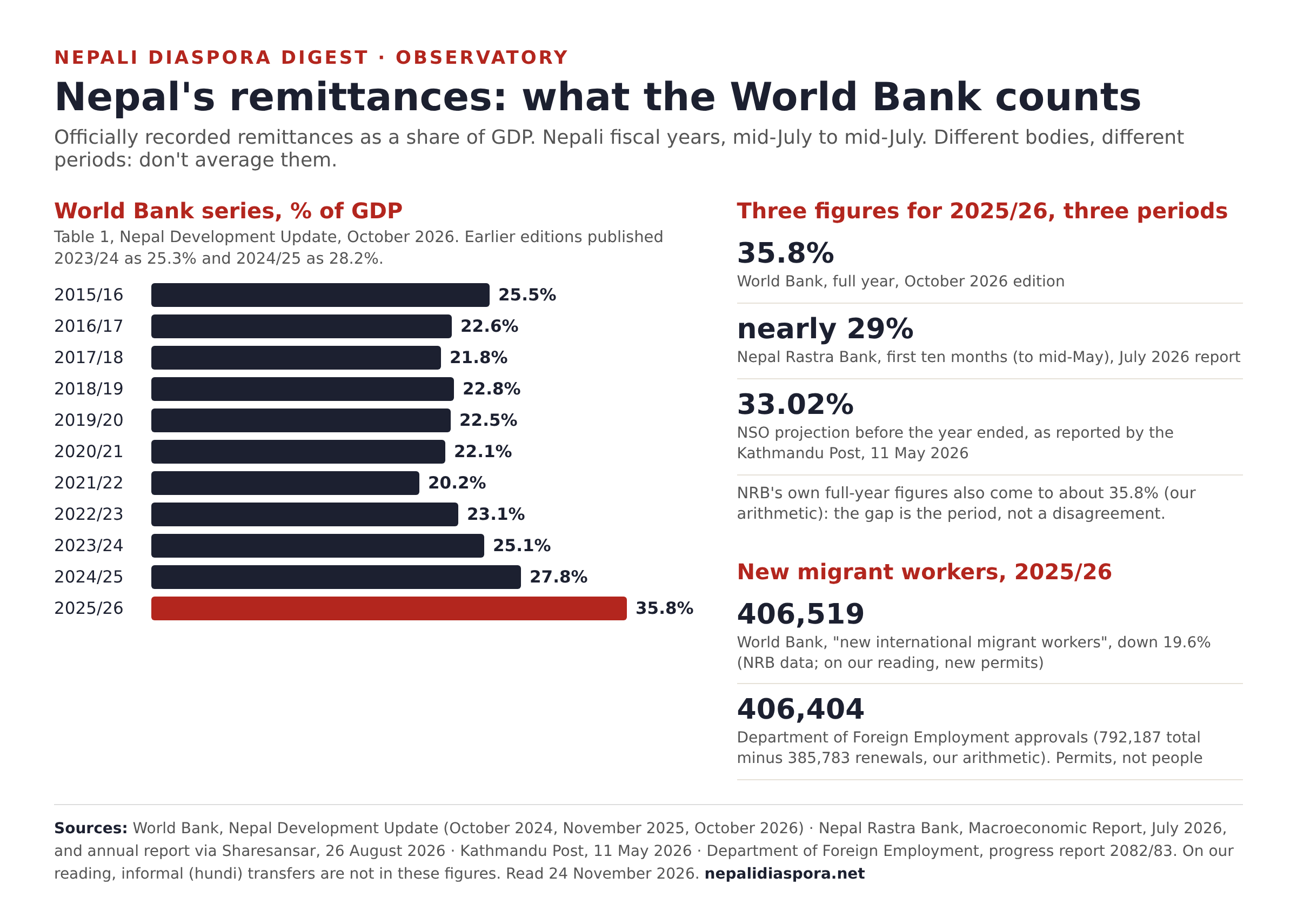
The World Bank calls remittances a critical stabiliser, supporting millions of Nepali households. By its count, officially recorded inflows reached a record 35.8% of GDP in the year to mid-July 2026, even though the number of new migrant workers fell. Its 2024 study credits remittances with more than 30% of the fall in poverty between 2011 and 2023, and warns that migration is costly and that there are too few jobs at home; its 2026 updates add the risk of depending on a few Gulf countries.
This page is the World Bank’s 2024 study, updated with the 2026 numbers, as of November 2026. The study is the special focus of the October 2024 Nepal Development Update, “International Migration and Well-being in Nepal”, written by Lokendra Phadera, Sarita Sapkota and Alvin Etang Ndip of the Bank’s Poverty and Equity team. The newest figures are from the October 2026 edition, produced by a team led by Abdoul Ganiou Mijiyawa with Nayan Krishna Joshi and Prabin Dongol; its own special focus is rebuilding after the August 2026 Rasuwa flood, not migration. The Bank counts officially recorded remittances. On our reading, that leaves out money sent informally through hundi. This is information, not financial advice.
What is the Nepal Development Update?
A report on Nepal’s economy that the World Bank publishes twice a year, usually in April and in October or November. Each edition covers growth, prices, public finances and the external sector, and most have a “special focus” on one theme. The October 2024 edition is the Bank’s most recent special focus on migration. The Bank’s Country Economic Memorandum of March 2025 repeats and extends that work in its migration chapter, by Phadera and Sapkota. The April and October 2026 editions report the latest remittance and migrant figures but we found no new migration policy recommendations in them.
Years here are Nepal’s fiscal years, mid-July to mid-July: FY26 means 2025/26, which ended in mid-July 2026.
How big are Nepal’s remittances?
A record 35.8% of GDP for the full year, by the World Bank’s count. You will also see lower figures for 2025/26. They cover less of the year, or were made before it ended:
World Bank: 35.8% of GDP, the full year 2025/26, up from 27.8% in 2024/25 (October 2026 edition, Table 1, from “NRB and World Bank staff calculations”).
Nepal Rastra Bank (NRB), the central bank: “nearly 29 percent of GDP in the first ten months of 2025/26”, in its Macroeconomic Report of July 2026, with data to mid-May.
National Statistics Office (NSO): about 33.02%, a projection for the year made before it ended, as the Kathmandu Post reported on 11 May 2026. We have not seen the NSO’s own report.
They count different periods, so don’t average them. In money, NRB’s annual report gives Rs 2,363.13 billion for the full year 2025/26, up 37.1%, or USD 16.19 billion, up 28.1%, as Sharesansar reported on 26 August 2026. The same report puts public debt of Rs 2,974.90 billion at 45.07% of GDP, so by our arithmetic NRB’s own full-year figures also come to about 35.8%. Its ten-month figure matches ten months of remittances set against a whole year’s GDP. The rupee figure grew faster than the dollar figure; NRB says the rupee fell 10.4% against the dollar after July 2025, and the World Bank lists that fall as one driver of the rise.
In the Bank’s October 2026 table, remittances were between 20.2% and 25.5% of GDP every year from 2015/16 to 2023/24. The jump came in the last two years. The Bank’s own numbers move too: its November 2025 and April 2026 editions put 2024/25 at 28.2% of GDP; the October 2026 edition says 27.8%. It revised 2023/24 from 25.3% to 25.1%, without saying why. And in October 2024 the Bank projected that remittances would “stabilize around 25 percent of GDP.”
Why did remittances rise while new migrant workers fell?
The October 2026 edition puts it in one sentence: “Remittances increased despite a 19.6 percent decline in new international migrant workers, reflecting higher remittances per worker, destination diversification, Nepali Rupee depreciation against the US dollar, and greater use of formal and digital channels.”
By the Bank’s count, the number of new international migrant workers fell to 406,519 in 2025/26. The Bank does not define the count; its source is NRB data, and the figure is within 115 of the government’s count of new labour permits (below), so on our reading it counts permits, not people who left. Outflows to the Middle East fell 39.3% to 231,779, which the Bank links to the regional conflict, a temporary suspension of labour approvals by Nepal’s government, stricter labour and visa policies in Saudi Arabia and the UAE, and workers turning towards East Asia and Europe. Outflows to Europe rose 32.5%, and to Malaysia more than six-fold after Malaysian factories resumed recruiting.
The Department of Foreign Employment’s own progress report for 2082/83 (2025/26) gives 792,187 labour approvals, of which 385,783 were re-entry approvals (renewals). That leaves 406,404 new approvals, by our arithmetic. Approvals are permits, not people or departures. Our page on where Nepali migrant workers go explains what the permit figures do and don’t count.
What do remittances do for families?
These figures are from the 2024 study, which used the 2021 census and Nepal’s household survey of 2022/23:
Who has someone abroad: 23.3% of households in 2021. The 2.2 million people living abroad were 7.5% of the population, and 80% of them were men.
How much it matters: in 2023 remittances paid for more than 20% of the average household’s spending, from 17% in the poorest fifth of households to nearly 25% in the richest.
What it pays for: 70% of migrants who send money send it mainly for daily consumption, and almost one-fifth mainly to repay loans. A 1% rise in remittances per person is “associated with” a 0.04% rise in education spending and 0.02% in health spending, a correlation, not proof of cause.
The Bank’s 70% is its own estimate from the 2022/23 household survey, counted per migrant. The statistics office’s report on the same survey counts each remittance instead, and gets a slightly different share: see our page on what remittances pay for in Nepal.
Did remittances cut poverty?
The Bank says they did much of the work, not most of it. The 2024 study states: “Over 30 percent of the poverty reduction between 2011 and 2023 is directly attributed to personal remittances (World Bank, Forthcoming).” The Bank’s Poverty and Equity Brief of October 2026 gives 32%, as its October 2024 brief already did, and says remittances kept about 2.6 million people out of poverty.
Two cautions. The paper with the method, “Decomposing poverty in Nepal”, is cited as forthcoming, and we could not find it published as of November 2026, so the calculation itself can’t be checked. And the brief notes that “the official 2023 welfare aggregate and poverty indicator are not strictly comparable to 2011.”
What does migration cost?
The study collects older surveys, each with its own year:
Recruitment: in 2016 the average cost of migrating to Qatar was 1.14 times Nepal’s annual GDP per person (a KNOMAD-ILO survey). Under the 2015 free-visa, free-ticket policy, agencies may charge at most NPR 10,000 in service fees, but the Bank says most charge more than ten times that.
Debt: 85% of migrant workers relied on informal loans, at an average interest rate of 27% (a 2023 study the Bank cites).
Deaths: over 1,000 migrants a year in recent years, citing the labour ministry (2022) and the Kathmandu Post (2024).
Coming home: in Nepal’s 2017/18 labour force survey, 14.3% of returnees were unemployed and 41.5% outside the labour force, and over 75% of those working had informal jobs. Only 15.1% did the same kind of work as abroad.
What did the World Bank recommend in 2024?
Lower costs, bigger benefits, and migration written into Nepal’s development and poverty plans. In the 2024 report, its points were these. We have not checked whether any has changed since:
Better, verifiable information on jobs abroad, and cheap formal loans in place of informal ones.
Better preparation before leaving: “The current 12-hour pre-departure orientation course has limited efficacy”, it wrote, and suggested language and money-planning skills.
More labour agreements and skills recognition. In 2024 the Bank wrote that Saudi Arabia and Kuwait, the second and fifth largest destinations, had no bilateral labour agreement or memorandum with Nepal, and suggested consular support on the model of India and the Philippines.
Help for returnees: job matching, reskilling and help to start businesses. The Bank said existing schemes reach few people and none had been rigorously evaluated.
In the end, fixing the structural problems in Nepal’s own job market.
What risks does the Bank flag?
Concentration. The April 2026 edition says 77.3% of Nepali migrant workers are in the Middle East, and that Saudi Arabia, Qatar and the UAE together send around 37% of all remittances (a share it takes from the 2022/23 household survey). That edition also reported that Nepal suspended all labour permits for 12 countries on 1 March 2026 and reinstated re-entry permits for seven on 17 March; we do not state the position since. It expected the conflict to add 17,267 people to the number of poor in 2025/26 (at USD 4.20 a day). Six months later, the October edition reported record inflows for the same year and wrote: “Key downside risks include a prolonged conflict in the Middle East, which could reduce tourist arrivals and remittance inflows, dampen consumption and services activity, and slow overall growth.”
What these reports don’t tell us
Informal money. On our reading, hundi transfers are outside the official figures, so the true total is unknown.
New household data. The household figures date from 2021 to 2023, the returnee figures from 2017/18. The 2026 editions update the macro numbers only.
How the figures fit together. Neither the World Bank nor NRB explains the gap between 35.8% and nearly 29%; on our arithmetic it is the period covered, not a disagreement.
The next edition. An April 2027 update could revise the 2025/26 figures again.
If you have a newer figure, reply with the source and we will update this page.
Sources
Read on 24 November 2026.
World Bank, Nepal Development Update: October 2024 (special focus by Phadera, Sapkota and Etang Ndip), November 2025, April 2026, October 2026; all editions
World Bank, Country Economic Memorandum, “Unlocking Nepal’s Growth Potential” (March 2025)
World Bank, Poverty and Equity Briefs, Nepal: October 2024, October 2026
Nepal Rastra Bank, Macroeconomic Report: Analysis and Outlook, July 2026
Department of Foreign Employment, annual progress report 2082/83
News: Kathmandu Post, 11 May 2026 (NSO projection); Sharesansar, 26 August 2026 (NRB annual report)
More from the Digest: What remittances pay for in Nepal: the living standards survey · Where Nepali migrant workers go: labour permits by country
The Nepali Diaspora Digest is the week in Nepal for Nepalis abroad, free every Friday: nepalidiaspora.net
— Binit, for the Nepali Diaspora Digest