


One ropani is 5,476 square feet (508.74 square metres) and is divided into 16 aana; one bigha is 72,900 square feet (6,772.63 square metres) and is divided into 20 kattha. The hills and the Kathmandu Valley count land in ropani, the Tarai in bigha, and Nepal’s land law records surveyed land in hectares and square metres.
This guide gives the full table, how to read the figures on a lalpurja, and why converter websites disagree, as of November 2026. One thing to know first: we found no government document that states a ropani or bigha in square feet or metres. The figures below are the conventional ones every converter uses, worked out by us from a 74-foot square (the ropani) and a 270-foot square (the bigha). The area printed on your own land record is the one that counts.
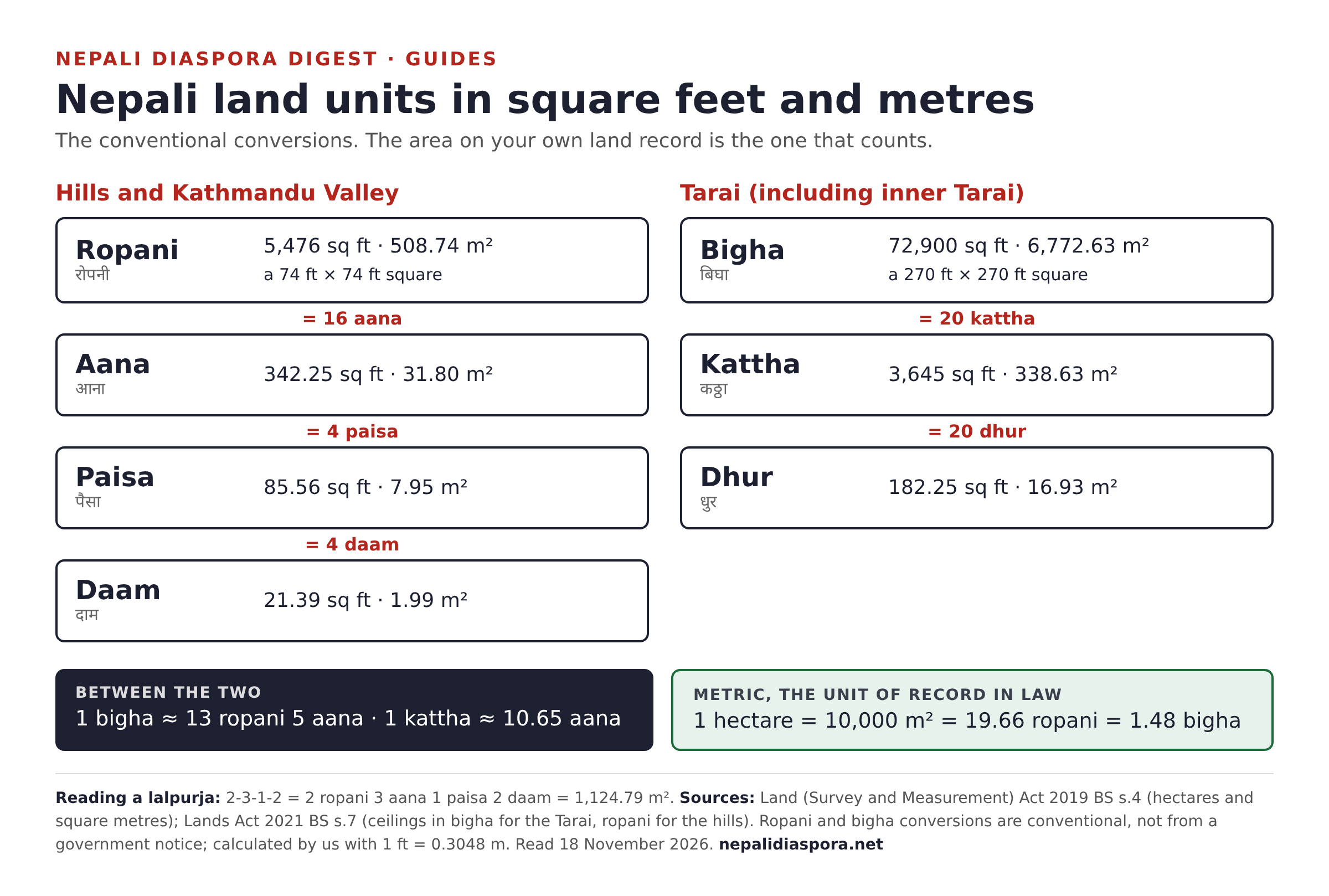
What is a ropani, aana, bigha and kattha in square feet and metres?
Hills and Kathmandu Valley
Unit Square feet Square metres Equals 1 ropani 5,476 508.74 16 aana 1 aana 342.25 31.80 4 paisa 1 paisa 85.56 7.95 4 daam 1 daam 21.39 1.99
Tarai
Unit Square feet Square metres Equals 1 bigha 72,900 6,772.63 20 kattha 1 kattha 3,645 338.63 20 dhur 1 dhur 182.25 16.93
Between the two, and metric
1 bigha = 13 ropani 5 aana (13.31 ropani), to the nearest aana
1 kattha = 0.67 ropani, or about 10.65 aana
1 ropani = about 1.5 kattha
1 hectare = 10,000 square metres = 19.66 ropani = 1.48 bigha
For readers in the US and UK: 1 ropani is about 0.126 acres, and 1 bigha about 1.67 acres
The square-metre figures use the international foot of exactly 0.3048 metres, so 1 ropani works out at 508.737 square metres, which rounds to 508.74.
Which system does my family’s land use?
It depends on where the land is. The Lands Act 2021 BS (section 7) states its ownership ceilings in bigha for “All Terai regions including inner Terai” and in ropani for the Kathmandu Valley and “All hilly regions except Kathmandu Valley”. In practice, land in Jhapa, Chitwan or Kailali is usually in bigha, kattha and dhur, and land in Kathmandu, Pokhara or Ilam in ropani, aana, paisa and daam. The Land Rules still ask for area in bigha or ropani next to hectares.
Older hill records may use a third, older system. A 2064 BS article by three Survey Department officers in the department’s own journal says that in the Sarpat (chain) survey begun under Prime Minister Bir Shumsher in 1952 BS, “the unit of the measurement was defined as Ropani-Ana in valley areas, Muri-Pathi in Hills areas and Bigha-Kattha in terai areas”. We found no official conversion for muri-pathi.
How do I read the area on a lalpurja?
In the hill system, area is usually written as four numbers in order: ropani, aana, paisa, daam. So 2-3-1-2 means 2 ropani, 3 aana, 1 paisa and 2 daam:
2 × 5,476 + 3 × 342.25 + 1 × 85.56 + 2 × 21.39 = 12,107 square feet, or 1,124.79 square metres
In the Tarai the order is bigha, kattha, dhur. So 1-5-10 means 1 bigha, 5 kattha and 10 dhur:
72,900 + 5 × 3,645 + 10 × 182.25 = 92,947.5 square feet, or 8,635.11 square metres
If your record gives hectares and square metres, the plot of 2-3-1-2 above is 1,124.79 square metres, or about 0.1125 hectares. The Land (Survey and Measurement) Act 2019 BS (section 4) requires surveyed land to be recorded in hectares and square metres, with square metres to two decimal places, and tells the Land Revenue (Malpot) Office to convert older records of surveyed land kept in bigha or ropani. We could not find which records have been converted, or what every printed certificate now shows, so check yours.
What are a lalpurja and a kitta number?
The lalpurja is the landowner’s certificate of ownership; the Survey Department’s own MeroKitta service calls it the जग्गाधनी प्रमाणपुर्जा (land ownership certificate). The kitta is the plot. The English translation of the survey Act defines a plot as “a piece of land that has boarder in all four sides and has similarity in right, possession and grade in each place”, and each plot has its own kitta number on the survey map and the register.
MeroKitta lets owners request a plot map and plot register online; it asks for a scan of the ownership certificate and the owner’s citizenship certificate. It has no unit calculator.
Why do converter websites give different numbers?
Mostly rounding, sometimes mistakes. We checked several popular pages on 18 November 2026:
508.72 or 508.74 square metres for a ropani? 5,476 square feet works out at 508.737 square metres, which rounds to 508.74. 508.72, in Wikipedia‘s list (its own table on the same page gives 508.737) and on many converters, is 0.02 square metres smaller, which matters only on large plots.
“1 Katha = 20 paisa”, on Housing Nepal, is wrong: a kattha is 20 dhur. Paisa belongs to the hill system. The same page gives a bigha as 6,772.41 square metres instead of 6,772.63.
A bigha of 2,000 square metres and a kattha of 100, on Merokalam, are wrong for Nepal. A Nepali bigha is more than three times that.
13 ropani or 13 ropani 5 aana? A bigha is 13 ropani and just over 5 aana (13.31 ropani); rounding it to 13 loses about 1,700 square feet.
Indian bigha, katha and dhur vary by state and are not Nepal’s units. Many search results for bigha to square feet are Indian.
Hamro Patro’s converter matches our table. It is a private company’s tool, not an official one, and neither the Survey Department nor the Department of Land Management offers a calculator.
Before you buy, sell or divide land
Check the area on the record itself, not on a converter, and in the unit it uses. For a sale or a division between family members, get the plot map and register (through MeroKitta or the survey office) and, if the boundaries are in doubt, a survey. If you are abroad, our guides on power of attorney and land rights for NRNs and foreign citizens cover the paperwork and the law.
Sources
Read on 18 November 2026. Conversions are ours, from 5,476 square feet a ropani, 72,900 square feet a bigha and 0.3048 metres a foot.
Land (Survey and Measurement) Act 2019 BS, section 4 (Nepali, Department of Survey); English translation (Nepal Archives)
Land (Survey and Measurement) Rules 2058, rule 9 and schedule 7; Land Rules 2021 BS
Lands Act 2021 BS, section 7 (English translation, Nepal Archives)
K. R. Adhikary, D. R. Paudyal and P. Joshi, Cadastre in Nepal: Past and Present, Nepalese Journal on Geoinformatics 6 (2064 BS), Survey Department
Department of Survey, MeroKitta
Converter pages checked: Hamro Patro, Wikipedia, Housing Nepal, Merokalam
If you have a government source that states these units in square metres, reply and send it. We will add it.
More from the Digest: Can foreigners or NRNs buy or inherit land in Nepal? · Power of attorney for Nepal from abroad
The Nepali Diaspora Digest is the week in Nepal for Nepalis abroad, free every Friday: nepalidiaspora.net
— Binit, for the Nepali Diaspora Digest