


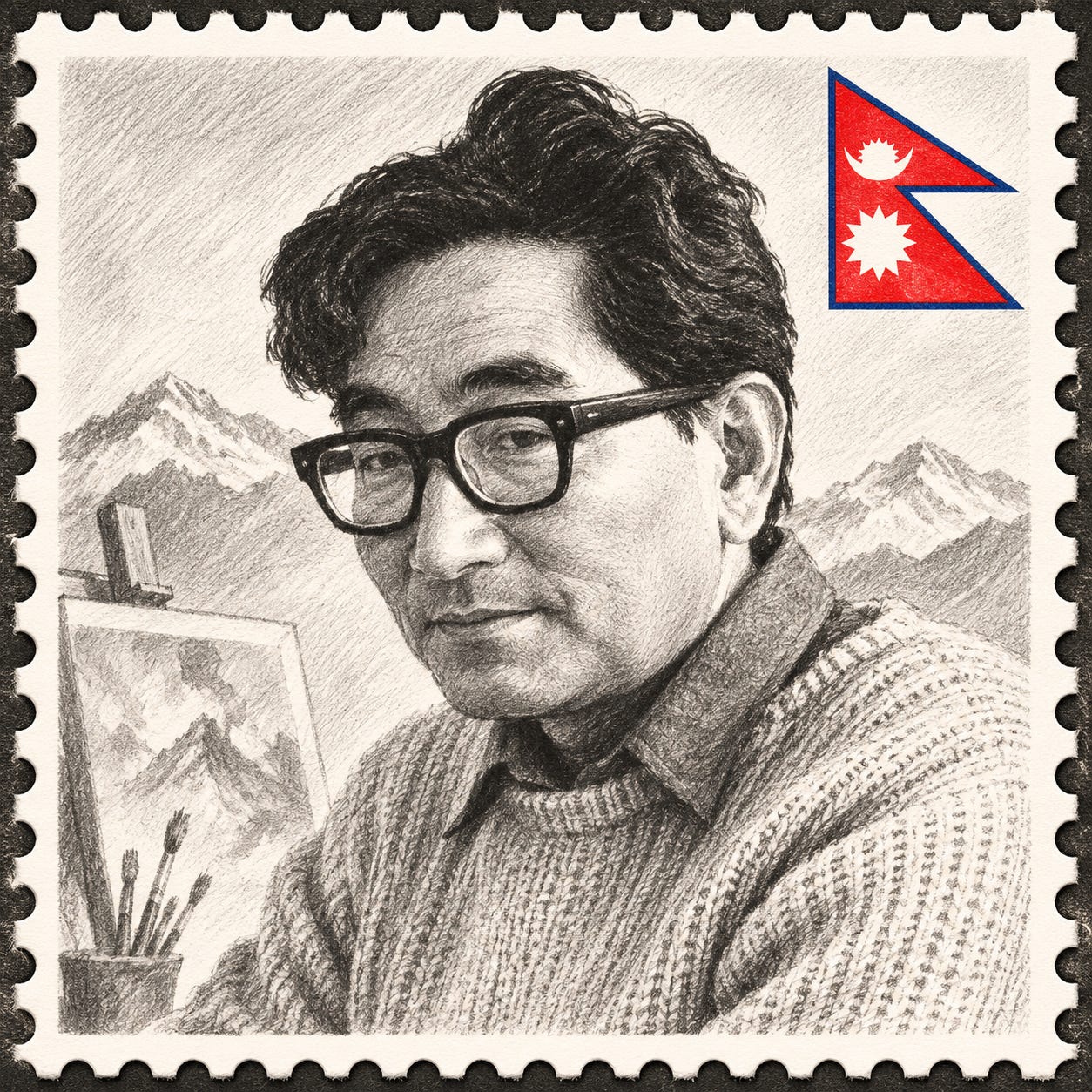
In 1962 a painter from Darjeeling hung his first solo exhibition in Nepal, at Tri-Chandra College in Kathmandu. He had trained in Calcutta, studied in Paris and worked in London, and many of the pictures on the walls were abstract. “Those who went to see his first exhibition could not help but question what they had seen,” the scholar Abhi Subedi told the Kathmandu Post in 2021. “People didn’t realise that Bangdel had commenced a paradigm shift in Nepal’s art scene at that moment.” The painter was Lain Singh Bangdel. Until 1961, by his family’s account and the Kathmandu Post’s, he had never set foot in Nepal, the country of his ancestors.
He went on to lead the Royal Nepal Academy, to write histories of Nepali painting and sculpture, and to photograph the gods being stolen from the Kathmandu Valley’s temples. This is his story, told from the records: the press, his biographer’s essays and a 2026 catalogue written by his family, hard parts included: his closeness to the palace, the complaints of other artists, and the dates nobody agrees on.
Where was he from, and when was he born?
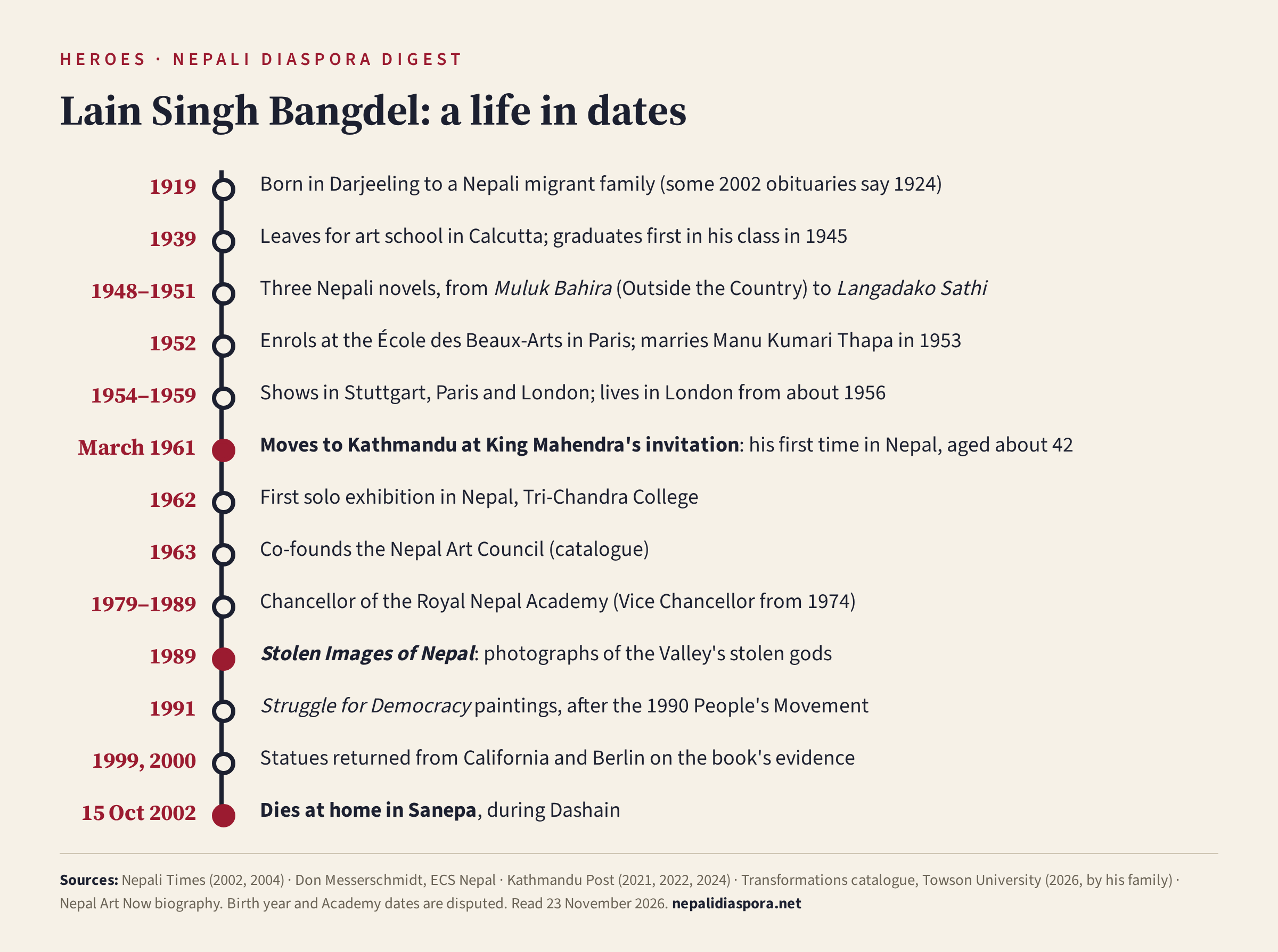
He was born in Darjeeling, in British India, to a Nepali migrant family; his father was a tea estate clerk. The Rossi & Rossi gallery, which sells his work, says the family was Rai, from Khotang in eastern Nepal. In Calcutta, a 2004 Nepali Times review of his biography says, he changed his surname from Rai to Bangdel, the name of his clan.
The fullest account of his childhood is the 2026 exhibition catalogue from Towson University in Maryland. Its biography is by Bibhakar Sunder Shakya, Bangdel’s son-in-law, drawing on Bangdel’s unpublished autobiography, and Shakya’s own press published it: it is the family’s account. By that account his mother died when he was eighteen months old, his grandmother raised him, and he lost six years of school because his elder brother was the one chosen to go. The Nepali Times review says he grew up with a feeling of disconnect and rootlessness that later showed in his novels and paintings.
His birth year is disputed. The family, his biographer Don Messerschmidt and the galleries give 1919, and Nepali Times said in 2021 that he died at 83, which fits. But two 2002 obituaries, in Nepali Times and on the writer Razen Manandhar’s blog, say 1924, and the bookseller Thuprai gives Bikram Sambat 1981, about 1924. We use 1919.
What did he do in Calcutta?
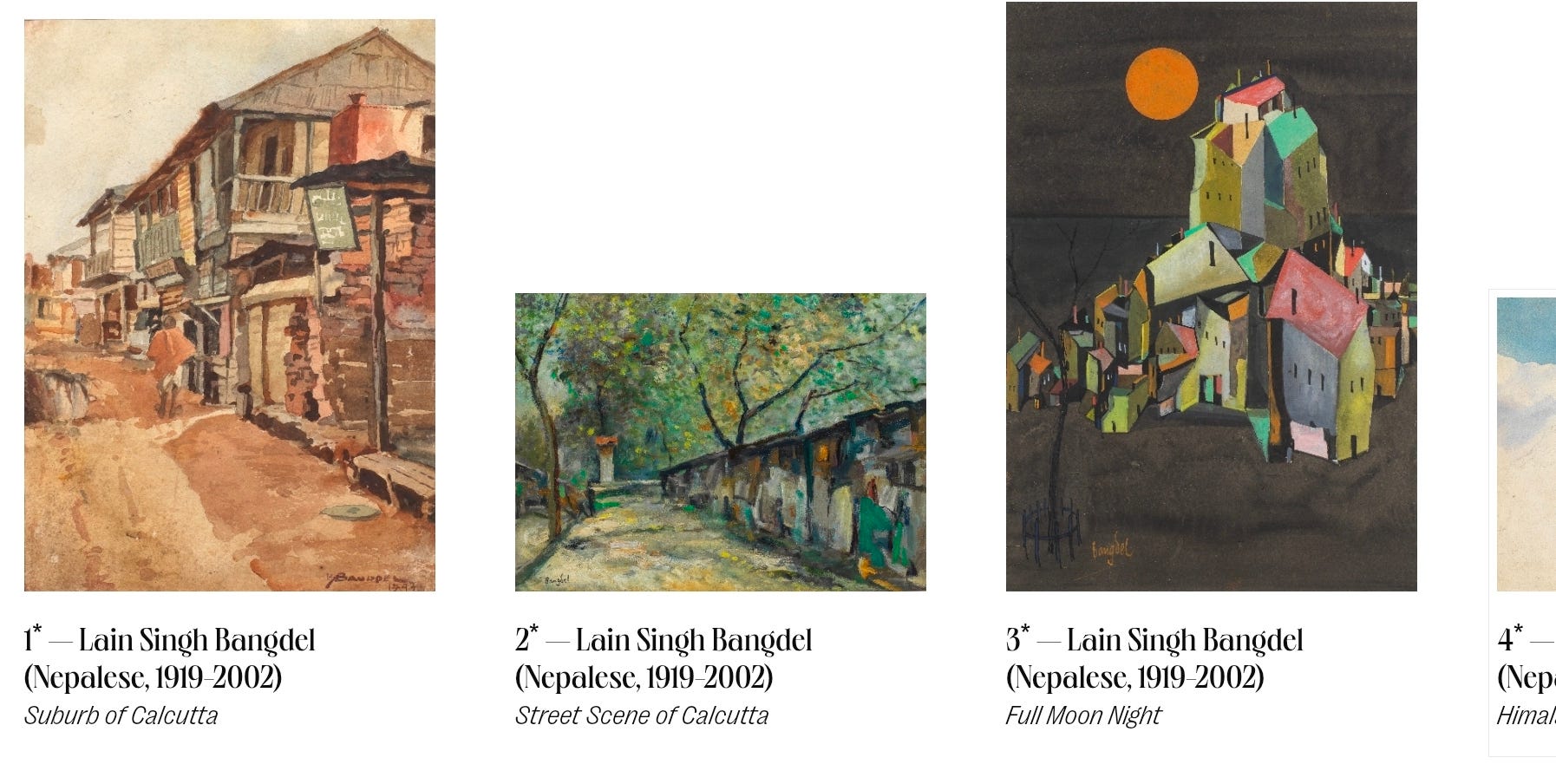
In July 1939, by the Nepali Times review, he left Darjeeling for the Government School of Art and Craft in Calcutta. He graduated in 1945, first in his class, by the account of Swosti Rajbhandari Kayastha of the Nepal Art Council. The family catalogue says he then worked at the advertising firm D. J. Keymer, sharing a desk with the young Satyajit Ray, the future film director. Only the catalogue has the desk; the Nepali Times review says Ray became a close friend.
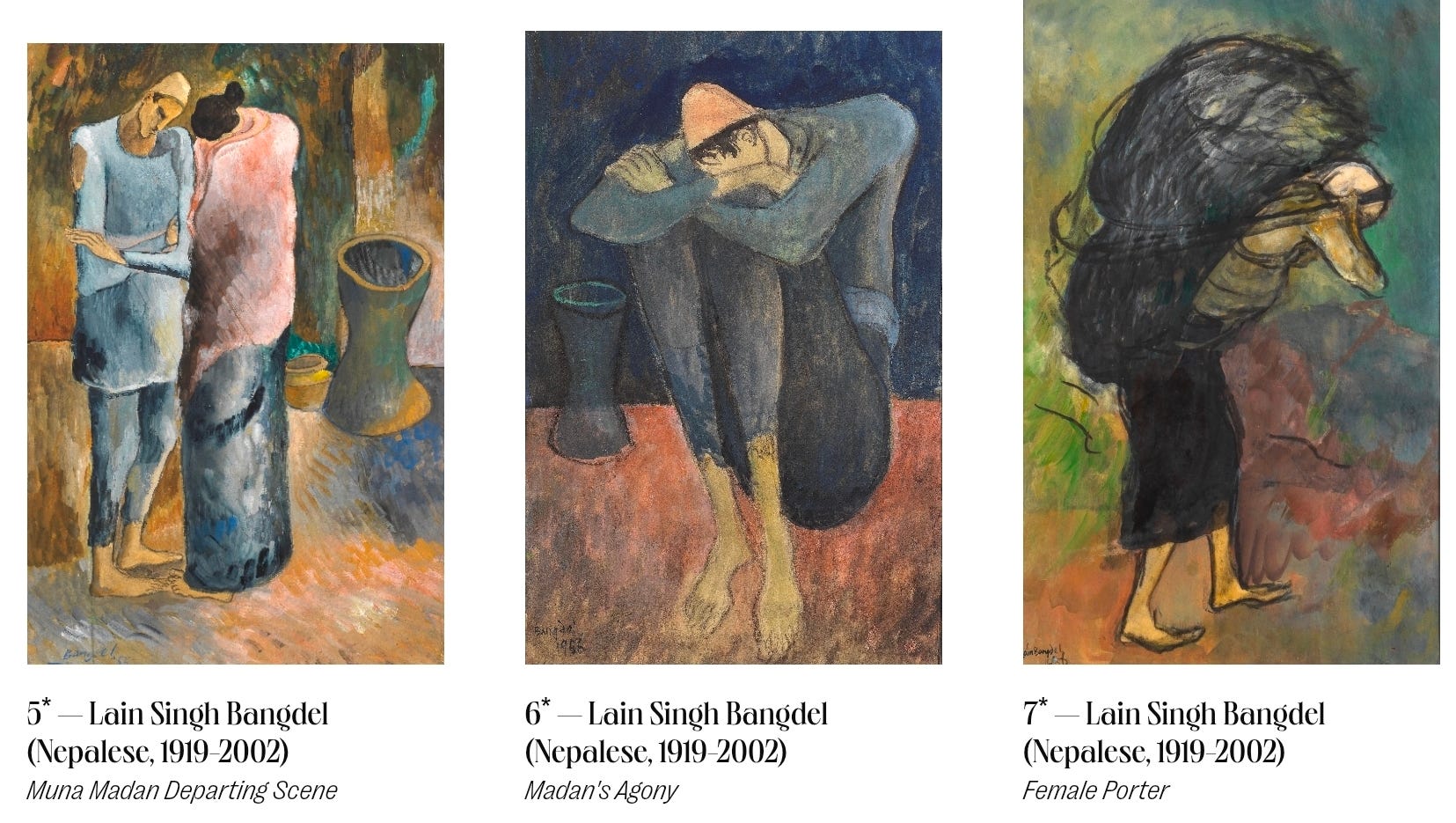
Between 1948 and 1951 he published three novels in Nepali, from Darjeeling and Calcutta: Muluk Bahira (Outside the Country), Maitighar (Maternal Home) and Langadako Sathi (Langada’s Friend), which, the Kathmandu Post wrote in 2022, imagines the life of a beggar. His paintings from Calcutta and Paris, it says, show the same poor and dispossessed. In 1950, the catalogue says, he founded a Nepali literary magazine, Prabhat (Dawn).
Why did he go to Paris and London?
How he paid for it depends on the source. The Nepali Times review says General Kaiser Shamsher JB Rana, impressed by his portrait of the writer Balkrishna Sama, gave him Rs 5,000; the family catalogue says he won design competitions; Manandhar wrote that he sold early paintings in the street. The catalogue has him in London by late 1951, and the Kathmandu Post says he enrolled at the École Nationale Supérieure des Beaux-Arts in Paris in 1952.
He exhibited in Stuttgart in 1954 and held solo shows in Paris in 1955 and London in 1959, Kayastha writes.
In 1953 he married Manu Kumari Thapa, a nurse in London who, a 2024 Kathmandu Post review says, supported him financially. From about 1956, the catalogue says, they lived in London, where he was an art director at a commercial agency, and by the end of the decade he was painting abstracts.
Who invited him to Nepal, and when?
Bangdel and B.P. Koirala, later Nepal’s first elected prime minister, had been friends since the 1940s, Don Messerschmidt writes in an essay adapted from Against the Current, the biography he wrote with Bangdel’s daughter Dina. Koirala came to Europe in 1957 and 1960, the Nepali Times review says, and tried to persuade him home, but the Bangdels were planning to emigrate to Canada. Messerschmidt quotes Koirala in London: “Bangdel-ji, you must come to Nepal. You have to establish a small art organization or a gallery or museum.” Then, by Bangdel’s recollection as Messerschmidt gives it, King Mahendra met him in London in 1960 (1961, says the Nepali Times review) and promised to help.
The family catalogue’s essay says a summons came in 1961 from King Mahendra and Prime Minister B. P. Koirala, but Mahendra had deposed and imprisoned Koirala in 1960, as Messerschmidt notes elsewhere. The catalogue’s own timeline puts a meeting with both men in London in 1960, while Koirala was still in office. By the time Bangdel moved, Koirala was in prison; other accounts call it the king’s invitation.
Lain and Manu moved to Kathmandu in March 1961, Messerschmidt writes. Within a week Manu was matron of the new national maternity hospital, weeks later Lain joined the Royal Nepal Academy, and the king gave them land for a home and studio.
How did he change art in Kathmandu?
By a story the 2021 Kathmandu Post article repeats, King Mahendra insisted on buying some of the 1962 works. In 1963, the catalogue says, he co-founded the Nepal Art Council, and in 1968-69 he was a Fulbright visiting teacher at Denison University in Ohio. In 1974 he became Vice Chancellor of the Royal Nepal Academy, and in 1979 King Birendra made him Chancellor, its head, for two terms until 1989 (the catalogue, Kayastha, Manandhar). The 2022 Kathmandu Post article says from 1972.
He also became the historian of the art he had grown up away from: histories of ancient Nepali painting and sculpture in Nepali, The Early Sculptures of Nepal in English (1982), and a German survey of 2,500 years of Nepali art. He painted mountains, terraced hills and Moon Over Kathmandu, which the 2024 review reads as the end of a long search for his own identity as a migrant.
Why did he photograph stolen gods?
He was warning about the theft of sacred art by the mid-1960s, the catalogue says. As theft peaked in the mid-1980s, Kanak Mani Dixit wrote in Nepali Times after his death, Bangdel began preparing a book. “I felt it was important to provide strong and authentic photographic evidence of sculptures which were stolen from the Valley and surrounding areas,” Nepali Times quoted him as saying.
Stolen Images of Nepal (Royal Nepal Academy, 1989) set before and after photographs of the places that had held statues; the 2004 Nepali Times review put the missing objects at 300. Its conclusion, as Nepali Times printed it: “When the devotees and people of the country are deprived of their gods and goddesses, their hearts bleed.” And: “Let us hope that some day these stolen sculptures will be returned to their respective temples and shrines.”
It was not safe work, Dixit wrote: idol theft was rampant in the last years of the Panchayat, with powerful people suspected, Bangdel was threatened with his life, and some suspected the man with the camera himself. Dixit names no one; we found no other account. The German collector Jürgen Schick, who documented the same thefts, is quoted in the same Nepali Times piece: “When I found Mr Bangdel at the Academy, at last I had the one Nepali who showed sensitivity to this subject. No one else.”
The book has since done what he hoped. In August 1999 a California collector shown it returned four statues, Nepali Times reported, and in 2000 another came back from Berlin on its evidence. In 2019, when a statue stolen from Patan turned up in Dallas, it was on page 248 of the book, and many statues it illustrated had already come back from America, England and Germany, the Kathmandu Post reported.
What do his critics say?
The first point is the palace. Mahendra brought him to Nepal as part of the Panchayat regime’s nation-building, the 2022 Kathmandu Post article says. The 2024 review goes further: after banning parties in 1960, Mahendra wanted a national identity, modern art was part of it, and Bangdel was “the chosen actuator”. It adds that Bangdel believed politics and art cannot go together, and calls the question of whether his career served a wider political movement open to discussion. The family catalogue says he distanced himself from partisan politics. In 1998, it also says, King Birendra appointed him to the Raj Parishad, the royal council.
The second is power. In an otherwise admiring blog obituary five days after Bangdel died, Manandhar wrote that he kept apart from other Nepali artists and that he “was accused of misusing his power, being undemocratic to juniors and favouring only his beloved ones.” He does not say who made the accusations, and Bangdel, who had just died, could not answer. Manandhar also noted that other painters were showing abstract work in Kathmandu when Bangdel first exhibited, and wrote that Bangdel was reluctant to teach and kept a small circle of followers. The family catalogue calls his studio an informal academy; a former student writes there that from 1989 Bangdel taught about ten of them free.
The third is the photographs. “Some even raise questions over the pictures of the stolen idols,” Manandhar wrote, without saying who or what. Against that stands the use made of the book since, by Nepal’s own archaeologists among others.
How did he paint democracy, and how did his life end?
Seeing blood shed for democracy in the 1990 People’s Movement (Jana Andolan) moved him deeply, Messerschmidt writes, and he painted an abstract series, Struggle for Democracy, finishing the best known in 1991. That year he also painted his old friend B.P. Koirala, nine years after Koirala’s death; Messerschmidt says he had been trying to paint him to his satisfaction since the 1970s. Manandhar called him a follower of the monarchy who did not mind painting Koirala and Ganesh Man Singh once the movement had won. The 2024 Kathmandu Post review calls the democracy paintings a response to their moment but “hardly a precursor to change”.
In April 1991 the Nepal Art Council opened its new gallery with his retrospective, the catalogue says, and his daughter Dina, an art historian in the United States, published a book of it in 1992. In his last years, the catalogue says, he spent long spells with her family in Columbus, Ohio. He died at home in Sanepa on 15 October 2002, during Dashain, and wrote and painted to the end, the Nepali Times review says.
Why is he being rediscovered now?
Largely because his family has made it happen, from abroad. In 2022 the Kathmandu Post wrote that his standing in Nepal did not match what people knew of his art, much of it in private collections. Dina died suddenly in 2017. Her husband, Bibhakar Shakya, founded the Bangdel & Shakya Foundation and says he has catalogued more than 600 works. Shows have followed: New York in 2022, the first posthumous solo museum show of his work outside Nepal, then Houston; Bonhams in London in 2023; and Towson, Maryland, in 2026. “At present, many Nepalis in Nepal and abroad do not know of Lain Singh Bangdel’s legacy, work and his contribution,” Shakya told Nepali Times. The revival is real, and the family is at its heart.
What does he mean to Nepalis abroad?
He was born outside Nepal, wrote in Nepali in Darjeeling and Calcutta (his first novel was Muluk Bahira, Outside the Country), and spent most of a decade in Paris and London, at first on his wife’s nurse’s wages. He arrived in Nepal at about 42, a newcomer, and spent the rest of his life making its art, and the record of its lost art, his own. A gallery biography describes his own sense of himself as a “Nepali that is new to Nepal”, though it does not say where the words come from. Many children of the diaspora seeing a homeland for the first time will know the feeling. And the book that helped bring gods home from California and Berlin was made by a man who had himself grown up outside Nepal.
What we could not confirm
His birth year: 1919 or 1924 (see above).
The “Sir”. The Nepal Art Now biography and the family catalogue say Britain made him a Knight Commander of the Royal Victorian Order (in 1986, the catalogue says) and call him Sir Lain Singh Bangdel. We found no London Gazette entry, nor official records for his other honours; two sources agree on Nepal’s Gorkha Dakshin Bahu in 1982.
When and how Koirala joined the invitation: the catalogue’s essay says 1961, its own timeline 1960 (see above).
His name in Nepali. His late-1970s Royal Nepal Academy books print लैनसिंह बाङ्गदेल, which we use; others write बाङ्देल.
The years he led the Academy (from 1979 or 1972), and the catalogue’s claims of firsts and of Devkota’s old seat. The Ray desk, the childhood details and the prizes are the family’s account only.
Stolen Images of Nepal and Against the Current (2004; 2006 in one source) themselves: we quote both only as others do.
Sources
Read on 23 November 2026.
Lain Singh Bangdel, Stolen Images of Nepal (Royal Nepal Academy, 1989), quoted in Kanak Mani Dixit, “Mr Bangdel has left the country”, Nepali Times, 1 November 2002
Don Messerschmidt, “Bangdel Paints Portraits” and “Bangdel Paints Democracy in the Abstract”, ECS Nepal, adapted from Messerschmidt and Dina Bangdel, Against the Current (Orchid Press, 2004), which we have not read
Bibhakar Sunder Shakya and others, Transformations: Lain Singh Bangdel, Art, Nepal, exhibition catalogue, Asian Arts & Culture Center, Towson University, 2026 (the family’s account)
Sraddha Basnyat, “Lain’s legacy”, Nepali Times, 6 February 2004; Ashish Dhakal, “Lain Singh Bangdel in New York”, Nepali Times, 16 November 2021
Kathmandu Post: “A statue stolen 35 years ago from Patan exhibited at Dallas Museum of Art” (2019); Srizu Bajracharya, “Remembering Lain Singh Bangdel” (2021); Shradha Ghale, “Revisiting a pioneering Nepali artist” (2022); Sanyukta Shrestha, “The psychology and politics of Bangdel’s art” (2024)
Lain Singh Bangdel, Prachin Nepali Chitrakala (Royal Nepal Academy, BS 2034), cover and title page, for the Nepali spelling of his name
Swosti Rajbhandari Kayastha, biography for Nepal Art Now, asianart.com; Rossi & Rossi, artist biography
Razen Manandhar, “Multi-dimensional personality Lain”, blog, 20 October 2002
Thuprai, author page (birth year in Bikram Sambat)
More from the Digest: Araniko: the Nepali artist behind Beijing’s White Stupa · Laxmi Prasad Devkota: the Mahakavi who wrote Nepal’s poem of leaving home
The Nepali Diaspora Digest is the week in Nepal for Nepalis abroad, free every Friday: nepalidiaspora.net
— Binit, for the Nepali Diaspora Digest